Key Highlights
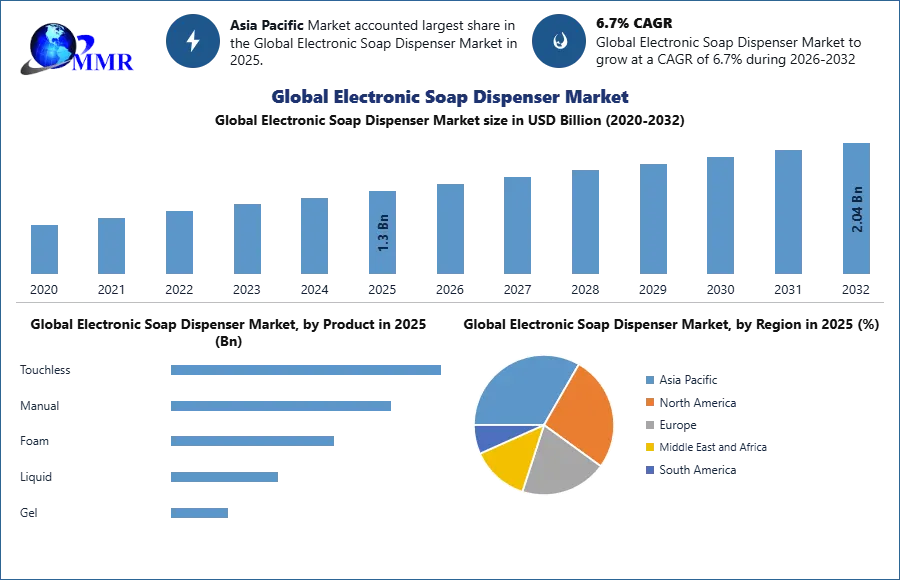
- Global market value reached USD 1.3 Billion in 2025.
- Market revenue is projected to approach USD 2.05 Billion by 2032.
- Growth is forecast at a CAGR of 6.7% between 2026 and 2032.
- Rising emphasis on hand hygiene remains the primary growth catalyst.
- Touchless dispensing technology continues to reshape purchasing decisions.
- Commercial applications maintain strong market leadership.
- Institutional environments are emerging as important growth centers.
- Asia-Pacific is becoming a critical expansion region for manufacturers.
- Smart building investments are creating new demand channels.
- Product innovation and distribution expansion remain central competitive strategies.
Why This Matters Now
A restroom fixture is becoming a boardroom decision.
Organizations that once treated soap dispensers as low-priority maintenance items are increasingly viewing them as visible indicators of health standards, customer experience, and facility modernization. As public expectations around hygiene continue to rise, purchasing decisions are moving beyond cost and toward automation, reliability, and touchless functionality.
The result is a market that sits at the intersection of public health, facility management, and smart infrastructure investment. Every new installation signals a broader shift toward automated environments designed to reduce physical contact while improving operational efficiency.
Market Overview
The Electronic Soap Dispenser Market Size has evolved far beyond its original role as a convenience product. According to Maximize Market Research, the market was valued at USD 1.3 Billion in 2025 and is expected to reach nearly USD 2.05 Billion by 2032, growing at a CAGR of 6.7%.
That growth carries a larger business implication. Demand is no longer being driven solely by replacement cycles. Instead, organizations are redesigning hygiene infrastructure as part of broader modernization programs.
From airports and hospitals to hotels and educational institutions, touchless dispensing systems are becoming standard components of facility upgrades. The trend is creating recurring opportunities for manufacturers capable of delivering durability, reliability, and integration with modern restroom environments.
Key Trends Driving Growth
The strongest trend influencing the market is the sustained focus on hand hygiene. What began as a public health requirement has become a permanent operational expectation.
A second trend is the rise of touchless environments. Facility managers increasingly prefer technologies that reduce physical contact points, helping improve sanitation while enhancing user confidence.
Smart building adoption is also creating momentum. Electronic soap dispensers are increasingly positioned alongside automated faucets, sensor-enabled lighting systems, and intelligent restroom management solutions. This places the category within broader capital expenditure programs rather than isolated maintenance budgets.
Sales channels are evolving as well. Buyers are expanding procurement options through both direct and indirect channels, enabling manufacturers to reach commercial, institutional, and residential customers more efficiently.
Another emerging trend is product differentiation. Manufacturers are introducing variations across foam, liquid, and gel dispensing formats to address specific end-user requirements and operating environments.
𝐃𝐨𝐰𝐧𝐥𝐨𝐚𝐝 𝐏𝐃𝐅 𝐁𝐫𝐨𝐜𝐡𝐮𝐫𝐞 @ https://www.maximizemarketresearch.com/request-sample/218968/
Segment Insights
Dominant Segment: Commercial Application
Commercial facilities represent the leading application segment. Hotels, offices, airports, retail centers, restaurants, and entertainment venues continue investing in touchless hygiene infrastructure. The dominance of this segment signals that customer-facing environments remain the industry’s largest revenue engine.
Fastest-Growing Segment: Touchless Products
Touchless dispensers are emerging as the most strategically significant product category. Their growth indicates that automation and hygiene are increasingly inseparable purchasing criteria for institutional and commercial buyers.
Material Leadership: Plastic
Plastic-based dispensers maintain significant market presence due to cost efficiency, manufacturing flexibility, and widespread commercial deployment.
Premium Opportunity: Steel
Steel dispensers continue attracting attention in high-traffic and premium environments where durability, aesthetics, and long-term performance influence purchasing decisions.
Institutional Expansion
Schools, universities, healthcare facilities, and public institutions are generating new demand as hygiene compliance becomes a larger operational priority.
Regional Growth Story
North America remains a significant market due to established hygiene standards, advanced commercial infrastructure, and continued adoption of automated facility technologies.
Europe continues benefiting from modernization initiatives across public and commercial buildings. Demand is supported by investments in sanitation upgrades and smart facility management systems.
The most compelling growth narrative is unfolding across Asia-Pacific. Rapid urbanization, expanding commercial infrastructure, and increasing awareness of hygiene standards are creating favorable conditions for market expansion. As more businesses adopt automated solutions, manufacturers are finding opportunities in both mature metropolitan markets and emerging urban centers.
The regional dynamic suggests that future competition will increasingly revolve around geographic execution. Companies that build distribution strength across fast-growing regions may gain advantages that product innovation alone cannot deliver.
Competitive Landscape
Competition in the Electronic Soap Dispenser Market is becoming less about hardware and more about positioning within broader facility ecosystems.
Leading companies are expanding portfolios across touchless, foam, liquid, and gel dispensing solutions to address multiple customer segments simultaneously. This indicates a shift from product-centric competition toward platform-style offerings designed to serve diverse commercial and institutional environments.
The presence of established manufacturers such as TOTO and other global participants signals that sanitation technology is becoming a strategic category rather than a niche accessory market.
For rivals, this raises the competitive bar. Companies can no longer compete solely on pricing. Reliability, sensor performance, maintenance efficiency, product aesthetics, and integration with smart facility initiatives are becoming critical differentiators.
Over the next 12–24 months, competition is likely to intensify around product upgrades, channel expansion, and customer retention strategies. Market leaders will seek to lock in long-term institutional relationships, while challengers will focus on capturing growth opportunities in developing regions and emerging commercial sectors.
Recent Developments
- Continued expansion of touchless dispensing solutions across commercial facilities.
- Growing investment in smart restroom and automated hygiene technologies.
- Increased focus on institutional deployments in education and healthcare environments.
- Broader availability of product variants including foam, liquid, and gel formats.
- Expansion of both direct and indirect sales channels to improve market reach.
Strategic Implications
For manufacturers, the opportunity extends beyond selling dispensers. The larger value lies in becoming part of facility modernization programs.
For distributors, channel strategy will become increasingly important as institutional buyers seek scalable procurement options.
For facility operators, automated hygiene systems are moving from operational expenses to customer-experience investments. The visible nature of sanitation infrastructure means purchasing decisions now influence brand perception, employee confidence, and visitor satisfaction.
The companies that align product innovation with facility management priorities will be positioned to capture disproportionate market share.
Future Outlook
The next phase of growth will be shaped by automation, institutional adoption, and the continued integration of hygiene technologies into smart environments.
As organizations invest in healthier and more efficient facilities, electronic soap dispensers will increasingly become standard infrastructure rather than optional upgrades. Demand is expected to expand across commercial, residential, and institutional settings as touchless solutions gain broader acceptance.
The winners will treat hygiene technology as a strategic platform; the losers will continue treating it as a commodity product.
Analyst Perspective
“The Electronic Soap Dispenser Market is entering a stage where hygiene, automation, and infrastructure modernization are converging. Organizations are investing in touchless solutions not only to improve sanitation but also to enhance operational efficiency and user confidence. This shift is expected to create sustained opportunities across commercial, residential, and institutional applications.” — Sidhhi Dole, Senior Research Analyst
About Maximize Market Research
Maximize Market Research Pvt. Ltd. (MMR) is a global market research and consulting company that provides reliable, data-focused, and practical business insights. The firm serves a wide range of industries, including healthcare, pharmaceuticals, technology, automotive, electronics, chemicals, personal care, and consumer goods. Through market forecasts, competitive analysis, strategic consulting, and industry impact assessments, MMR helps organizations understand changing market conditions, identify growth opportunities, and make informed business decisions for long-term success.
2nd Floor, Navale IT Park Phase 3
Pune Banglore Highway, Narhe
Pune, Maharashtra 411041, India
+91 9607365656
sales@maximizemarketresearch.com
