Sensitive Skin Care Products Market Set for Strong Growth as Dermatology-Led Formulations, Clean Beauty, and Personalized Skincare Reshape Consumer Demand
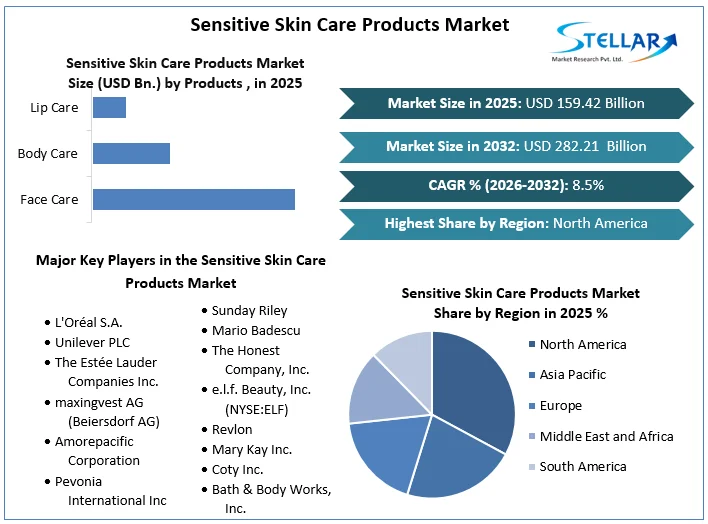
PUNE, India, June 19, 2026 — The Sensitive Skin Care Products Market is entering a new phase of growth driven by rising consumer awareness, dermatologist-backed formulations, ingredient transparency, and expanding demand for hypoallergenic skincare solutions. According to the latest Sensitive Skin Care Products Market Report published by Stellar Market Research, the market was valued at USD 159.42 billion in 2025 and is projected to reach USD 282.21 billion by 2032, expanding at a CAGR of 8.5% during 2026–2032.
The report highlights how increasing prevalence of skin sensitivity linked to pollution, climate stress, lifestyle changes, and heightened ingredient awareness is transforming purchasing behavior across developed and emerging economies. As consumers seek safer, fragrance-free, and clinically tested formulations, brands are accelerating investments in innovation, dermatological science, and sustainable product development.
Market Opportunity Overview
The global beauty and personal care industry is witnessing a significant shift toward skin health rather than cosmetic enhancement alone. Sensitive skin care products are no longer considered niche offerings but have become mainstream consumer essentials.
Growing concerns around allergens, synthetic additives, preservatives, and environmental stressors are prompting consumers to choose products formulated specifically for sensitive skin. Simultaneously, advancements in skin microbiome research, barrier-repair ingredients, and AI-powered skin diagnostics are creating opportunities for premium and personalized product portfolios.
As retailers expand clean beauty sections and online skincare consultations become commonplace, manufacturers are positioning sensitive skin care as a high-growth category with strong margins and recurring consumer demand.
𝐃𝐨𝐰𝐧𝐥𝐨𝐚𝐝 𝐅𝐫𝐞𝐞 𝐏𝐃𝐅 𝐁𝐫𝐨𝐜𝐡𝐮𝐫𝐞: https://www.stellarmr.com/report/req_sample/Sensitive-Skin-Care-Products-Market/1727
Key Findings from the Report
The global Sensitive Skin Care Products Market is forecast to grow from USD 159.42 billion in 2025 to USD 282.21 billion by 2032.
The market is projected to register a CAGR of 8.5% during 2026–2032.
Face Care Products represent the dominant product segment, generating the largest revenue contribution globally.
Distribution channels include supermarkets and hypermarkets, specialty stores, pharmacies, drugstores, online retail, and other channels.
North America remains the leading regional market due to strong consumer awareness, premium skincare adoption, and dermatologist-recommended product penetration.
Asia-Pacific is emerging as the fastest-growing region, supported by rising disposable incomes, urbanization, and growing skincare awareness.
Increasing investments in skin barrier science, microbiome-friendly formulations, and clean-label products are creating attractive opportunities for investors and strategic buyers.
Market Drivers and Restraints
Key Drivers
Growing Consumer Awareness of Skin Sensitivity
Consumers are increasingly recognizing conditions such as eczema, rosacea, irritation, redness, and dryness, leading to higher demand for specialized skincare solutions.
Innovation in Product Formulations
The incorporation of ceramides, probiotics, oat extracts, niacinamide, and barrier-repair technologies is improving product efficacy and expanding consumer adoption.
Expansion of Digital and Direct-to-Consumer Channels
Online platforms, tele-dermatology services, and personalized skincare recommendations are enhancing accessibility and consumer engagement.
Key Restraints
Premium Product Pricing
Sensitive skin formulations often require specialized ingredients, extensive testing, and compliance processes, resulting in higher retail prices.
Consumer Skepticism Around Product Claims
The absence of universally accepted definitions for “sensitive skin” products in some markets creates challenges around consumer trust and product differentiation.
Technology, Regulation, and Sustainability Trends
Technology is becoming a critical differentiator in the sensitive skin care category. AI-driven skin analysis tools, digital diagnostics, and personalized formulation platforms are helping brands deliver customized recommendations.
Regulatory scrutiny around ingredient transparency, labeling accuracy, and safety testing is increasing across North America, Europe, and parts of Asia-Pacific. Companies are responding by strengthening compliance frameworks and investing in clinically validated claims.
Sustainability initiatives are also shaping purchasing decisions. Brands are increasingly adopting recyclable packaging, biodegradable ingredients, cruelty-free testing protocols, and responsible sourcing practices to align with evolving ESG expectations.
Regional Insights
North America Leads Market Revenue
North America continues to dominate the Sensitive Skin Care Products Market due to high awareness levels, premium product adoption, and strong dermatologist influence. The United States remains a key revenue contributor, supported by robust innovation pipelines and direct-to-consumer business models.
Asia-Pacific Emerges as Growth Engine
Asia-Pacific is expected to record the fastest expansion during the forecast period. Countries including China, India, South Korea, and Japan are witnessing rising demand for sensitive skin solutions due to pollution exposure, changing lifestyles, growing middle-class populations, and increasing beauty-conscious consumers.
Europe Strengthens Premium Segment Demand
European consumers are increasingly prioritizing clean-label, organic, and clinically tested skincare products, creating opportunities for premium sensitive skin care brands.
Recent Industry Developments
L’Oréal (2025): Expanded skin health innovation initiatives through advanced dermatological research and AI-supported beauty technologies, strengthening personalized skincare capabilities.
Johnson & Johnson (2025): Increased investments in skin biology research and consumer health innovation programs focused on barrier repair and sensitive skin solutions.
Beiersdorf (2025): Expanded sustainability commitments across skincare portfolios while enhancing product development focused on skin microbiome science.
Unilever (2024): Introduced new sensitive skincare formulations emphasizing fragrance-free and dermatologist-tested ingredients, supporting growth across premium retail channels.
Estée Lauder Companies (2024): Accelerated science-backed skincare innovation and digital consumer engagement programs to strengthen its presence in clinically oriented skincare segments.
𝐃𝐨𝐰𝐧𝐥𝐨𝐚𝐝 𝐅𝐫𝐞𝐞 𝐏𝐃𝐅 𝐁𝐫𝐨𝐜𝐡𝐮𝐫𝐞: https://www.stellarmr.com/report/req_sample/Sensitive-Skin-Care-Products-Market/1727
Competitive Landscape
The market remains highly competitive, characterized by continuous product innovation, brand differentiation, and expanding dermatological partnerships.
Major participants include L’Oréal, Unilever, Johnson & Johnson, Beiersdorf, Procter & Gamble, Estée Lauder Companies, Kao Corporation, Amorepacific, Sebapharma, and Pevonia International.
Leading companies are focusing on:
New product launches
Clinical validation and testing
Digital personalization platforms
Sustainable packaging initiatives
Strategic partnerships with dermatology experts
Expansion into high-growth emerging markets
Analyst Commentary
“Sensitive skincare is evolving from a niche category into a foundational segment of the global beauty industry. Consumers increasingly view skin health as an investment, creating long-term opportunities for brands that combine clinical efficacy, ingredient transparency, and personalized experiences. Companies capable of integrating dermatological science with sustainability will be best positioned to capture future market share,” said a Senior Research Analyst at Stellar Market Research.
Future Outlook
Through 2032, demand for sensitive skin care products is expected to remain resilient as consumers prioritize preventive skincare and ingredient safety. Continued advances in skin barrier science, microbiome research, AI-powered diagnostics, and sustainable manufacturing will shape competitive dynamics.
Investment activity is likely to increase across premium skincare, dermatology-focused product lines, and digital consumer engagement platforms. As regulatory expectations become more stringent and consumer scrutiny intensifies, brands emphasizing transparency, efficacy, and sustainability are expected to outperform the broader skincare market.
About Stellar Market Research
Stellar Market Research is a global market research and business consulting firm delivering strategic intelligence across diverse industries. The company provides comprehensive market analysis, competitive benchmarking, industry forecasting, and actionable business insights that help organizations identify growth opportunities and make informed decisions. Leveraging advanced research methodologies and deep sector expertise, Stellar Market Research serves multinational corporations, investors, startups, and government institutions worldwide. Its reports combine quantitative analysis with strategic market intelligence to support business expansion, investment planning, innovation strategies, and long-term competitive positioning across rapidly evolving global markets.
Media Contact
Stellar Market Research
Website: http://stellarmr.com
Email: sales@stellarmr.com
