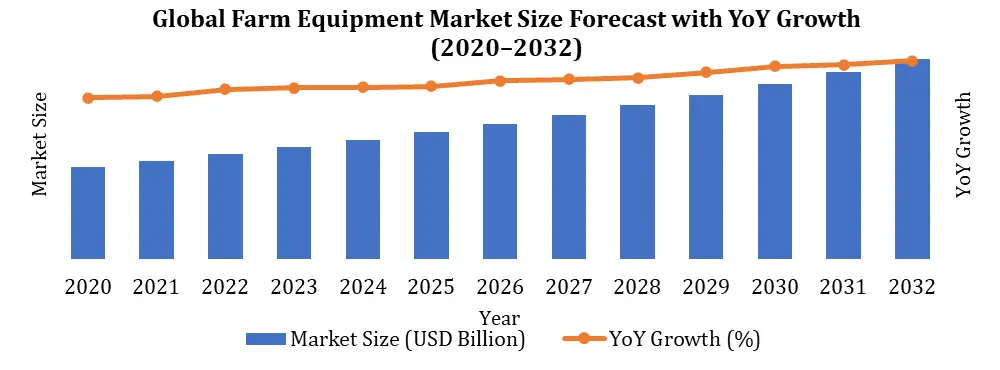
Market Overview
The Global Farm Equipment Market is increasingly defined by technology adoption rather than simple machinery replacement. Governments, commercial farms, agricultural cooperatives, and independent operators are accelerating investments in equipment that improves productivity and reduces operational complexity.
Mechanization remains a core growth driver. In many developing regions, equipment adoption continues to rise as farmers seek higher yields and more efficient operations. In developed markets, investment increasingly focuses on advanced machinery capable of supporting precision agriculture and digital farm management.
The industry’s evolution mirrors broader transportation and industrial equipment trends. Buyers are no longer evaluating machinery solely on horsepower or capacity. Connectivity, automation, efficiency, maintenance requirements, and lifecycle value have become equally important procurement considerations.
The result is a market where technology leadership increasingly determines competitive advantage.
Key Trends Driving Growth
Precision agriculture is becoming one of the industry’s most powerful growth catalysts. Farmers are using data-driven approaches to optimize planting, irrigation, fertilization, and harvesting activities. Equipment capable of supporting these objectives is attracting greater investment.
Automation is also reshaping the competitive landscape. Labor shortages and rising labor costs are encouraging adoption of machinery that reduces dependence on manual operations. Equipment manufacturers are responding with increasingly sophisticated solutions designed to improve operational efficiency.
Connectivity is emerging as another strategic differentiator. Modern agricultural equipment is increasingly integrated into broader digital ecosystems that enable monitoring, performance analysis, maintenance management, and operational planning.
Sustainability considerations are influencing purchasing behavior as well. Farmers are seeking equipment that supports more efficient use of fuel, water, fertilizers, and other resources. These priorities align with broader environmental and productivity objectives.
Technology integration is creating opportunities beyond equipment sales. Software services, data management capabilities, predictive maintenance solutions, and aftermarket support are becoming increasingly important sources of value creation.
Request a Free Sample Copy or View Report Summary
Segment Insights
- Dominant Segment: Tractors
- Tractors remain the most significant product category within the farm equipment industry.
- Their role as the foundation of agricultural operations supports continued demand across developed and emerging markets.
- Mechanization initiatives and productivity improvement programs continue to strengthen tractor adoption.
- Fastest-Growing Segment: Not Specified in the Report
- The report identifies multiple equipment categories but does not specify the fastest-growing segment.
- Growth opportunities exist across harvesting equipment, planting machinery, irrigation equipment, and precision agriculture solutions.
- Product categories include:
- Tractors
- Harvesting Equipment
- Planting Equipment
- Irrigation Equipment
- Other Agricultural Machinery
- Strategic significance:
- Tractors remain central to mechanization strategies.
- Harvesting and planting technologies support productivity improvements.
- Precision farming equipment increasingly influences purchasing decisions.
Regional Growth Story
Asia-Pacific remains one of the most influential regions in the Global Farm Equipment Market. Rapid agricultural modernization, increasing mechanization rates, and government support for productivity improvement are creating strong demand for equipment solutions.
India and China continue to play particularly important roles. Both countries are investing in agricultural efficiency, mechanization, and rural development programs. These initiatives support equipment demand while creating long-term opportunities for manufacturers.
North America remains a technology-driven market. Farmers increasingly adopt advanced machinery capable of supporting precision agriculture, data analytics, and operational optimization. Equipment suppliers that deliver digital capabilities are gaining strategic advantages.
Europe’s market is shaped by sustainability priorities, productivity objectives, and regulatory requirements. Investments increasingly focus on technologies that improve resource efficiency while supporting environmental goals.
Emerging agricultural economies across Latin America, Africa, and parts of Southeast Asia also represent significant long-term opportunities as mechanization adoption continues to increase.
Competitive Landscape
Competition is shifting from machinery manufacturing toward integrated agricultural technology ecosystems.
Leading manufacturers are increasingly competing through automation capabilities, connectivity platforms, precision agriculture tools, and digital service offerings. This evolution signals a broader transition from equipment suppliers to agricultural productivity partners.
The competitive implications are significant. Companies capable of combining machinery, software, connectivity, and data analytics create stronger customer relationships and recurring revenue opportunities. Those advantages can strengthen pricing power and increase barriers to entry.
Technology investment is becoming a critical differentiator. Manufacturers that accelerate development of intelligent equipment platforms are likely to gain market share as digital agriculture adoption expands.
The aftermarket is also evolving. Predictive maintenance, remote diagnostics, software updates, and connected service offerings are becoming increasingly important components of competitive strategy.
For suppliers and component manufacturers, this transformation creates opportunities to participate in higher-value technology ecosystems rather than traditional hardware supply chains alone.
Recent Developments
- Precision agriculture adoption continues to influence equipment development priorities.
- Manufacturers are increasing investment in automation and digital farming technologies.
- Connectivity capabilities are becoming increasingly integrated into modern agricultural machinery.
- Government programs supporting mechanization are encouraging equipment purchases across developing markets.
- Sustainability objectives are driving demand for more efficient agricultural equipment solutions.
Strategic Implications
For OEMs, competitive success increasingly depends on technological differentiation rather than manufacturing scale alone. Connectivity, automation, software integration, and operational intelligence are becoming core purchasing criteria.
For suppliers, opportunities are expanding beyond traditional mechanical components. Sensors, electronics, software systems, connectivity platforms, and precision agriculture technologies are gaining strategic importance.
Investors should view the market through the lens of agricultural digitization. Equipment manufacturers that successfully transition into technology-enabled agricultural platforms may capture greater long-term value than those focused primarily on machinery sales.
For policymakers, mechanization remains a critical tool for improving food production, agricultural competitiveness, and rural economic development.
Future Outlook
The Global Farm Equipment Market is moving toward a future where machinery functions as an intelligent, connected, and increasingly autonomous operating platform. Productivity gains will increasingly come from software, automation, connectivity, and data analytics rather than mechanical performance alone.
The next generation of market leaders will be the companies that transform farm equipment into integrated digital agriculture ecosystems, while laggards risk being confined to competing on hardware specifications in an industry increasingly driven by intelligence, connectivity, and operational outcomes.
Analyst Perspective
“The Global Farm Equipment Market is entering a period where mechanization, automation, and digital agriculture are converging. Organizations that align equipment innovation with productivity improvement, connectivity, and operational efficiency will be best positioned to capitalize on long-term growth opportunities across global agricultural markets.” — Dharati Raut, Analyst
About Maximize Market Research
Maximize Market Research Pvt. Ltd. (MMR) is a global market research and consulting company that provides reliable, data-focused, and practical business insights. The firm serves a wide range of industries, including healthcare, pharmaceuticals, technology, automotive, electronics, chemicals, personal care, and consumer goods. Through market forecasts, competitive analysis, strategic consulting, and industry impact assessments, MMR helps organizations understand changing market conditions, identify growth opportunities, and make informed business decisions for long-term success.
2nd Floor, Navale IT Park Phase 3
Pune Banglore Highway, Narhe
Pune, Maharashtra 411041, India
+91 9607365656
sales@maximizemarketresearch.com
