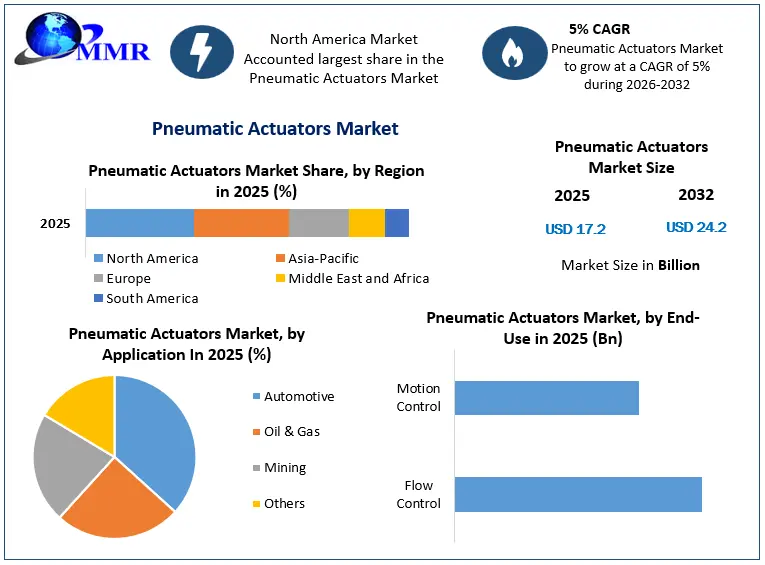
Market Overview
The Pneumatic Actuators Market sits at the center of a broad industrial transformation. Companies across manufacturing, energy, chemicals, water treatment, and infrastructure sectors are investing in automation technologies designed to improve efficiency and reduce operational risk.
Pneumatic actuators play a critical role within these systems. They convert compressed air into mechanical motion, enabling precise control of valves, dampers, and industrial equipment. Their reliability, simplicity, and suitability for demanding operating environments continue to support widespread adoption.
What has changed is the strategic importance of automation. Industrial organizations are no longer implementing automation solely to reduce labor requirements. They are pursuing productivity gains, process consistency, energy efficiency, and operational resilience.
As a result, actuator selection increasingly influences plant performance, maintenance requirements, and long-term operating economics.
Key Trends Driving Growth
Industrial automation remains the strongest catalyst shaping market demand. Manufacturing facilities are accelerating investment in automated systems to improve throughput, reduce human error, and maintain quality standards.
Smart manufacturing initiatives are creating additional opportunities. As production environments become more connected, actuators must integrate with digital control architectures and support increasingly sophisticated automation strategies.
Process industries continue to drive demand. Oil and gas facilities, chemical processing plants, power generation operations, and water treatment facilities require dependable motion-control systems capable of operating under demanding conditions.
Another significant trend is the growing focus on operational efficiency. Industrial operators increasingly evaluate equipment based on lifecycle performance rather than upfront cost. Reliability, maintenance requirements, and system integration capabilities are becoming critical purchasing criteria.
Industrial safety requirements are also influencing investment decisions. Pneumatic actuation systems are often preferred in applications where electrical alternatives may create operational or environmental risks. This continues to support adoption across hazardous operating environments.
The broader digitization of industrial infrastructure is further expanding market opportunities. Modern facilities increasingly require automated control systems capable of supporting real-time monitoring, predictive maintenance, and operational optimization initiatives.
Request a Free Sample Copy or View Report Summary
Segment Insights
- Dominant Segment: Double-Acting Pneumatic Actuators
- Double-acting pneumatic actuators account for the largest share of the market.
- Their ability to provide controlled motion in both directions supports widespread adoption across industrial automation applications.
- The segment’s leadership reflects growing demand for precise and reliable process control.
- Fastest-Growing Segment: Not Specified in the Report
- The report identifies multiple market segments but does not specify the fastest-growing segment.
- Growth opportunities exist across industrial automation, valve control, manufacturing, and process-industry applications.
- Product categories include:
- Double-Acting Pneumatic Actuators
- Spring Return Pneumatic Actuators
- Key application sectors include:
- Oil and Gas
- Chemicals
- Power Generation
- Water and Wastewater
- Manufacturing Industries
- Strategic significance:
- Process automation remains a primary growth engine.
- Industrial digitization is increasing the value of advanced control systems.
- Infrastructure modernization continues to expand deployment opportunities.
Regional Growth Story
Asia-Pacific remains one of the most important growth regions for the Pneumatic Actuators Market. Manufacturing expansion, industrial infrastructure investment, and increasing automation adoption are creating strong demand across multiple end-use sectors.
China continues to play a pivotal role due to its large manufacturing base and ongoing industrial modernization efforts. Industrial automation remains central to productivity improvement initiatives, supporting continued equipment investment.
India is emerging as another important market. Manufacturing expansion, infrastructure development, and industrial digitization programs are creating new opportunities for automation technology suppliers.
North America remains a strategically important region due to advanced industrial operations, automation investments, and ongoing modernization projects. Manufacturers continue to prioritize productivity enhancement and operational efficiency.
Europe’s market benefits from strong industrial automation adoption, advanced manufacturing capabilities, and increasing emphasis on energy-efficient operations. Regulatory focus on productivity and sustainability further supports technology investment.
Across global markets, industrial competitiveness increasingly depends on automation capabilities, making actuator technologies a critical component of long-term infrastructure strategies.
Competitive Landscape
Competition is shifting from component manufacturing toward automation ecosystem participation.
Leading suppliers are increasingly competing through reliability, integration capabilities, and long-term operational performance. Customers no longer view actuators as standalone products. They evaluate them as critical elements within broader automation architectures.
This shift has important implications for supplier dynamics. Companies capable of delivering complete automation solutions gain stronger customer relationships and greater pricing leverage. Integration expertise increasingly matters as much as mechanical performance.
Technology leadership is becoming a differentiator. Manufacturers that invest in advanced actuator designs, enhanced durability, and compatibility with digital control systems are positioning themselves to capture higher-value opportunities.
The aftermarket is also evolving. Maintenance support, replacement services, diagnostics, and lifecycle management are becoming increasingly important sources of competitive advantage.
For investors, the market reflects broader industrial automation trends. Companies aligned with smart manufacturing, process optimization, and digital infrastructure initiatives are positioned to benefit from long-term industrial modernization spending.
Recent Developments
- Industrial automation investments continue to accelerate across manufacturing and process industries.
- Smart factory initiatives are increasing demand for integrated control technologies.
- Process industries are upgrading infrastructure to improve efficiency and operational reliability.
- Manufacturers are focusing on actuator designs that support enhanced durability and system performance.
- Digital transformation initiatives are creating opportunities for automation-focused equipment suppliers.
Strategic Implications
For OEMs, future growth increasingly depends on integration capabilities rather than hardware performance alone. Customers are seeking solutions that fit seamlessly into broader automation ecosystems.
For suppliers, industrial digitization creates opportunities to move beyond traditional component manufacturing and participate in higher-value automation platforms.
For industrial operators, actuator performance directly affects productivity, maintenance costs, and operational continuity. Procurement decisions are therefore becoming more strategic.
Investors should view the market as part of the broader industrial automation value chain. Long-term growth increasingly depends on the adoption of intelligent manufacturing systems, digital process control, and operational optimization technologies.
Future Outlook
The Pneumatic Actuators Market is evolving alongside the global transition toward automated, connected, and data-driven industrial operations. Demand will increasingly be shaped by smart manufacturing investments, industrial digitization initiatives, and the pursuit of operational efficiency.
The next generation of market leaders will be companies that transform pneumatic actuation into an integrated element of intelligent industrial ecosystems, while laggards risk remaining component suppliers in an industry increasingly defined by automation intelligence, system connectivity, and process optimization.
Analyst Perspective
“The Pneumatic Actuators Market is benefiting from accelerating industrial automation, infrastructure modernization, and smart manufacturing adoption. Companies that combine reliability, operational efficiency, and integration capabilities will be best positioned to capture emerging opportunities across global industrial markets.” — Dharati Raut, Analyst
About Maximize Market Research
Maximize Market Research Pvt. Ltd. (MMR) is a global market research and consulting company that provides reliable, data-focused, and practical business insights. The firm serves a wide range of industries, including healthcare, pharmaceuticals, technology, automotive, electronics, chemicals, personal care, and consumer goods. Through market forecasts, competitive analysis, strategic consulting, and industry impact assessments, MMR helps organizations understand changing market conditions, identify growth opportunities, and make informed business decisions for long-term success.
2nd Floor, Navale IT Park Phase 3
Pune Banglore Highway, Narhe
Pune, Maharashtra 411041, India
+91 9607365656
sales@maximizemarketresearch.com
