Why This Matters Now
The US death care industry is moving into a period of structural change as consumers demand greater transparency, financial planning options and personalized memorial experiences. Funeral operators, cemetery providers and product manufacturers face pressure to modernize services while maintaining trust during critical life events.
The market opportunity is expanding beyond traditional funeral services. Businesses that improve planning options, digital engagement and customer experience are positioned to capture changing demand patterns across the end-of-life ecosystem.
Market Overview
The US Death Care Market includes funeral homes, cemeteries, pre-need and at-need arrangements, caskets, vaults, facility rentals, embalming services, urns and related products. The industry supports families, communities and service providers managing end-of-life needs.
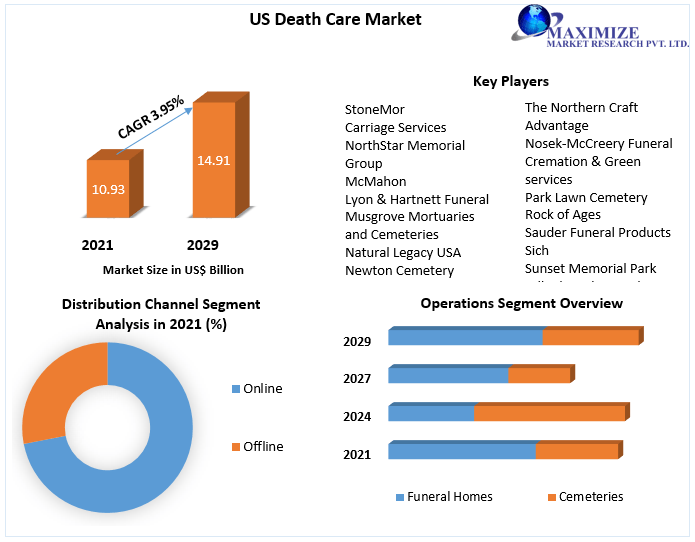
The market reached USD 10.93 billion in 2021 and is projected to grow to USD 14.91 billion by 2029 at a 3.95% CAGR. The growth outlook is shaped by demand for organized funeral services, rising acceptance of advance planning and the need for structured financial preparation.
Unlike many healthcare segments driven by clinical innovation, death care growth is influenced by demographic patterns, consumer decisions and service delivery models. Companies are competing on reliability, personalization and the ability to support families through complex arrangements.
Key Trends Driving Growth
Pre-need planning is becoming a major market driver. Families increasingly choose arrangements before the time of need to reduce financial uncertainty and simplify decision-making. This creates more predictable revenue opportunities for funeral operators and service providers.
The industry is also seeing a shift toward personalized memorial experiences. Consumers are seeking services that reflect individual preferences, creating opportunities for providers offering customized packages and broader service portfolios.
Technology adoption is influencing customer interaction. Digital tools, online planning resources and improved communication platforms are changing how families research and select death care services. Providers that improve accessibility and convenience can strengthen customer relationships.
Cremation trends and alternative memorial formats are influencing product demand. Companies are adapting portfolios to address different preferences, including changing requirements for urns, caskets, rental options and memorial services.
Request a Free Sample Copy or View Report Summary
Segment Insights
- Dominant Segment — Operations: Funeral Homes
Funeral homes hold the largest share within the operations segment. Their continued importance comes from providing comprehensive services, coordination support and direct engagement with families during end-of-life arrangements. - Fastest-Growing Segment — Arrangements: Pre-Need Agreements
Pre-need agreements represent a significant growth opportunity as consumers focus on advance planning. These arrangements help families manage future financial obligations and create demand visibility for service providers. - Product & Services Segment — Caskets and Vaults
Caskets and vaults maintain the largest share among product categories due to continued demand for burial-related products, cremation caskets and specialized options. - Service Diversification Opportunity
Providers expanding beyond traditional offerings into personalized memorial services, planning solutions and broader customer support models can strengthen market positioning.
Regional Growth Story
The US market remains the focus of this analysis, with demand shaped by regional variations in consumer preferences, service availability and demographic trends. Established funeral networks, cemetery operators and independent providers compete across local markets.
Healthcare spending patterns, aging demographics and family financial planning behavior influence demand for organized death care services. Unlike acute healthcare markets, the sector depends heavily on consumer decisions, cultural preferences and local service infrastructure.
Global markets including Germany, the UK, China, Japan, India and South Korea are also experiencing changes in end-of-life service models, but the US market continues to show strong industry development through established operators and structured service networks.
Competitive Landscape
The US Death Care Market includes established operators, regional funeral homes, cemetery groups and product suppliers. Competition is based on geographic presence, service quality, pricing, brand reputation and portfolio breadth.
Key companies analyzed in the market include StoneMor, Carriage Services, NorthStar Memorial Group, McMahon, Lyon & Hartnett Funeral Home, Musgrove Mortuaries and Cemeteries, Natural Legacy USA, Newton Cemetery, Park Lawn Cemetery, Rock of Ages, Sauder Funeral Products and Hillenbrand control.
Industry consolidation and strategic expansion indicate a shift toward larger networks capable of offering broader services and operational efficiencies. Companies investing in customer experience and flexible planning solutions are better positioned as consumer expectations change.
Recent Developments
- Market participants continue expanding service offerings across funeral operations, cemetery management and related products to address broader consumer needs.
- Growth in pre-need arrangements is encouraging providers to develop stronger planning-focused business models.
- Product suppliers are adapting portfolios around burial, cremation and memorial preferences.
Strategic Implications
For funeral operators, the priority is shifting from traditional service delivery toward customer-centered planning ecosystems. Businesses that improve transparency, convenience and personalization can capture long-term customer relationships.
For investors, the market offers opportunities linked to stable demand, service modernization and operational expansion. However, competitive advantage will depend on adapting to consumer preferences rather than relying only on legacy models.
For regulators and communities, maintaining service accessibility and consumer protection remains important as the industry evolves.
Future Outlook
The US Death Care Market will continue growing steadily as families seek organized, flexible and financially manageable end-of-life solutions. The strongest opportunities will come from providers combining trusted local services with modern planning tools and diversified offerings.
The future leaders will be companies that transform death care from a traditional service category into a more accessible, transparent and customer-focused experience, while laggards will struggle to adapt to changing expectations.
Analyst Perspective
“US death care is moving toward a more planned and personalized service environment. Providers that balance traditional trust with modern customer solutions will be better positioned to capture future opportunities,” said Komal Patil, Research Analyst.
About Maximize Market Research
Maximize Market Research Pvt. Ltd. (MMR) is a global market research and consulting company that provides reliable, data-focused, and practical business insights. The firm serves a wide range of industries, including healthcare, pharmaceuticals, technology, automotive, electronics, chemicals, personal care, and consumer goods. Through market forecasts, competitive analysis, strategic consulting, and industry impact assessments, MMR helps organizations understand changing market conditions, identify growth opportunities, and make informed business decisions for long-term success.
2nd Floor, Navale IT Park Phase 3
Pune Banglore Highway, Narhe
Pune, Maharashtra 411041, India
+91 9607365656
sales@maximizemarketresearch.com
