Why This Matters Now
Hospitals, device manufacturers, and healthcare investors are facing a sharper demand shift: children require medical technologies designed around their physiology, not modified adult solutions. Pediatric care is moving toward specialized devices that improve diagnosis speed, treatment accuracy, and long-term outcomes.
The market expansion signals a broader healthcare transformation. Providers are prioritizing early intervention, remote monitoring, and personalized care pathways as pediatric conditions become more complex to manage. Companies that develop safe, scalable, and clinically targeted solutions are positioned to capture rising demand.
Market Overview
The Pediatric Medical Device Market includes medical technologies designed for newborns, infants, children, and adolescents. These devices support diagnosis, monitoring, treatment, and management of pediatric conditions across hospitals, clinics, and homecare settings.
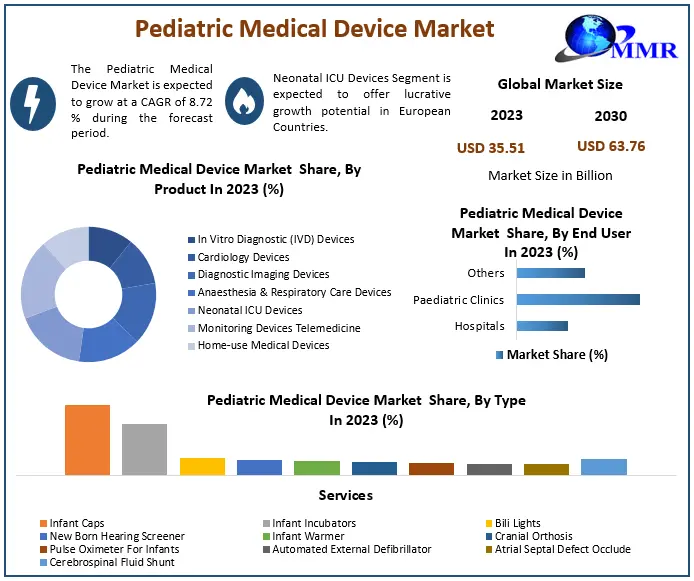
The market reached USD 35.51 billion in 2023 and is expected to expand to USD 63.76 billion by 2030. The growth trajectory is linked to increasing pediatric disease burden, healthcare technology advancement, research investments, and growing adoption of child-specific medical solutions.
Chronic conditions such as diabetes and asthma, congenital disorders, neonatal complications, and respiratory challenges are increasing demand for specialized devices. The business impact is clear: healthcare systems need technologies that reduce complications, support early diagnosis, and improve care efficiency.
Key Trends Driving Growth
Pediatric healthcare is moving toward precision-focused treatment. Device developers are investing in smaller, safer, and more adaptable technologies that match children’s clinical requirements. Personalized medicine is influencing device design by encouraging solutions tailored to age, condition, and patient response.
Digital health is becoming a major growth avenue. Wearable devices and remote monitoring platforms allow continuous tracking of pediatric health indicators, supporting earlier intervention and reducing dependence on hospital-based monitoring.
AI integration is creating opportunities in pediatric diagnostics and monitoring. Advanced imaging tools, connected devices, and data-driven healthcare platforms can support faster clinical decisions, although regulatory validation remains essential for adoption.
Telemedicine is also expanding access. Remote consultations and connected monitoring tools are helping healthcare providers extend pediatric expertise beyond major medical centers, particularly in regions where specialist availability is limited.
Request a Free Sample Copy or View Report Summary
Segment Insights
- Dominant Segment: Neonatal ICU Devices — The Neonatal ICU Devices segment dominated the Pediatric Medical Device Market in 2023 and is expected to maintain leadership. Demand is driven by the need for intensive support systems for premature infants and critically ill newborns.
- Fastest-Growing Segment: Connected and Advanced Pediatric Monitoring Solutions — Growth is supported by wearable technologies, wireless monitoring, and digital healthcare adoption that improve real-time visibility into pediatric conditions.
Regional Growth Story
The United States remains a key innovation market due to advanced healthcare infrastructure, strong pediatric research activity, and demand for specialized treatment technologies. Hospitals and healthcare networks are increasingly adopting advanced monitoring, imaging, and minimally invasive pediatric solutions.
Germany and the UK continue to represent important European markets, supported by established healthcare systems and focus on improving pediatric treatment outcomes. Regulatory pathways and reimbursement structures influence how quickly innovative devices reach clinical adoption.
China is emerging as a major manufacturing and healthcare technology hub. The country’s expanding medical infrastructure and device development ecosystem create opportunities for pediatric technology companies.
Japan and South Korea are advancing pediatric healthcare through technology-driven healthcare models, while India presents growth opportunities through expanding healthcare access, rising investment in medical infrastructure, and increasing demand for specialized pediatric care.
Competitive Landscape
The competitive environment includes global medical technology companies focused on pediatric innovation, including advanced monitoring, neonatal care, imaging, and minimally invasive treatment solutions. Companies such as Medtronic, Philips Healthcare, Abbott Laboratories, Boston Scientific Corporation, and Johnson & Johnson are identified among key participants in the market.
Competition is shifting from product availability toward clinical value. Manufacturers that deliver safer devices, stronger evidence generation, digital connectivity, and improved patient outcomes are strengthening their market position.
Regulatory requirements remain a major strategic factor. Pediatric device developers face additional testing and approval challenges because products must demonstrate safety and effectiveness across different age groups.
Recent Developments
- Increased adoption of minimally invasive pediatric procedures is encouraging innovation in specialized surgical and diagnostic devices.
- Wearable pediatric monitoring technologies are expanding remote care capabilities and enabling continuous health tracking.
- Advanced imaging technologies designed for children are improving diagnostic accuracy and patient experience.
- Research and development investment is supporting personalized pediatric healthcare solutions.
Strategic Implications
For hospitals, investment in pediatric-specific devices can improve care quality and operational efficiency. For pharmaceutical and biotech companies, better monitoring and diagnostic tools create stronger pathways for clinical research and treatment development.
For investors, the opportunity lies in companies combining medical device expertise with digital health, AI, and personalized healthcare capabilities. Reimbursement clarity and regulatory readiness will remain decisive factors in determining commercial success.
Future Outlook
The Pediatric Medical Device Market is moving toward connected, personalized, and outcome-driven healthcare. The next phase of growth will favor companies that integrate clinical innovation with regulatory discipline and scalable healthcare delivery models. Future leaders will be those that turn pediatric precision care into accessible, measurable, and globally adoptable solutions.
Analyst Perspective
“Rising demand for specialized pediatric healthcare solutions, combined with advances in monitoring technologies, personalized medicine, and digital healthcare, is creating new opportunities across the pediatric medical device ecosystem. Companies focusing on safety, innovation, and patient-specific care approaches are positioned to benefit from this market expansion.”
— Komal Patil, Research Analyst
About Maximize Market Research
Maximize Market Research Pvt. Ltd. (MMR) is a global market research and consulting company that provides reliable, data-focused, and practical business insights. The firm serves a wide range of industries, including healthcare, pharmaceuticals, technology, automotive, electronics, chemicals, personal care, and consumer goods. Through market forecasts, competitive analysis, strategic consulting, and industry impact assessments, MMR helps organizations understand changing market conditions, identify growth opportunities, and make informed business decisions for long-term success.
2nd Floor, Navale IT Park Phase 3
Pune Banglore Highway, Narhe
Pune, Maharashtra 411041, India
+91 9607365656
sales@maximizemarketresearch.com
