Market Overview
The All Terrain Robots Market is evolving from a niche robotics segment into an important component of autonomous transportation and industrial mobility ecosystems.
Organizations operating in difficult terrain increasingly require machines capable of performing tasks without exposing workers to operational risks. Mining companies, defense agencies, agricultural operators, logistics providers, and infrastructure organizations are turning toward robotic mobility platforms capable of navigating uneven landscapes, remote locations, and hazardous environments.
Technological progress is accelerating adoption. Improvements in artificial intelligence, machine learning, sensor fusion, LiDAR systems, GPS integration, machine vision, and edge computing are enabling robots to navigate increasingly complex environments with greater autonomy.
What changed is the maturity of the enabling technologies. Autonomous mobility systems that once existed primarily in research environments are now becoming operational tools across commercial and government applications.
Key Trends Driving Growth
The most important trend influencing the market is the convergence of robotics and autonomous mobility.
Advanced navigation systems now allow robotic platforms to operate with reduced human intervention. This capability creates significant operational advantages for industries facing labor shortages, safety concerns, and productivity challenges.
Artificial intelligence is becoming a major competitive differentiator. Modern robotic systems can analyze terrain conditions, optimize routes, avoid obstacles, and make operational decisions in real time. These capabilities improve efficiency while reducing operational risk.
Electrification is also influencing platform development. Battery-powered robotic systems offer advantages in emissions reduction, noise control, operational flexibility, and maintenance efficiency. As battery technologies improve, manufacturers gain greater opportunities to expand deployment scenarios.
Connectivity is becoming equally important. Connected robotic platforms can transmit operational data, support remote monitoring, receive software updates, and integrate into broader enterprise management systems. This evolution aligns closely with trends driving software-defined vehicles and intelligent transportation systems.
Another major shift involves human-machine collaboration. Rather than replacing workers entirely, many organizations are deploying robots to handle repetitive, hazardous, or physically demanding tasks while human operators focus on higher-value activities.
Request a Free Sample Copy or View Report Summary
Segment Insights
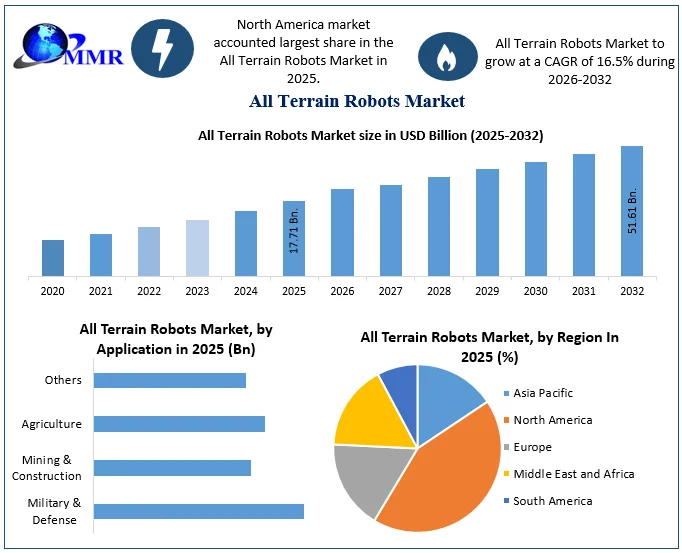
- Dominant Segment: Defense and security applications remain among the most influential deployment categories due to increasing demand for unmanned ground operations, reconnaissance, surveillance, and mission support capabilities.
- Fastest-Growing Segment: Industrial and commercial applications are emerging as major growth opportunities as mining, logistics, agriculture, and infrastructure operators accelerate automation initiatives.
- Autonomous navigation technologies continue gaining importance as customers prioritize operational efficiency and reduced human intervention.
- Electrified robotic platforms are attracting attention due to sustainability goals, operational efficiency requirements, and advancements in battery technology.
- Software-driven robotics architectures are creating opportunities for platform upgrades, feature expansion, and lifecycle value enhancement.
Regional Growth Story
North America remains a significant market due to strong defense spending, advanced robotics development capabilities, and growing industrial automation adoption.
The United States continues to play a leading role in autonomous mobility innovation. Investments in defense modernization, logistics automation, and intelligent transportation technologies are supporting broader adoption of all terrain robotic systems.
Europe is benefiting from industrial automation initiatives, advanced manufacturing capabilities, and increasing focus on workforce safety. Germany remains particularly important because of its expertise in robotics, engineering, and intelligent mobility technologies.
Asia-Pacific is becoming an increasingly influential region. China, Japan, South Korea, and India are expanding investments in automation, robotics, infrastructure modernization, and smart manufacturing. These developments are creating favorable conditions for robotic mobility platform deployment.
Mining-intensive regions are also emerging as important adoption centers as operators seek autonomous solutions capable of improving productivity and reducing operational risk in challenging environments.
Competitive Landscape
Competition is shifting from hardware capability alone toward integrated autonomy ecosystems.
The leading companies are increasingly focused on combining mobility platforms, artificial intelligence, advanced sensors, connectivity solutions, and software capabilities into unified operational systems. This signals a broader transformation in how value is created across the robotics industry.
Technology leadership increasingly depends on software performance. Navigation algorithms, perception systems, remote operation capabilities, cybersecurity frameworks, and data analytics are becoming as important as mechanical engineering.
Partnership activity across robotics developers, sensor manufacturers, AI providers, and transportation technology companies indicates growing ecosystem integration. Future market leadership is likely to favor organizations capable of delivering complete autonomous operating environments rather than standalone robotic vehicles.
For transportation stakeholders, this evolution mirrors broader trends already visible in connected vehicles and software-defined mobility platforms.
Recent Developments
- Increased integration of AI-powered navigation systems into all terrain robotic platforms.
- Growing adoption of advanced sensors, machine vision, and autonomous perception technologies.
- Rising investment in robotic systems designed for hazardous and remote operating environments.
- Expansion of connected robotics architectures supporting remote monitoring and software updates.
- Greater focus on electrified mobility platforms to improve operational efficiency and sustainability performance.
Strategic Implications
For mobility technology providers, all terrain robots represent an expansion of autonomous transportation beyond traditional vehicle markets.
For industrial operators, robotic mobility platforms provide opportunities to improve safety, reduce labor dependency, and increase operational efficiency. Organizations operating in remote locations stand to benefit significantly from autonomous deployment models.
For defense agencies, robotic platforms enhance mission flexibility while reducing personnel exposure to dangerous environments.
For investors, the market demonstrates the growing convergence between transportation technology, artificial intelligence, industrial automation, and robotics. Companies positioned at this intersection may capture significant value as autonomous mobility ecosystems mature.
For suppliers, opportunities increasingly reside in sensors, batteries, connectivity systems, semiconductor technologies, autonomous software, and robotic control architectures.
Future Outlook
The future of autonomous mobility will extend far beyond passenger vehicles and highway transportation. The companies that successfully combine rugged mobility, artificial intelligence, connectivity, and software-defined autonomy into scalable all terrain platforms will define the next era of industrial and transportation automation, while competitors focused solely on conventional vehicle markets risk missing one of the industry’s most important mobility transformations.
Analyst Perspective
“The All Terrain Robots Market is moving beyond specialized applications and becoming an integral part of autonomous mobility ecosystems. Organizations that combine advanced robotics, intelligent navigation, connectivity, and operational scalability will be best positioned to capitalize on emerging opportunities across transportation and industrial sectors.” — Dharati Raut, Analyst
About Maximize Market Research
Maximize Market Research Pvt. Ltd. (MMR) is a global market research and consulting company that provides reliable, data-focused, and practical business insights. The firm serves a wide range of industries, including healthcare, pharmaceuticals, technology, automotive, electronics, chemicals, personal care, and consumer goods. Through market forecasts, competitive analysis, strategic consulting, and industry impact assessments, MMR helps organizations understand changing market conditions, identify growth opportunities, and make informed business decisions for long-term success.
2nd Floor, Navale IT Park Phase 3
Pune Banglore Highway, Narhe
Pune, Maharashtra 411041, India
+91 9607365656
sales@maximizemarketresearch.com
