Market Overview
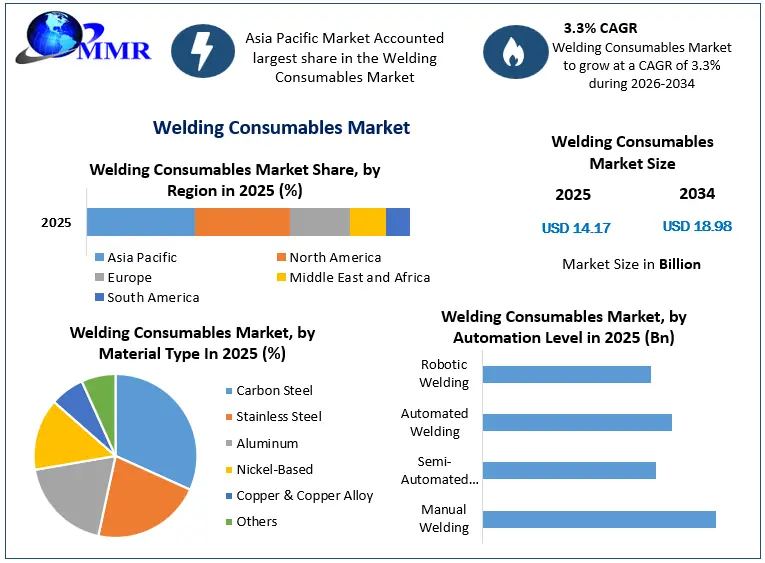
The global Welding Consumables Market was valued at USD 14.17 billion in 2025 and is forecast to reach nearly USD 18.98 billion by 2034, growing at a CAGR of 3.3%. That growth signals a steady expansion of industrial fabrication activity worldwide. For manufacturers, it means sustained demand for production equipment, maintenance services, and fabrication materials across multiple industries.
Demand is increasingly linked to operational efficiency rather than simple production volume. Manufacturers are investing in technologies that shorten production cycles, reduce reject rates, and minimize post-weld processing requirements. Welding consumables sit at the center of those productivity improvements, making them a critical component of modern industrial operations.
Unlike many industrial materials that fluctuate with new construction cycles, welding consumables benefit from both new fabrication projects and ongoing maintenance requirements. This dual-demand structure provides greater market resilience during periods of economic uncertainty.
Key Trends Driving Growth
Industrial automation is emerging as the strongest structural driver in the market. End-use industries are adopting automated welding systems to address labor shortages, improve consistency, and increase production efficiency. As automated welding installations expand, demand for high-performance consumables designed for robotic and automated applications is rising.
The automotive industry remains a key catalyst. Vehicle manufacturers continue investing in production efficiency, lightweight material processing, and precision manufacturing. These requirements increase the need for advanced welding consumables capable of supporting higher production speeds and tighter quality specifications.
Infrastructure development is creating another major growth engine. Emerging economies are expanding transportation networks, industrial facilities, commercial buildings, and public infrastructure. Each project generates substantial demand for welding materials throughout fabrication and assembly processes.
Energy infrastructure is also becoming increasingly important. The refurbishment of aging refineries and the construction of new gas manufacturing facilities are creating long-term opportunities for consumable suppliers. Maintenance-intensive assets require continuous welding support throughout their operational lifecycles.
Request a Free Sample Copy or View Report Summary
Segment Insights
- Dominant Segment: Stick Electrodes
- The stick electrodes segment accounted for the largest share of the market in 2025 and is expected to maintain significant relevance throughout the forecast period. Their widespread industrial use and versatility continue to support demand across multiple fabrication applications.
- Fastest-Growing Segment: Not explicitly specified in the report.
- The report confirms strong growth opportunities across advanced welding applications driven by automation adoption but does not identify a specific fastest-growing product segment.
- Key End-Use Industries
- Automotive
- Aerospace
- Construction
- Engineering
- Energy infrastructure
- Repair and maintenance operations
- Technology Trend
- Automated welding solutions are gaining share due to their ability to reduce cycle times, lower reject rates, and improve manufacturing productivity.
Regional Growth Story
Asia-Pacific remains the center of global welding activity due to its concentration of manufacturing capacity, infrastructure investment, automotive production, and industrial expansion. Large-scale construction projects and industrial development programs continue to generate strong demand for welding materials across the region.
China remains a major manufacturing hub, while India is strengthening its position through infrastructure modernization, industrial expansion, and transportation investments. Growing automotive production and industrial fabrication activities are expanding opportunities for welding consumable suppliers across both markets.
North America and Europe represent mature but strategically important markets. Manufacturers in these regions are increasingly focused on automation, productivity enhancement, and advanced fabrication technologies. This creates demand for premium consumables that support higher-quality welds and automated production systems.
Japan and South Korea continue to benefit from their advanced manufacturing ecosystems, particularly in automotive, shipbuilding, industrial machinery, and precision engineering sectors where welding quality standards remain exceptionally high.
Competitive Landscape
Competition is shifting from product availability toward productivity outcomes. Suppliers that help manufacturers reduce downtime, improve weld consistency, and integrate with automated production systems are gaining strategic importance.
The market’s competitive direction signals a broader industrial transformation. Welding consumable manufacturers are no longer competing solely on price and distribution. They are increasingly competing on metallurgical expertise, automation compatibility, application-specific performance, and process optimization capabilities.
This evolution strengthens the position of companies with advanced research and development capabilities. Suppliers capable of developing specialized consumables for automotive manufacturing, aerospace applications, energy infrastructure, and automated fabrication environments are likely to capture higher-value opportunities.
The growing emphasis on operational efficiency also increases customer switching costs. Once manufacturers validate consumables within automated production systems, supplier relationships tend to become more strategic and longer-term.
Recent Developments
- Growing adoption of automated welding technologies across industrial sectors.
- Increased investment in infrastructure and construction projects globally.
- Rising demand from automotive and aerospace manufacturing operations.
- Expansion of repair and maintenance applications supporting recurring consumable demand.
- Continued investment in energy infrastructure and industrial facility upgrades.
Strategic Implications
For automotive OEMs and transportation manufacturers, welding consumables are becoming increasingly tied to production efficiency and quality assurance objectives. The ability to support automated welding systems directly influences manufacturing competitiveness.
For suppliers, the opportunity extends beyond selling consumables. The larger value proposition lies in delivering productivity gains, process optimization, and application-specific expertise that improve customer performance.
For investors, the market’s resilience stems from diversified demand sources. Construction, manufacturing, energy infrastructure, transportation, and maintenance activities collectively provide a broad demand base that reduces dependence on any single industry cycle.
Future Outlook
The next phase of competition will be defined by automation readiness. As manufacturers modernize fabrication operations, demand will increasingly shift toward consumables optimized for robotic welding, advanced manufacturing systems, and productivity-driven production environments.
Market leaders will be the companies that align welding consumables with industrial automation strategies, while laggards will remain trapped in commodity-driven competition as manufacturing moves toward smarter, faster, and increasingly automated production ecosystems.
Analyst Perspective
“The Welding Consumables Market is entering a phase where productivity and automation are becoming more important than volume alone. Companies that align product innovation with automated manufacturing requirements will be best positioned to capture long-term value as industrial modernization accelerates globally.” — Dharati Raut, Analyst
About Maximize Market Research
Maximize Market Research Pvt. Ltd. (MMR) is a global market research and consulting company that provides reliable, data-focused, and practical business insights. The firm serves a wide range of industries, including healthcare, pharmaceuticals, technology, automotive, electronics, chemicals, personal care, and consumer goods. Through market forecasts, competitive analysis, strategic consulting, and industry impact assessments, MMR helps organizations understand changing market conditions, identify growth opportunities, and make informed business decisions for long-term success.
2nd Floor, Navale IT Park Phase 3
Pune Banglore Highway, Narhe
Pune, Maharashtra 411041, India
+91 9607365656
sales@maximizemarketresearch.com
