Market Overview
The underwater robotics industry has evolved from a specialized offshore tool into a strategic technology platform supporting transportation, energy security, defense readiness, and industrial infrastructure management. Organizations are deploying robotic systems to access environments that are expensive, dangerous, or impossible for human divers to reach consistently.
The market’s expansion reflects a fundamental change in how underwater operations are conducted. Operators increasingly prioritize automation, predictive maintenance, and real-time data acquisition. This transition is creating new demand for robotic platforms capable of executing complex subsea missions with greater accuracy and lower operational costs.
As digital transformation expands across industrial sectors, underwater robotics is becoming an extension of connected infrastructure strategies. Data gathered beneath oceans, rivers, ports, and offshore facilities is increasingly integrated into broader operational intelligence systems.
Key Trends Driving Growth
The most significant trend is the rise of autonomous marine operations. Underwater robotics platforms are increasingly performing inspection, surveillance, mapping, and maintenance tasks with limited human intervention. This shift improves operational efficiency while reducing exposure to hazardous conditions.
Offshore infrastructure management is becoming a major growth catalyst. Aging subsea assets require continuous monitoring to ensure reliability and regulatory compliance. Robotic inspection systems provide operators with more frequent and higher-quality data, enabling proactive maintenance strategies.
Maritime transportation modernization is creating additional opportunities. Ports and shipping operators are investing in digital technologies to improve operational visibility and infrastructure reliability. Underwater robotics supports these objectives by delivering accurate assessments of underwater assets and navigational environments.
Ocean intelligence is emerging as another strategic growth area. Governments, research institutions, and commercial operators increasingly require high-resolution underwater data. Robotics platforms are becoming essential tools for collecting, analyzing, and transmitting information from difficult-to-access marine environments.
Defense and security applications continue to support market development. Naval organizations are expanding investments in autonomous systems capable of surveillance, reconnaissance, and mission support activities. These investments are accelerating innovation across navigation systems, sensors, and autonomous mission management technologies.
Request a Free Sample Copy or View Report Summary
Segment Insights
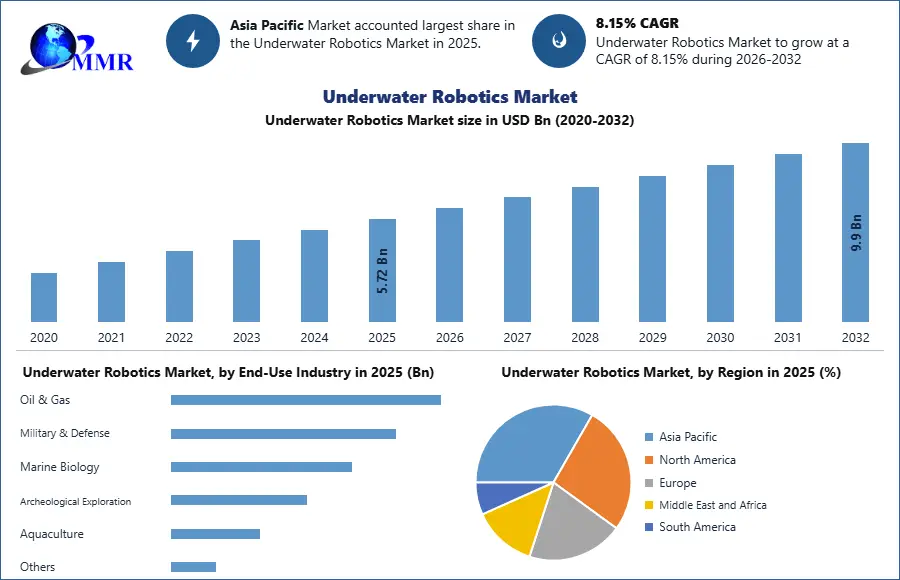
- Dominant Segment: Remotely Operated Vehicles (ROVs) remain a major segment within the underwater robotics ecosystem according to the report, supported by extensive use in offshore inspection, maintenance, and intervention activities.
- Fastest-Growing Segment: The report highlights growing momentum for autonomous underwater technologies, although a specific fastest-growing segment designation should only be attributed where explicitly stated in the report.
- Offshore energy applications continue to represent a critical source of demand due to ongoing subsea inspection and maintenance requirements.
- Defense and security deployments are expanding as autonomous capabilities become increasingly important for maritime operations.
- Scientific exploration and oceanographic research remain important contributors to technology advancement and market adoption.
- Industrial infrastructure monitoring is becoming a larger opportunity as operators seek continuous visibility into underwater assets.
Regional Growth Story
North America remains a significant market due to strong offshore energy activity, advanced marine technology capabilities, and ongoing defense investments. The United States continues to drive demand for autonomous and remotely operated systems supporting both commercial and government applications.
Europe maintains a leadership position in marine engineering and offshore technology development. Countries with extensive maritime industries and offshore infrastructure are accelerating adoption of robotic solutions designed to improve operational efficiency and asset reliability.
Asia-Pacific is becoming increasingly important as maritime trade, offshore development, and infrastructure investments expand. China, Japan, South Korea, and India continue investing in technologies that support marine operations, transportation modernization, and industrial growth.
Growing offshore exploration activities across multiple regions are expanding the addressable market for underwater robotics providers. Increased investment in subsea infrastructure is creating sustained demand for inspection, maintenance, and monitoring capabilities.
Competitive Landscape
Competition is increasingly centered on autonomy, data intelligence, and mission capability rather than hardware alone.
The industry’s strategic direction mirrors developments seen in autonomous mobility and software-defined transportation systems. Competitive advantage is shifting toward companies capable of integrating advanced sensors, navigation technologies, artificial intelligence, and analytics into unified operational platforms.
Manufacturers are focusing on reducing mission costs while expanding operational capabilities. The ability to collect actionable data and convert it into operational intelligence is becoming as important as the robotic platform itself.
The market is also witnessing growing convergence between robotics, software, connectivity, and analytics. Companies that successfully combine these capabilities can create recurring service revenue streams while strengthening customer relationships.
For infrastructure operators, supplier selection increasingly depends on lifecycle value rather than equipment cost alone. This trend favors technology leaders capable of delivering measurable operational improvements.
Recent Developments
- Increased deployment of robotic systems for subsea inspection and monitoring activities.
- Growing adoption of autonomous underwater technologies across commercial and government applications.
- Expansion of ocean data collection initiatives supported by advanced robotics platforms.
- Continued investment in offshore infrastructure maintenance and operational efficiency programs.
- Rising integration of advanced sensing, navigation, and automation technologies within underwater systems.
Strategic Implications
For transportation and maritime operators, underwater robotics is becoming an essential infrastructure management tool. The ability to continuously monitor underwater assets supports reliability, safety, and operational performance objectives.
For investors, the market represents exposure to several long-term growth themes, including autonomy, industrial digitization, maritime modernization, and infrastructure intelligence.
For technology suppliers, future value creation will depend on delivering integrated solutions rather than standalone hardware. Customers increasingly seek operational outcomes, predictive insights, and data-driven decision support capabilities.
For policymakers and regulators, underwater robotics can improve environmental monitoring, infrastructure oversight, and maritime security while supporting broader digital transformation initiatives.
Future Outlook
The underwater robotics industry is moving toward a future where autonomous marine systems become permanent components of global transportation, energy, defense, and infrastructure networks. As artificial intelligence, sensor technologies, and autonomous navigation capabilities continue to advance, robotic systems will assume a larger share of underwater operations traditionally performed by humans.
The next market leaders will be the companies that transform underwater robots into connected intelligence platforms, while laggards will remain trapped in equipment-centric business models as autonomous marine ecosystems become the foundation of future ocean operations.
Analyst Perspective
“The underwater robotics industry is entering a new phase where autonomy, digital intelligence, and operational efficiency are converging. Organizations that invest in advanced robotic capabilities today will be better positioned to manage increasingly complex marine infrastructure and operational environments in the future,” — Dharati Raut, Analyst.
About Maximize Market Research
Maximize Market Research Pvt. Ltd. (MMR) is a global market research and consulting company that provides reliable, data-focused, and practical business insights. The firm serves a wide range of industries, including healthcare, pharmaceuticals, technology, automotive, electronics, chemicals, personal care, and consumer goods. Through market forecasts, competitive analysis, strategic consulting, and industry impact assessments, MMR helps organizations understand changing market conditions, identify growth opportunities, and make informed business decisions for long-term success.
2nd Floor, Navale IT Park Phase 3
Pune Banglore Highway, Narhe
Pune, Maharashtra 411041, India
+91 9607365656
sales@maximizemarketresearch.com
