Market Overview
The HVAC Equipment Market is evolving alongside broader changes in infrastructure development, industrial modernization, and sustainability policy. Organizations are prioritizing systems that improve energy efficiency, reduce emissions, and support digital facility management strategies.
Market expansion is closely linked to growing investments in commercial buildings, industrial facilities, transportation infrastructure, and urban development projects. Climate-control technologies are increasingly integrated into broader operational performance initiatives rather than functioning as standalone systems.
For automotive and transportation stakeholders, HVAC infrastructure plays a critical role in manufacturing environments, logistics facilities, warehousing operations, transit stations, airports, and mobility ecosystems. The reliability of these systems directly affects productivity, worker comfort, equipment performance, and energy consumption.
The market’s evolution also reflects changing customer expectations. Buyers increasingly demand intelligent systems capable of real-time monitoring, predictive maintenance, and automated optimization.
Key Trends Driving Growth
Energy efficiency remains the most important market driver. Governments, businesses, and infrastructure operators continue implementing initiatives designed to reduce energy consumption and improve environmental performance.
The adoption of smart building technologies is accelerating demand for advanced HVAC solutions. Connected systems equipped with sensors, analytics platforms, and automation capabilities enable facility operators to optimize performance while reducing operating costs.
Indoor air quality has become a major investment priority. Organizations increasingly recognize the relationship between air quality, workforce productivity, occupant comfort, and regulatory compliance. This trend is influencing equipment specifications across commercial and industrial applications.
Urbanization is generating additional demand. Expanding cities require new commercial facilities, residential developments, transportation hubs, and public infrastructure. Each project creates opportunities for HVAC equipment suppliers and service providers.
Industrial modernization is another significant growth catalyst. Manufacturers are upgrading facilities to improve operational efficiency, support automation initiatives, and meet sustainability objectives. Advanced climate-control systems are increasingly integrated into these transformation programs.
Digital facility management is reshaping purchasing behavior. Customers now evaluate HVAC investments based on lifecycle performance, energy savings, and operational intelligence rather than upfront equipment costs alone.
Request a Free Sample Copy or View Report Summary
Segment Insights
- Dominant Segment: The report identifies cooling equipment as a major segment within the HVAC equipment market, supported by rising demand across commercial, industrial, and infrastructure applications.
- Fastest-Growing Segment: The report highlights strong opportunities across advanced HVAC technologies; however, no specific fastest-growing segment designation is explicitly provided. In accordance with source requirements, no unsupported classification is included.
- Smart HVAC solutions are gaining attention due to their ability to improve energy efficiency and operational visibility.
- Commercial applications continue to represent a major source of equipment demand.
- Industrial facilities are increasing investments in climate-control modernization initiatives.
- Energy management capabilities are becoming increasingly important in procurement decisions.
Regional Growth Story
North America remains a significant market due to strong demand for energy-efficient infrastructure and ongoing modernization of commercial and industrial facilities. Investments in intelligent building systems continue to support equipment upgrades.
The United States is benefiting from rising adoption of smart infrastructure technologies and growing emphasis on energy optimization. Commercial real estate owners, industrial operators, and infrastructure developers are increasingly prioritizing high-performance HVAC systems.
Europe continues to advance sustainability-driven investments. Regulatory initiatives focused on energy efficiency and emissions reduction are encouraging organizations to modernize climate-control infrastructure.
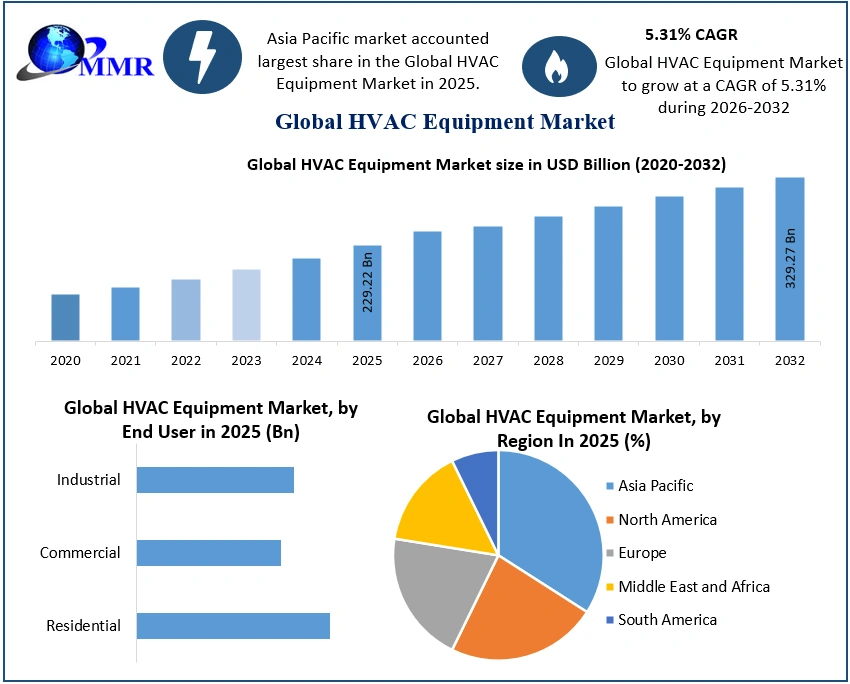
Asia-Pacific represents a major growth opportunity. China, India, Japan, and South Korea are investing heavily in urban development, industrial expansion, transportation infrastructure, and smart city initiatives. These projects are generating significant demand for HVAC equipment and associated technologies.
The regional landscape increasingly favors suppliers capable of delivering energy-efficient solutions that align with long-term sustainability objectives.
Competitive Landscape
Competition is moving beyond equipment performance toward integrated energy-management capabilities.
Leading manufacturers are investing in smart technologies, automation platforms, digital monitoring tools, and connected service models. These investments signal a broader shift toward lifecycle value creation rather than one-time equipment sales.
The market is increasingly influenced by software and analytics. HVAC providers capable of delivering predictive maintenance, remote monitoring, and operational optimization are strengthening their competitive positions.
This transition mirrors broader trends visible across automotive and transportation industries, where connected systems and software-defined capabilities are becoming essential differentiators. Infrastructure customers increasingly expect similar intelligence from climate-control systems.
Competitive dynamics also favor companies with strong sustainability credentials. Energy efficiency performance is becoming a critical factor influencing procurement decisions, project approvals, and long-term customer relationships.
For investors, the market’s direction suggests increasing convergence between traditional equipment manufacturing and digital infrastructure services.
Recent Developments
- Increased adoption of smart HVAC technologies and building automation systems.
- Growing investment in energy-efficient climate-control infrastructure.
- Rising focus on indoor air quality improvements across commercial and industrial sectors.
- Expansion of digital monitoring and predictive maintenance capabilities.
- Continued integration of sustainability objectives into HVAC purchasing decisions.
- Increasing deployment of intelligent energy-management solutions.
Strategic Implications
For transportation operators, HVAC systems are becoming essential components of efficient infrastructure management. Airports, transit hubs, logistics facilities, and mobility centers require advanced climate-control technologies to support operational performance and sustainability goals.
For facility owners, the shift toward intelligent climate management creates opportunities to reduce energy costs while improving asset performance. Long-term value increasingly depends on operational efficiency rather than simple equipment ownership.
For manufacturers, growth opportunities extend beyond hardware. Service contracts, analytics platforms, predictive maintenance solutions, and digital optimization tools are becoming increasingly important revenue streams.
For investors, the market benefits from exposure to multiple structural growth drivers, including urbanization, sustainability initiatives, digital transformation, and infrastructure modernization.
Future Outlook
The HVAC Equipment Market is becoming a critical pillar of sustainable infrastructure development. As digital buildings, connected transportation networks, industrial automation systems, and energy-efficiency mandates continue expanding, demand for intelligent climate-control solutions will intensify.
The next generation of market leaders will be the companies that transform HVAC systems into data-driven energy platforms, while laggards will remain trapped in equipment-centric models as customers increasingly prioritize intelligence, efficiency, and sustainability.
Analyst Perspective
“The HVAC Equipment Market is undergoing a transformation driven by energy efficiency, digitalization, and sustainability. Organizations that align climate-control investments with long-term operational and environmental objectives will be best positioned to capture future value,” — Dharati Raut, Analyst
About Maximize Market Research
Maximize Market Research Pvt. Ltd. (MMR) is a global market research and consulting company that provides reliable, data-focused, and practical business insights. The firm serves a wide range of industries, including healthcare, pharmaceuticals, technology, automotive, electronics, chemicals, personal care, and consumer goods. Through market forecasts, competitive analysis, strategic consulting, and industry impact assessments, MMR helps organizations understand changing market conditions, identify growth opportunities, and make informed business decisions for long-term success.
2nd Floor, Navale IT Park Phase 3
Pune Banglore Highway, Narhe
Pune, Maharashtra 411041, India
+91 9607365656
sales@maximizemarketresearch.com
