Market Overview
The Building Automation System Market has moved beyond conventional facility management. Automation platforms now serve as enterprise-wide operational intelligence systems that connect heating, ventilation, air conditioning, lighting, security, energy management, and occupancy monitoring into a unified digital environment.
This shift is occurring because infrastructure owners face multiple pressures simultaneously. Energy costs remain a concern. Sustainability mandates continue to tighten. Occupants expect safer and more efficient facilities. Operators require greater visibility into asset performance.
For transportation stakeholders, building automation systems have become strategic infrastructure investments. Modern airports, transit stations, logistics centers, fleet depots, and automotive manufacturing facilities increasingly depend on automated systems to maintain performance while reducing operating expenses.
The market’s expansion reflects a broader trend toward intelligent infrastructure. Organizations no longer view buildings as static assets. They increasingly treat facilities as data-generating operational platforms capable of supporting business objectives through automation and analytics.
Key Trends Driving Growth
Energy efficiency remains the most powerful force shaping market demand. Organizations are investing in automation systems that provide real-time monitoring and control of energy-intensive operations. The ability to reduce consumption while maintaining performance has become a major competitive advantage.
The rapid growth of connected infrastructure is creating new opportunities. IoT-enabled sensors, intelligent controls, and cloud-based analytics platforms are enabling operators to manage facilities with greater precision. This capability improves operational visibility and supports faster decision-making.
Predictive maintenance is becoming increasingly important. Traditional maintenance models often rely on fixed schedules or reactive responses. Automation systems allow operators to identify performance issues before failures occur, reducing downtime and extending asset life.
Digital transformation initiatives are also accelerating adoption. Organizations across commercial, industrial, and transportation sectors are integrating automation systems into broader operational modernization strategies. Building intelligence is becoming part of enterprise intelligence.
Security integration is another major trend. Facility operators increasingly seek centralized platforms capable of managing access control, surveillance systems, environmental monitoring, and operational infrastructure from a single interface.
Sustainability objectives continue to influence investment decisions. Building automation systems help organizations track energy performance, reduce emissions, and support environmental compliance initiatives without compromising operational efficiency.
Request a Free Sample Copy or View Report Summary
Segment Insights
- Dominant Segment: The report identifies security and access control systems as a significant segment within the Building Automation System Market, reflecting increasing demand for integrated facility protection and operational visibility.
- Fastest-Growing Segment: The report highlights strong growth opportunities across automation technologies; however, no explicit fastest-growing segment designation is provided. In accordance with source requirements, no unsupported classification is included.
- Energy management solutions continue to attract investment due to their ability to optimize operational costs.
- HVAC automation remains a critical application area across commercial and industrial facilities.
- Integrated control platforms are gaining adoption as organizations seek centralized operational oversight.
- Smart monitoring and analytics capabilities are becoming key differentiators in purchasing decisions.
Regional Growth Story
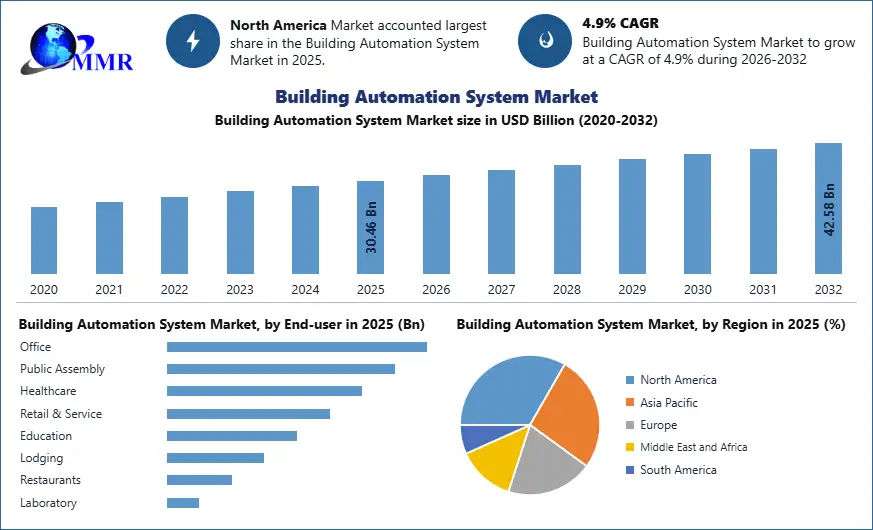
North America remains one of the most important markets due to strong adoption of smart building technologies and growing investment in digital infrastructure. Organizations across the region continue upgrading facilities to improve efficiency and operational performance.
The United States is witnessing increasing deployment of intelligent building technologies across commercial properties, transportation facilities, industrial sites, and public infrastructure. The combination of digital transformation and sustainability initiatives continues to support market expansion.
Europe is benefiting from stringent energy-efficiency policies and environmental regulations. Infrastructure operators increasingly view automation systems as essential tools for achieving sustainability targets and reducing long-term operating costs.
Asia-Pacific represents a significant growth opportunity. China, India, Japan, and South Korea continue investing in urbanization, transportation modernization, smart city initiatives, and industrial development. These investments are creating sustained demand for advanced building automation technologies.
Across regions, the market increasingly favors providers capable of delivering scalable, interoperable, and energy-efficient solutions that support broader digital transformation goals.
Competitive Landscape
Competition is shifting away from standalone hardware toward integrated digital ecosystems.
Leading companies are investing in cloud connectivity, artificial intelligence, analytics platforms, and IoT-enabled infrastructure. These investments signal a broader industry transition toward software-driven operational intelligence.
The competitive battleground increasingly resembles developments in the automotive industry, where software capabilities are becoming as important as physical products. Facility operators now evaluate automation providers based on data insights, interoperability, cybersecurity, and lifecycle value.
Technology providers that successfully combine building controls, analytics, energy management, and predictive maintenance capabilities are strengthening customer relationships and expanding recurring revenue opportunities.
The market also reflects growing convergence between infrastructure management and digital services. Organizations increasingly expect automation systems to function as strategic business platforms rather than isolated operational tools.
This evolution is raising barriers to entry and favoring companies with extensive technology portfolios, software expertise, and long-term service capabilities.
Recent Developments
- Increased deployment of IoT-enabled building automation platforms.
- Growing adoption of integrated energy-management solutions.
- Expansion of predictive maintenance and remote monitoring capabilities.
- Rising investment in intelligent security and access-control technologies.
- Greater focus on sustainability and energy-efficiency optimization.
- Continued integration of cloud-based analytics and automation software.
Strategic Implications
For transportation operators, building automation systems are becoming critical components of infrastructure modernization strategies. Airports, railway stations, logistics hubs, and fleet facilities require intelligent systems capable of optimizing operations while reducing costs.
For investors, the market provides exposure to multiple structural growth themes, including smart infrastructure, digital transformation, energy efficiency, and sustainability. These drivers support long-term investment interest across public and private sectors.
For technology providers, opportunities increasingly extend beyond equipment sales. Software subscriptions, analytics services, predictive maintenance solutions, and digital infrastructure management platforms are becoming major value-creation channels.
For policymakers, building automation offers a practical pathway to improve energy performance, reduce emissions, and support sustainable urban development objectives.
Future Outlook
The Building Automation System Market is becoming the digital operating system for modern infrastructure. As transportation networks, industrial facilities, commercial buildings, and urban environments become increasingly connected, automation platforms will play a larger role in managing operational complexity.
The next generation of market leaders will be the companies that transform buildings into intelligent, data-driven infrastructure assets, while laggards will struggle as software-powered operational intelligence becomes the defining advantage in infrastructure management.
Analyst Perspective
“The Building Automation System Market is entering a phase where intelligence, connectivity, and energy optimization are becoming inseparable. Organizations that integrate automation into broader digital transformation strategies will be best positioned to achieve long-term operational and sustainability goals,” — Dharati Raut, Analyst
About Maximize Market Research
Maximize Market Research Pvt. Ltd. (MMR) is a global market research and consulting company that provides reliable, data-focused, and practical business insights. The firm serves a wide range of industries, including healthcare, pharmaceuticals, technology, automotive, electronics, chemicals, personal care, and consumer goods. Through market forecasts, competitive analysis, strategic consulting, and industry impact assessments, MMR helps organizations understand changing market conditions, identify growth opportunities, and make informed business decisions for long-term success.
2nd Floor, Navale IT Park Phase 3
Pune Banglore Highway, Narhe
Pune, Maharashtra 411041, India
+91 9607365656
sales@maximizemarketresearch.com
