Key Highlights
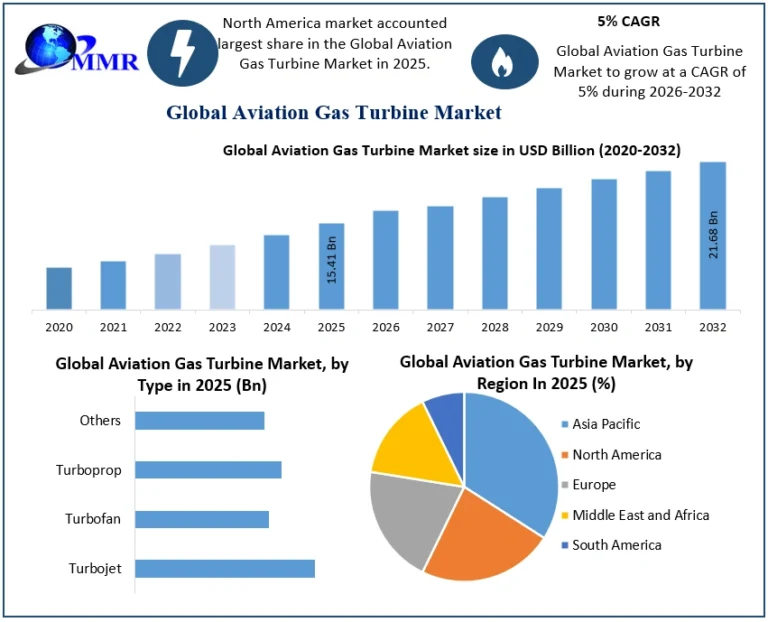
- The Aviation Gas Turbine Market is valued at USD 15.41 billion in 2025 and is projected to reach USD 21.68 billion by 2032.
- The market is forecast to expand at a CAGR of 5% during 2026–2032.
- North America holds the largest market share.
- Turbofan, turbojet, turboprop, and other turbine technologies form the core product categories.
- Commercial aircraft, defense aircraft, business aircraft, and specialized aviation platforms represent the major application segments.
- Major industry participants include General Electric Aviation, CFM International, Pratt & Whitney, Rolls-Royce, MTU Aero Engines, Avio Aero, Engine Alliance, International Aero Engines, and NPO Saturn.
Why This Matters Now
The aviation industry is entering a decisive investment cycle. Airlines are rebuilding capacity, defense agencies are upgrading fleets, and engine manufacturers are racing to deliver higher efficiency and lower operating costs. The strategic importance of gas turbines has moved beyond propulsion. It now influences airline profitability, national defense readiness, aerospace supply chains, and industrial competitiveness.
At the same time, governments are increasing scrutiny of fuel consumption and emissions performance. This is pushing manufacturers to invest heavily in advanced turbine architectures, digital engine monitoring, lightweight materials, and next-generation propulsion technologies. The result is a market where technology leadership increasingly determines commercial success.
Market Overview
The Aviation Gas Turbine Market is projected to expand from USD 15.41 billion in 2025 to USD 21.68 billion by 2032, reflecting sustained demand across both commercial and defense aviation sectors. The forecast growth rate of 5% signals a market supported by long-term aircraft procurement cycles and continuous engine replacement requirements. Every incremental gain in turbine efficiency translates directly into lower operating costs for airlines and enhanced mission capabilities for defense operators.
What changed is the strategic role of propulsion technology. Aircraft operators are no longer focused solely on engine performance. They are increasingly prioritizing lifecycle economics, maintenance efficiency, reliability, and sustainability metrics.
Why now? Global air traffic recovery, defense modernization programs, and growing aircraft fleets are converging simultaneously, creating sustained demand across the aerospace value chain.
Get a sample of the report: https://www.maximizemarketresearch.com/request-sample/72439/
Key Trends Driving Growth
Fuel efficiency remains the dominant competitive battleground. Engine manufacturers are investing in advanced turbine designs that reduce fuel consumption while delivering higher thrust and improved reliability. These improvements directly affect airline operating margins and fleet economics.
Commercial aviation expansion continues to drive engine demand. Airlines across major aviation markets are pursuing fleet renewal strategies to improve operational efficiency and meet evolving environmental requirements. New-generation aircraft increasingly rely on advanced gas turbine technologies capable of delivering improved performance over legacy systems.
Defense modernization is creating a parallel growth engine. Governments are allocating resources toward next-generation fighter aircraft, transport platforms, surveillance systems, and strategic aviation assets. Modern turbine engines provide enhanced range, payload capability, and mission flexibility.
Digitalization is also transforming the market. Predictive maintenance systems, real-time engine diagnostics, and data-driven fleet management solutions are reducing downtime while extending engine service life. This shift is creating new revenue streams across maintenance, repair, and overhaul ecosystems.
Segment Insights
- Dominant Segment: Commercial Aircraft Application Segment
- Commercial aviation continues to represent the largest source of demand as airlines expand fleets, replace aging aircraft, and improve operational efficiency.
- Rising passenger traffic and fleet modernization programs support sustained engine procurement activity.
- Fastest-Growing Segment: Defense Aircraft Application Segment
- Military modernization initiatives across major economies are accelerating demand for advanced turbine-powered aircraft.
- Defense procurement programs increasingly prioritize propulsion systems capable of supporting next-generation mission requirements.
- Technology Segments
- Turbofan
- Turbojet
- Turboprop
- Others
The growing preference for advanced propulsion systems reflects a broader industry shift toward maximizing performance while controlling operating costs. Aircraft operators increasingly evaluate engines as long-term strategic assets rather than standalone equipment purchases.
Regional Growth Story
North America remains the largest regional market. The region benefits from a strong aerospace manufacturing base, substantial defense spending, major commercial airline operators, and the presence of leading engine manufacturers. Market leadership translates into continued investment in research, production capacity, and advanced propulsion technologies.
Europe remains a critical center for aerospace innovation. Engine manufacturers and aircraft producers across Germany, the United Kingdom, France, and other European markets continue to advance fuel-efficiency technologies and next-generation propulsion platforms.
Asia-Pacific is becoming increasingly important as airlines expand fleets and governments invest in aviation infrastructure. China, India, Japan, and South Korea are strengthening their aerospace ecosystems through manufacturing investments, aviation development programs, and defense modernization initiatives.
Middle East and Africa continue to benefit from airline expansion strategies and strategic aviation investments, while South America offers long-term opportunities linked to commercial aviation development and fleet renewal.
Competitive Landscape
Competition in the Aviation Gas Turbine Market extends far beyond engine sales. The industry’s leading companies are competing for decades-long revenue streams that include maintenance contracts, digital services, upgrades, and aftermarket support.
Major participants include General Electric Aviation, CFM International, Pratt & Whitney, Rolls-Royce, Avio Aero, Engine Alliance, International Aero Engines, MTU Aero Engines, and NPO Saturn.
The market structure increasingly favors companies capable of integrating advanced engineering, manufacturing scale, digital capabilities, and global service networks. This creates significant barriers to entry while strengthening the position of established aerospace leaders.
Another important signal is the growing emphasis on long-term customer relationships. Engine manufacturers are shifting from product-centric business models toward lifecycle-service strategies that generate recurring revenue and improve customer retention.
Technology leadership is becoming the primary differentiator. Companies that achieve meaningful gains in fuel efficiency, durability, and operational reliability are positioned to capture larger shares of future aircraft programs.
Recent Developments
- Increased investment in next-generation turbine technologies focused on fuel efficiency and performance enhancement.
- Expansion of digital engine monitoring and predictive maintenance capabilities.
- Growing emphasis on advanced materials and manufacturing processes to improve engine durability.
- Rising collaboration across aerospace supply chains to address production requirements and delivery schedules.
- Continued focus on supporting both commercial aviation recovery and defense modernization programs.
Strategic Implications
For airlines, turbine efficiency increasingly determines competitive advantage. Lower fuel consumption directly improves profitability while supporting sustainability objectives.
For defense organizations, advanced propulsion systems enhance operational readiness and mission effectiveness. Engine performance is becoming a critical component of national security strategies.
For investors, the market offers exposure to long-duration aerospace demand cycles supported by fleet expansion, replacement requirements, and recurring aftermarket revenues.
For policymakers, maintaining domestic aerospace capabilities has become a strategic priority tied to industrial competitiveness, technological sovereignty, and defense preparedness.
Future Outlook
The next phase of market development will be defined by the convergence of efficiency, digitalization, and sustainability. Aircraft operators will continue prioritizing engines that reduce operating costs while meeting increasingly demanding performance requirements.
As aerospace manufacturers accelerate innovation and airlines modernize fleets, propulsion technology will become one of the most decisive competitive factors across the aviation sector. The companies that lead in efficiency, reliability, and lifecycle value creation will define the next generation of aviation, while those that fail to innovate risk losing relevance in an increasingly technology-driven aerospace market.
Analyst Perspective
“The Aviation Gas Turbine Market is evolving from a traditional propulsion market into a strategic technology ecosystem. Future leaders will be determined not only by engine performance, but by their ability to deliver efficiency, digital intelligence, lifecycle value, and long-term operational advantages across global aviation networks.” — Neha Nalawade
About Maximize Market Research
Maximize Market Research Pvt. Ltd. (MMR) is a global market research and consulting company that provides reliable, data-focused, and practical business insights. The firm serves a wide range of industries, including healthcare, pharmaceuticals, technology, automotive, electronics, chemicals, personal care, and consumer goods. Through market forecasts, competitive analysis, strategic consulting, and industry impact assessments, MMR helps organizations understand changing market conditions, identify growth opportunities, and make informed business decisions for long-term success.
Contact Maximize Market Research:
2nd Floor, Navale IT Park Phase 3
Pune Banglore Highway, Narhe
Pune, Maharashtra 411041, India
+91 9607365656
sales@maximizemarketresearch.com
