Key Highlights
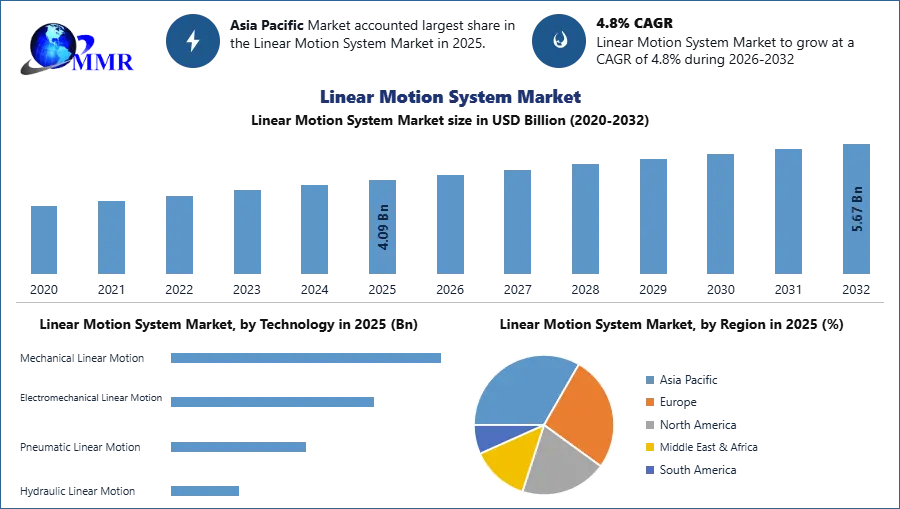
- Global Linear Motion System Market valued at USD 4.09 billion in 2025.
- Market projected to reach USD 5.67 billion by 2032.
- CAGR estimated at 4.8% during 2026–2032.
- Asia-Pacific remains the leading regional market.
- Automotive and semiconductor industries are among the largest end users.
- Industrial automation and precision engineering continue to drive demand.
- Major companies include THK Co., Ltd., Bosch Rexroth AG, HIWIN Technologies, NSK Ltd., and SKF Group.
- EV manufacturing expansion is increasing demand for high-precision motion systems.
Why This Matters Now
Automotive manufacturers are facing simultaneous pressure to scale EV production, improve manufacturing efficiency, and reduce operational costs. The factories that deploy precision automation fastest will gain a significant advantage in productivity, quality control, and production flexibility.
Linear motion systems have become critical infrastructure inside modern automotive plants. As OEMs redesign production lines for electric vehicles and software-defined vehicles, demand for high-speed and highly accurate motion technologies is accelerating across assembly, welding, inspection, and material-handling operations.
Market Overview
The Global Linear Motion System Market was valued at USD 4.09 billion in 2025 and is expected to reach nearly USD 5.67 billion by 2032, expanding at a CAGR of 4.8% during the forecast period. The market serves industries requiring precise, repeatable, and efficient linear movement, including automotive, semiconductor, aerospace, medical devices, machine tools, and food processing.
For automotive manufacturers, linear motion systems have moved beyond basic automation components. They now represent strategic enablers of smart manufacturing, supporting robotic assembly, battery production, quality inspection, and advanced material handling. The shift toward digital factories is increasing the value of precision motion technologies across production ecosystems.
The market’s growth trajectory is closely linked to broader industrial automation investments. Manufacturers are increasingly prioritizing productivity gains, labor optimization, and manufacturing resilience, creating sustained demand for advanced motion control solutions.
Key Trends Driving Growth
The most significant market shift is the rapid expansion of automated manufacturing. Automotive plants are integrating robotics, AI-driven production systems, and connected factory technologies that require precise positioning and repeatable movement. Linear motion systems provide the mechanical foundation for these capabilities.
Electric vehicle manufacturing is creating a new demand cycle. Battery module assembly, cell handling, pack manufacturing, and automated inspection systems require high-precision motion technologies capable of operating at high speeds while maintaining accuracy. As EV production volumes increase globally, suppliers of motion systems gain access to a growing addressable market.
The transition from pneumatic and hydraulic systems toward electromechanical solutions is also reshaping competitive dynamics. Manufacturers increasingly favor electric motion systems because they offer better positioning accuracy, lower maintenance requirements, improved energy efficiency, and easier integration with Industry 4.0 platforms.
Semiconductor manufacturing continues to strengthen demand fundamentals. Chip fabrication requires micron-level precision and contamination-free operations, making advanced linear motion technologies indispensable. Continued investments in semiconductor capacity globally create additional growth opportunities for suppliers serving both automotive and electronics markets.
Supply chain resilience has become another strategic priority. Manufacturers are investing in automation technologies to reduce labor dependency, improve throughput consistency, and mitigate operational disruptions. This trend supports long-term demand for motion control systems across industrial sectors.
Explore detailed analysis, insights, and growth opportunities
Segment Insights
- Dominant Segment: Automotive and semiconductor & electronics industries represent the leading end-user segments, driven by extensive automation requirements and precision manufacturing demands.
- Fastest-Growing Segment: Electrically driven and advanced automation-oriented motion solutions are gaining momentum as manufacturers transition toward smart factories and digital production environments.
- Multi-axis systems are increasingly preferred in complex production environments because they support synchronized movement and higher throughput. These capabilities are particularly valuable in battery assembly and advanced automotive manufacturing.
- Motion controllers and intelligent control technologies are emerging as high-growth categories as manufacturers seek software-enabled optimization and real-time diagnostics.
Regional Growth Story
Asia-Pacific leads the global Linear Motion System Market due to its concentration of automotive, electronics, and industrial manufacturing activities. China, Japan, South Korea, and India continue to expand automation investments while increasing production capacity across strategic industries.
China remains central to global manufacturing growth, supported by EV production expansion, robotics adoption, and industrial modernization programs. Japan and South Korea continue to benefit from advanced manufacturing ecosystems and strong technology leadership in precision engineering.
India is emerging as an increasingly important manufacturing destination as automotive production, electronics assembly, and industrial automation investments accelerate. Growing localization strategies among global OEMs are creating opportunities for automation suppliers throughout the value chain.
North America and Europe continue to invest heavily in smart manufacturing, semiconductor capacity, and advanced automotive production. Regulatory pressure for efficiency improvements and sustainability targets is encouraging broader deployment of automated production technologies.
Competitive Landscape
Competition is increasingly centered on precision performance, automation integration, and digital capabilities rather than hardware alone. Major participants including THK Co., Ltd., Bosch Rexroth AG, HIWIN Technologies, NSK Ltd., and SKF Group are strengthening their positions through technology innovation and industrial automation expertise.
The industry’s strategic direction suggests growing emphasis on integrated solutions combining actuators, guides, motors, controllers, and software platforms. Suppliers capable of delivering complete automation ecosystems are positioned to gain stronger pricing power and deeper customer relationships.
Technology leadership is shifting toward companies that can support Industry 4.0 deployments, predictive maintenance capabilities, and intelligent motion control. As automotive manufacturers digitize production environments, software-enabled differentiation will become increasingly important.
Recent Developments
- Expansion of industrial automation projects across automotive manufacturing facilities.
- Increased adoption of electromechanical motion systems replacing traditional hydraulic and pneumatic technologies.
- Growing deployment of multi-axis motion platforms in advanced manufacturing applications.
- Rising semiconductor manufacturing investments supporting demand for precision motion technologies.
- Integration of intelligent controllers and digital diagnostics into motion system architectures.
Strategic Implications
For OEMs, linear motion systems are becoming a competitive differentiator rather than a supporting technology. Faster, more precise, and more flexible manufacturing systems directly affect production economics and product quality.
Tier-1 suppliers face growing pressure to deliver automation-ready components compatible with connected factory environments. Companies that align product development with EV production requirements, semiconductor manufacturing needs, and smart factory architectures will capture disproportionate growth opportunities.
Investors should monitor automation spending cycles, EV manufacturing capacity additions, and semiconductor expansion projects. These sectors are likely to remain the strongest demand generators for advanced motion technologies through the forecast period.
Future Outlook
The next phase of market growth will be defined by the convergence of EV manufacturing, semiconductor expansion, industrial automation, and intelligent factory systems. Companies that combine precision engineering with software-driven automation capabilities will shape the next generation of manufacturing competitiveness, while slower adopters risk losing operational efficiency and strategic relevance.
Analyst Perspective
“Demand for precision automation is accelerating as manufacturers pursue higher productivity, greater flexibility, and smarter production environments. Linear motion systems are increasingly becoming core enablers of industrial transformation across automotive, semiconductor, and advanced manufacturing sectors.” — Dharati Raut, Analyst
About Maximize Market Research
Maximize Market Research Pvt. Ltd. (MMR) is a global market research and consulting company that provides reliable, data-focused, and practical business insights. The firm serves a wide range of industries, including healthcare, pharmaceuticals, technology, automotive, electronics, chemicals, personal care, and consumer goods. Through market forecasts, competitive analysis, strategic consulting, and industry impact assessments, MMR helps organizations understand changing market conditions, identify growth opportunities, and make informed business decisions for long-term success.
Contact Us :
2nd Floor, Navale IT Park Phase 3
Pune Banglore Highway, Narhe
Pune, Maharashtra 411041, India
+91 9607365656
sales@maximizemarketresearch.com
