Key Highlights
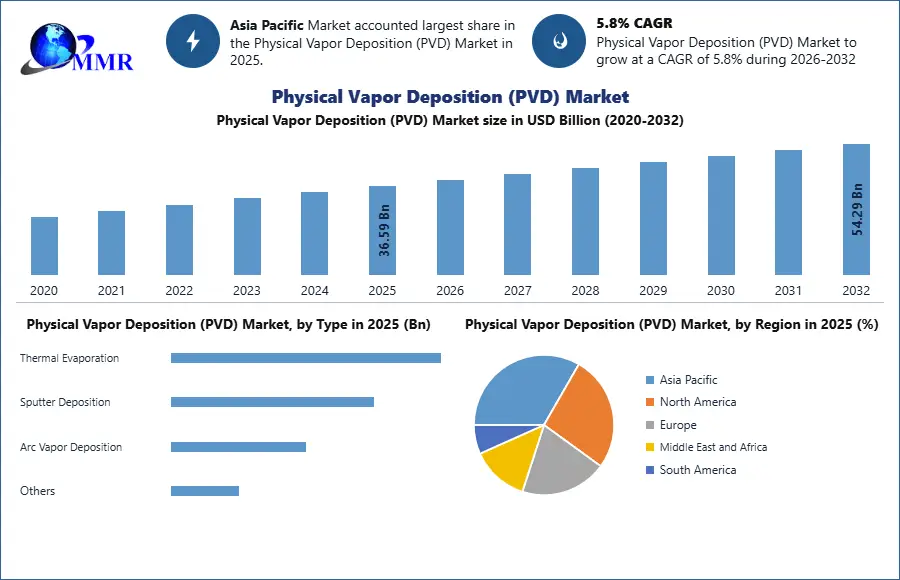
- Global Physical Vapor Deposition Market valued at USD 36.59 billion in 2025.
- Market projected to reach USD 54.29 billion by 2032.
- Forecast CAGR stands at 5.8% from 2026 to 2032.
- Growing adoption of advanced coatings across automotive, electronics, and semiconductor industries.
- Rising EV production is increasing demand for high-performance coated components.
- Asia-Pacific remains the leading regional market.
- Semiconductor expansion is creating new opportunities for PVD equipment and coating suppliers.
- Demand for lightweight, durable, and environmentally compliant coating technologies continues to rise.
Why This Matters Now
Automotive manufacturers are racing to improve vehicle efficiency, durability, and sustainability while managing the transition toward electrification. Advanced coating technologies have become strategic assets because they directly influence component performance, production efficiency, and product lifespan.
Physical Vapor Deposition is increasingly moving from a niche manufacturing process to a critical industrial capability. As EV production expands and semiconductor demand rises, companies that secure access to advanced coating technologies are positioning themselves for stronger margins and greater technological differentiation.
Market Overview
The Global Physical Vapor Deposition (PVD) Market was valued at USD 36.59 billion in 2025 and is expected to reach nearly USD 54.29 billion by 2032, growing at a CAGR of 5.8% during the forecast period.
PVD technology enables manufacturers to deposit thin films and protective coatings onto materials with exceptional precision. These coatings improve hardness, corrosion resistance, wear protection, thermal stability, and aesthetic appearance. The process has become increasingly important across automotive manufacturing, semiconductor fabrication, aerospace engineering, medical devices, and electronics production.
For automotive OEMs, PVD coatings offer a pathway to lighter, more durable, and more efficient vehicle components. As manufacturers seek to reduce vehicle weight while extending component life, advanced surface engineering technologies are gaining strategic importance.
The market’s steady growth trajectory highlights a broader industrial shift toward performance-driven manufacturing. Companies are investing in technologies that increase durability while reducing maintenance requirements and lifecycle costs.
Key Trends Driving Growth
The transition from internal combustion engines to electric vehicles is creating a new demand cycle for advanced coatings. EV manufacturers require highly durable coatings for battery systems, power electronics, electric motors, connectors, and thermal management components.
Battery technology is emerging as a particularly important growth area. PVD coatings can enhance material performance, improve conductivity, and support longer operational life. As global EV production expands, suppliers with advanced coating capabilities gain access to a rapidly growing customer base.
The semiconductor industry’s expansion is another major growth catalyst. Modern vehicles increasingly depend on semiconductors for powertrain management, ADAS systems, connectivity functions, infotainment platforms, and autonomous driving technologies. PVD processes are widely used in semiconductor fabrication, making chip production growth directly relevant to market demand.
Automotive design trends are also supporting adoption. OEMs increasingly use decorative and functional coatings to improve appearance while meeting durability requirements. PVD technologies provide environmentally preferable alternatives to some traditional coating methods, helping manufacturers align with tightening sustainability standards.
Lightweight materials continue to gain traction across vehicle platforms. Aluminum, composites, and advanced alloys often require specialized surface treatments to maintain performance under demanding operating conditions. PVD coatings help manufacturers balance weight reduction objectives with durability expectations.
Manufacturing automation is creating additional opportunities. Automated coating systems improve consistency, reduce waste, and support high-volume production environments. As smart factories become more common, advanced coating technologies are becoming more deeply integrated into digital manufacturing workflows.
Explore detailed analysis, insights, and growth opportunities
Segment Insights
- Dominant Segment: Equipment and coating technologies serving industrial manufacturing applications continue to account for the largest share of market demand due to widespread adoption across automotive, electronics, and semiconductor sectors.
- Fastest-Growing Segment: Semiconductor and advanced electronics applications are emerging as high-growth opportunities as global chip production capacity expands and automotive electronics content increases.
- Automotive manufacturers remain significant end users due to growing demand for wear-resistant, corrosion-resistant, and decorative coatings.
- Thin-film technologies are gaining traction because they support higher performance standards while reducing material consumption.
- Advanced coating applications for EV batteries, electric motors, and power electronics are creating new growth avenues for suppliers.
Regional Growth Story
Asia-Pacific dominates the Physical Vapor Deposition Market and continues to benefit from strong manufacturing ecosystems across automotive, electronics, and semiconductor industries.
China remains the largest growth contributor due to its extensive EV production capacity, electronics manufacturing base, and semiconductor investment activity. The country’s push for industrial modernization continues to create demand for advanced manufacturing technologies, including PVD systems.
Japan and South Korea maintain strong positions due to their leadership in electronics, semiconductor production, automotive engineering, and precision manufacturing. These countries remain important centers for coating technology innovation and equipment development.
India is becoming an increasingly attractive market as automotive production expands and government initiatives encourage domestic manufacturing. Growing EV investments and localization strategies are expected to support demand for advanced surface engineering technologies.
North America remains a key market driven by aerospace, semiconductor, and automotive manufacturing investments. The United States continues to prioritize domestic semiconductor capacity expansion, creating opportunities for PVD equipment suppliers.
Europe benefits from strong automotive engineering capabilities, particularly in Germany. Stringent environmental regulations and premium vehicle manufacturing requirements continue to support adoption of advanced coating technologies.
Competitive Landscape
Competition is increasingly centered on technology performance, process efficiency, and coating quality. Manufacturers are investing in next-generation deposition technologies capable of delivering higher precision, greater durability, and improved production throughput.
The competitive environment also highlights growing convergence between automotive, semiconductor, and electronics supply chains. Suppliers capable of serving multiple high-growth industries can better diversify revenue streams and strengthen pricing power.
Capacity expansion and technology investments signal confidence in long-term demand fundamentals. Companies are positioning themselves to capture opportunities generated by EV production growth, semiconductor expansion, and industrial modernization.
Innovation is becoming a key differentiator. Suppliers that improve coating consistency, reduce process costs, and support environmentally compliant manufacturing practices are strengthening their competitive positions.
As automotive electronics content continues to increase, partnerships between coating technology providers, semiconductor manufacturers, and automotive suppliers are likely to become more important.
Recent Developments
- Increased adoption of PVD coatings in electric vehicle components and battery systems.
- Rising semiconductor manufacturing investments supporting demand for thin-film deposition technologies.
- Expansion of advanced coating applications across automotive and electronics industries.
- Growing focus on environmentally sustainable surface engineering processes.
- Higher investments in precision manufacturing and automated coating systems.
- Continued development of advanced thin-film technologies designed for high-performance applications.
Strategic Implications
For automotive OEMs, PVD technology is becoming increasingly important for balancing efficiency, durability, and sustainability objectives. The ability to enhance component performance without adding significant weight creates a competitive advantage in both EV and conventional vehicle platforms.
Tier-1 suppliers are under pressure to deliver components that meet stricter durability and efficiency standards. Advanced coating technologies can help suppliers differentiate products while supporting OEM performance requirements.
Investors should monitor intersections between PVD adoption, EV manufacturing growth, and semiconductor expansion. These industries are becoming increasingly interconnected, creating opportunities for suppliers positioned across multiple value chains.
Governments pursuing domestic manufacturing and semiconductor self-sufficiency strategies may further accelerate investments in advanced production technologies, including PVD systems.
Future Outlook
The next generation of automotive and electronics manufacturing will be defined by companies that combine advanced materials, precision coatings, and scalable production technologies, while those that delay investment risk falling behind in performance, efficiency, and product innovation.
Analyst Perspective
“Physical Vapor Deposition technologies are becoming increasingly important as manufacturers seek higher-performance materials, greater durability, and improved manufacturing efficiency. The convergence of EV growth, semiconductor expansion, and advanced manufacturing is creating long-term opportunities across the PVD value chain.” — Dharati Raut, Analyst
About Maximize Market Research
Maximize Market Research Pvt. Ltd. (MMR) is a global market research and consulting company that provides reliable, data-focused, and practical business insights. The firm serves a wide range of industries, including healthcare, pharmaceuticals, technology, automotive, electronics, chemicals, personal care, and consumer goods. Through market forecasts, competitive analysis, strategic consulting, and industry impact assessments, MMR helps organizations understand changing market conditions, identify growth opportunities, and make informed business decisions for long-term success.
Contact Us :
2nd Floor, Navale IT Park Phase 3
Pune Banglore Highway, Narhe
Pune, Maharashtra 411041, India
+91 9607365656
sales@maximizemarketresearch.com
