Key Highlights
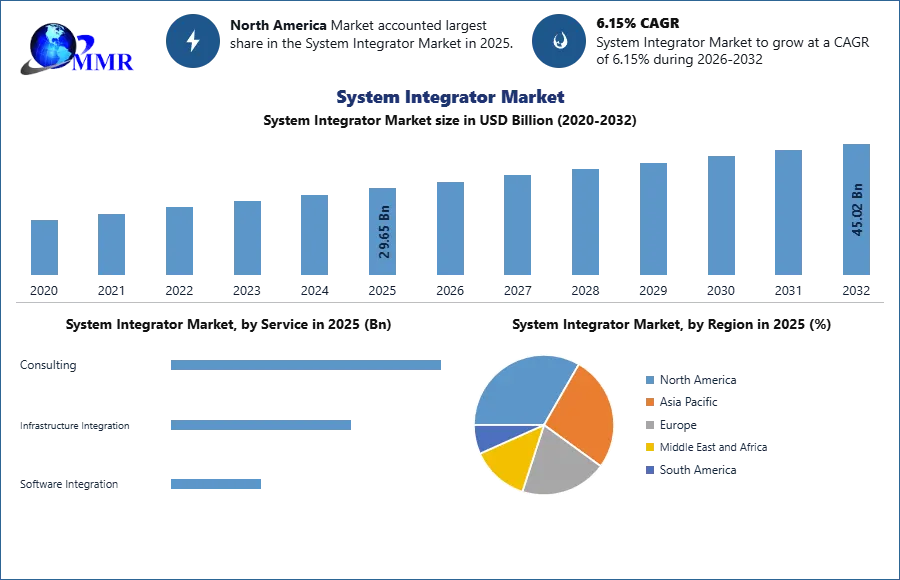
- Global System Integrator Market valued at USD 29.65 billion in 2025.
- Market expected to reach USD 45.02 billion by 2032.
- Forecast CAGR stands at 6.15% from 2026 to 2032.
- Industry 4.0 adoption is accelerating demand for integration services.
- Automotive manufacturers are expanding investments in connected factories and digital production systems.
- Industrial automation remains a major growth catalyst.
- Smart manufacturing initiatives are increasing integration complexity across production ecosystems.
- Asia-Pacific continues to represent a significant growth region due to expanding manufacturing capacity.
Why This Matters Now
Automotive manufacturers are redesigning factories faster than at any point since the introduction of large-scale industrial robotics. OEMs that fail to integrate production systems, digital platforms, and supply chain networks risk losing efficiency, agility, and competitiveness as vehicle technology becomes increasingly software-driven.
The challenge is no longer automation alone. Manufacturers must connect hundreds of systems across engineering, production, logistics, quality control, and customer operations. System integrators have become strategic partners in that transformation, enabling automotive companies to operate unified digital ecosystems rather than isolated technology environments.
Market Overview
The Global System Integrator Market was valued at USD 29.65 billion in 2025 and is expected to reach nearly USD 45.02 billion by 2032, expanding at a CAGR of 6.15% during the forecast period.
System integrators enable organizations to connect hardware, software, automation platforms, communication networks, and operational technologies into unified business systems. As industrial operations become increasingly digital, the complexity of technology environments continues to rise, driving demand for integration expertise.
Within the automotive sector, system integration has become essential to managing modern manufacturing environments. Vehicle production now combines robotics, artificial intelligence, machine vision, Industrial Internet of Things (IIoT) platforms, predictive maintenance tools, and cloud-based analytics systems.
The market’s growth highlights a broader shift toward connected operations. Automotive companies are prioritizing real-time visibility, production flexibility, and data-driven decision-making to remain competitive in rapidly evolving mobility markets.
Key Trends Driving Growth
The expansion of Industry 4.0 remains the most significant growth driver. Manufacturers increasingly require seamless connectivity between production equipment, enterprise software, supply chain systems, and digital monitoring platforms. System integrators are helping bridge these technology environments.
Electric vehicle production is creating new integration requirements. EV manufacturing introduces additional complexity through battery production lines, power electronics assembly, software management systems, and automated quality control processes. Integrating these functions efficiently has become a competitive necessity.
The transition toward software-defined vehicles is also reshaping demand. Automotive manufacturers must manage larger volumes of data throughout product development, production, and lifecycle management. Integration solutions enable information to move across departments without disruption.
Connected mobility initiatives continue generating opportunities. Vehicle connectivity, telematics systems, fleet management platforms, and mobility services require robust integration frameworks capable of supporting large-scale data exchange.
Supply chain digitization has become increasingly important following disruptions affecting semiconductors, logistics, and raw material availability. Manufacturers are investing in integrated supply chain platforms to improve visibility and reduce operational risk.
Smart factory investments are accelerating globally. Advanced robotics, automated material handling systems, digital twins, and predictive maintenance solutions all require sophisticated integration capabilities. This trend strengthens demand for system integration services across manufacturing ecosystems.
Regulatory compliance is another important factor. Automotive manufacturers face growing reporting obligations related to emissions, sustainability targets, cybersecurity requirements, and operational transparency. Integrated digital systems simplify compliance management and improve audit readiness.
Explore detailed analysis, insights, and growth opportunities
Segment Insights
- Dominant Segment: Industrial automation integration remains the leading application area due to widespread adoption of robotics, manufacturing execution systems, and factory automation technologies.
- Fastest-Growing Segment: Industry 4.0 and smart manufacturing integration services are experiencing strong growth as organizations expand digital transformation initiatives.
- Automotive manufacturing continues to represent a key end-use sector because of increasing production complexity and automation requirements.
- Cloud-connected integration platforms are gaining traction as manufacturers seek scalable and flexible operational architectures.
- Integration services supporting Industrial IoT deployments are becoming increasingly important across vehicle manufacturing and logistics operations.
Regional Growth Story
North America remains a major market for system integration services due to advanced industrial infrastructure, significant automation investments, and ongoing digital transformation initiatives.
The United States continues to lead adoption across automotive manufacturing, logistics, and industrial automation. OEMs are investing heavily in connected production facilities capable of supporting EV manufacturing and advanced mobility technologies.
Asia-Pacific is emerging as a powerful growth engine. China, Japan, South Korea, and India continue expanding manufacturing capacity while accelerating digitalization efforts. These developments create significant opportunities for integration service providers.
China’s position as a leading automotive and EV manufacturing hub is driving substantial investment in factory modernization and industrial automation. System integration capabilities are becoming increasingly important as production networks expand in scale and complexity.
Japan and South Korea continue leveraging strengths in robotics, electronics, and advanced manufacturing technologies. Their industrial ecosystems rely heavily on integrated automation environments that require continuous modernization.
India is gaining momentum as automotive production expands and manufacturers pursue localization strategies. Investments in smart manufacturing facilities are creating additional demand for system integration expertise.
Europe remains a strategically important market due to advanced automotive engineering capabilities and strong Industry 4.0 adoption. German manufacturers, in particular, continue investing in connected manufacturing platforms to maintain global competitiveness.
Competitive Landscape
Competition is increasingly shifting toward providers capable of delivering end-to-end integration capabilities rather than isolated implementation services. Automotive manufacturers prefer partners that can connect enterprise software, factory automation systems, industrial networks, and analytics platforms through a unified architecture.
Technology partnerships, platform expansions, and digital transformation investments signal a broader market transition toward integrated operational ecosystems. Companies capable of managing complex multi-vendor environments are strengthening their market positions.
The industry is also benefiting from the convergence of information technology and operational technology. System integrators that understand both domains are becoming increasingly valuable as manufacturing environments become more software-intensive.
Competitive advantage is increasingly tied to expertise in cloud computing, cybersecurity, industrial automation, artificial intelligence, and Industrial IoT technologies. Providers that combine these capabilities are positioned to capture higher-value projects.
Recent Developments
- Growing adoption of Industry 4.0 integration projects across manufacturing industries.
- Expansion of Industrial IoT deployments requiring advanced integration capabilities.
- Increased investment in smart factory modernization initiatives.
- Rising deployment of cloud-based industrial platforms.
- Strong demand for integrated automation and analytics solutions.
- Continued convergence of operational technology and enterprise information technology environments.
Strategic Implications
For automotive OEMs, system integration has become a strategic investment that directly affects operational efficiency, production flexibility, and innovation capacity. Companies with fully connected operations can respond faster to market changes and manufacturing disruptions.
Tier-1 suppliers face similar pressures. Integrated production and logistics systems improve visibility, reduce delays, and strengthen collaboration with automotive manufacturers.
Investors should view system integration as a long-term beneficiary of industrial digitalization. Growth in EV manufacturing, connected mobility, industrial automation, and smart factories is expanding demand for integration expertise across global markets.
Governments promoting advanced manufacturing and digital transformation initiatives may further accelerate adoption. Industrial competitiveness increasingly depends on connected technology ecosystems rather than standalone equipment investments.
Future Outlook
The next generation of automotive leaders will be distinguished by their ability to build fully integrated digital enterprises that connect production, supply chains, engineering, and mobility services in real time, while organizations that remain fragmented will face rising operational costs and declining competitive agility.
Analyst Perspective
“Organizations are increasingly prioritizing connected operations, automation, and digital transformation initiatives. System integrators play a critical role in helping manufacturers unify complex technology environments and unlock greater operational efficiency across the value chain.” — Dharati Raut, Analyst
About Maximize Market Research
Maximize Market Research Pvt. Ltd. (MMR) is a global market research and consulting company that provides reliable, data-focused, and practical business insights. The firm serves a wide range of industries, including healthcare, pharmaceuticals, technology, automotive, electronics, chemicals, personal care, and consumer goods. Through market forecasts, competitive analysis, strategic consulting, and industry impact assessments, MMR helps organizations understand changing market conditions, identify growth opportunities, and make informed business decisions for long-term success.
Contact Us :
2nd Floor, Navale IT Park Phase 3
Pune Banglore Highway, Narhe
Pune, Maharashtra 411041, India
+91 9607365656
sales@maximizemarketresearch.com
