Key Highlights
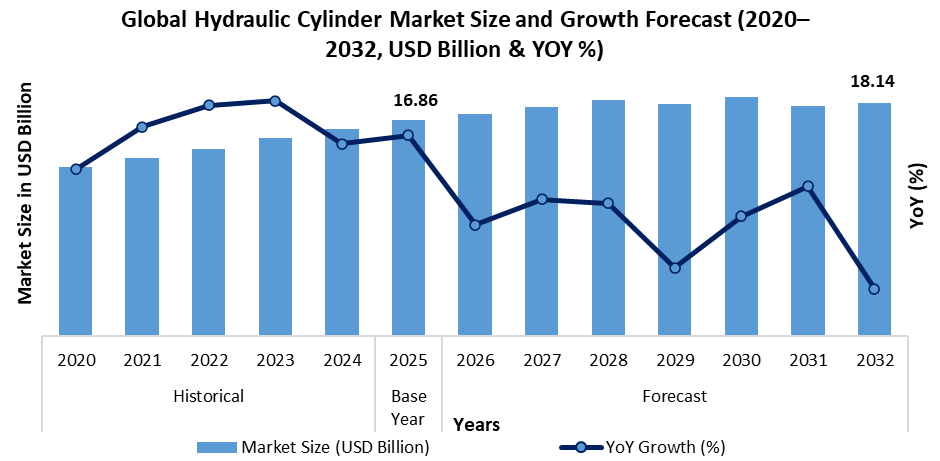
- Global Hydraulic Cylinder Market valued at USD 16.86 billion in 2025.
- Market projected to reach USD 18.14 billion by 2032.
- Forecast CAGR stands at 5.81% during 2026–2032.
- Smart hydraulic cylinders are emerging as a major technology trend.
- Demand for energy-efficient hydraulic systems is increasing across industries.
- Industrial automation and infrastructure investments continue to support market growth.
- Mobile equipment and industrial machinery remain important application areas.
- Asia-Pacific continues to benefit from expanding manufacturing and infrastructure activity.
Why This Matters Now
Automotive manufacturers, equipment suppliers, and industrial operators are facing increasing pressure to improve productivity while reducing operating costs and emissions. Hydraulic systems remain essential for heavy-duty performance, but the market is rapidly shifting toward smarter, more efficient, and digitally connected solutions.
The transition is particularly important as manufacturing facilities modernize and infrastructure investment accelerates globally. Companies that adopt advanced hydraulic technologies are improving reliability, reducing downtime, and strengthening operational competitiveness in increasingly demanding environments.
Market Overview
The Global Hydraulic Cylinder Market was valued at USD 16.86 billion in 2025 and is expected to reach nearly USD 18.14 billion by 2032, growing at a CAGR of 5.81% during the forecast period.
Hydraulic cylinders remain critical components across construction equipment, material handling systems, agricultural machinery, industrial automation platforms, and transportation equipment. Their ability to deliver high force output, durability, and operational precision continues to make them indispensable in demanding industrial applications.
The market is entering a new phase of development driven by smart hydraulic technologies. Manufacturers are increasingly integrating sensors, monitoring systems, and digital control capabilities into hydraulic cylinders to improve operational visibility and predictive maintenance performance.
For automotive and transportation stakeholders, this evolution creates opportunities to improve manufacturing efficiency, enhance equipment reliability, and optimize lifecycle costs. As industries move toward connected operations, hydraulic systems are becoming more intelligent and data-driven.
Key Trends Driving Growth
The most significant trend reshaping the market is the emergence of smart hydraulic cylinders. By integrating sensors and real-time monitoring technologies, manufacturers can track performance, identify maintenance requirements, and reduce unexpected equipment failures.
Industrial automation continues to generate strong demand. Modern production environments require precise motion control and dependable actuation systems capable of operating continuously under demanding conditions. Hydraulic cylinders remain a preferred solution in many industrial applications because of their power density and durability.
Infrastructure development is another major growth catalyst. Governments and private-sector investors continue funding transportation networks, construction projects, logistics facilities, and industrial expansion programs. These activities increase demand for construction machinery, lifting equipment, and material handling systems that depend heavily on hydraulic technologies.
Energy efficiency is becoming an increasingly important purchasing criterion. Equipment operators are seeking hydraulic solutions capable of delivering high performance while minimizing energy consumption and operating costs. Manufacturers are responding with advanced designs focused on efficiency improvements and reduced environmental impact.
Digital manufacturing initiatives are also influencing market direction. Smart factories increasingly require connected equipment capable of generating operational data. Hydraulic cylinders equipped with monitoring capabilities support predictive maintenance strategies and help improve overall equipment effectiveness.
Fleet modernization is creating additional opportunities. Transportation operators, logistics companies, and industrial fleets are replacing aging equipment with more advanced machinery designed to improve productivity, safety, and sustainability performance.
Explore detailed analysis, insights, and growth opportunities
Segment Insights
- Dominant Segment: Mobile hydraulic cylinders continue to account for a significant share of market demand due to extensive usage across construction, agricultural, transportation, and material handling equipment.
- Fastest-Growing Segment: Smart hydraulic cylinders equipped with sensors and monitoring technologies are emerging as one of the most rapidly expanding technology categories within the market.
- Construction and heavy equipment applications remain major demand generators because of ongoing infrastructure investments and urban development projects.
- Industrial machinery applications continue to expand as manufacturers adopt automated production systems requiring reliable hydraulic actuation.
- Energy-efficient hydraulic systems are gaining market traction as operators prioritize lower operating costs and improved sustainability performance.
Regional Growth Story
Asia-Pacific remains one of the most important regions for hydraulic cylinder demand, supported by industrialization, infrastructure expansion, and manufacturing growth.
China continues to play a leading role due to its extensive construction equipment industry, manufacturing base, and infrastructure development programs. Demand for advanced hydraulic technologies is increasing as equipment manufacturers focus on productivity improvements and technological upgrades.
India is emerging as an increasingly attractive growth market. Government infrastructure initiatives, expanding industrial activity, and manufacturing investments are creating new opportunities for hydraulic equipment suppliers.
Japan and South Korea continue to benefit from advanced manufacturing capabilities and strong positions in industrial machinery production. Their focus on automation and precision engineering supports demand for high-performance hydraulic solutions.
North America remains a strategically important market due to ongoing investments in industrial automation, logistics infrastructure, and heavy equipment modernization. Equipment operators increasingly prioritize reliability, efficiency, and predictive maintenance capabilities.
Europe maintains strong demand supported by advanced manufacturing, construction activity, and stringent sustainability objectives. Equipment manufacturers across Germany and other major industrial economies continue investing in hydraulic innovations that improve operational efficiency.
Competitive Landscape
Competition is increasingly shifting toward technological differentiation rather than purely mechanical performance. Manufacturers are investing in smart hydraulic solutions that combine traditional force capabilities with digital monitoring, predictive maintenance, and data analytics features.
Technology integration is becoming a major competitive advantage. Suppliers capable of offering connected hydraulic systems gain stronger relationships with equipment manufacturers seeking to modernize their product portfolios.
Investment activity across the sector signals confidence in long-term demand fundamentals. Companies continue expanding product capabilities to address growing customer requirements for efficiency, reliability, and digital connectivity.
The competitive environment also highlights increasing convergence between hydraulics and industrial automation. Manufacturers that successfully integrate hydraulic performance with digital intelligence are likely to strengthen their market positions.
As equipment operators focus on reducing lifecycle costs, suppliers offering higher reliability and predictive maintenance capabilities may achieve greater pricing power and customer retention.
Recent Developments
- Growing adoption of smart hydraulic cylinders with integrated sensing technologies.
- Rising demand for energy-efficient hydraulic systems across industrial sectors.
- Increased investment in industrial automation and connected manufacturing environments.
- Expansion of infrastructure projects supporting construction equipment demand.
- Greater focus on predictive maintenance and equipment reliability solutions.
- Ongoing development of digitally enabled hydraulic technologies designed to improve operational performance.
Strategic Implications
For OEMs, hydraulic cylinders are no longer simply mechanical components. Advanced hydraulic technologies are becoming strategic tools for improving equipment efficiency, reliability, and operational intelligence.
Tier-1 suppliers face increasing pressure to provide smarter solutions capable of supporting connected equipment ecosystems. The ability to deliver digital functionality alongside hydraulic performance is becoming an important competitive differentiator.
Investors should monitor trends related to industrial automation, infrastructure spending, smart manufacturing, and equipment modernization. These factors will continue influencing demand patterns across the hydraulic cylinder value chain.
Fleet operators and industrial users stand to benefit from improved uptime, lower maintenance costs, and enhanced operational visibility. Smart hydraulic technologies can deliver measurable productivity gains while supporting broader digital transformation objectives.
Future Outlook
The next generation of hydraulic cylinder market leaders will be those that successfully combine mechanical performance, energy efficiency, and digital intelligence, while companies relying solely on traditional product capabilities risk losing relevance in an increasingly connected industrial landscape.
Analyst Perspective
“The hydraulic cylinder industry is evolving beyond conventional mechanical applications toward intelligent, connected, and energy-efficient solutions. Smart hydraulic technologies are creating new opportunities for manufacturers, equipment suppliers, and industrial operators seeking greater productivity and operational reliability.” — Dharati Raut, Analyst
About Maximize Market Research
Maximize Market Research Pvt. Ltd. (MMR) is a global market research and consulting company that provides reliable, data-focused, and practical business insights. The firm serves a wide range of industries, including healthcare, pharmaceuticals, technology, automotive, electronics, chemicals, personal care, and consumer goods. Through market forecasts, competitive analysis, strategic consulting, and industry impact assessments, MMR helps organizations understand changing market conditions, identify growth opportunities, and make informed business decisions for long-term success.
Contact Us :
2nd Floor, Navale IT Park Phase 3
Pune Banglore Highway, Narhe
Pune, Maharashtra 411041, India
+91 9607365656
sales@maximizemarketresearch.com
