Key Highlights
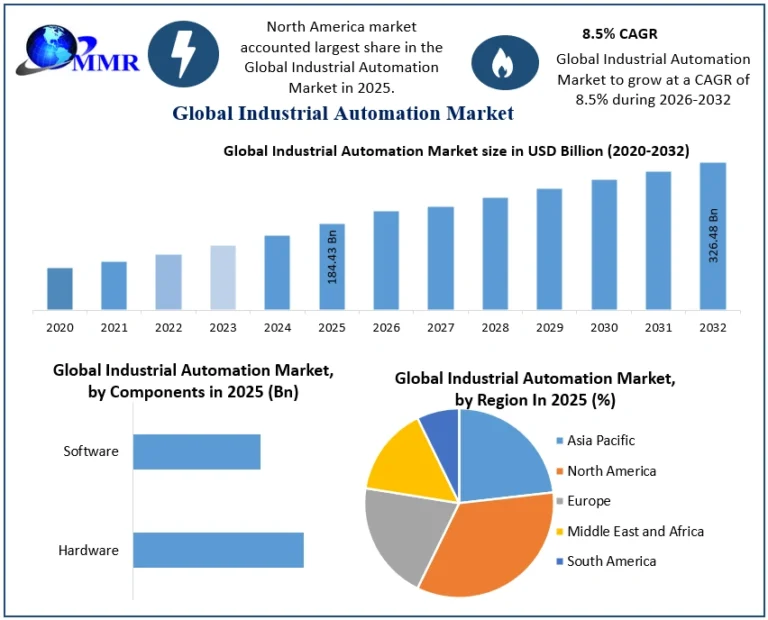
- Industrial Automation Market valued at USD 184.43 billion in 2025.
- Market expected to reach USD 326.48 billion by 2032.
- CAGR projected at 8.5% during the forecast period.
- Industry 4.0 initiatives continue accelerating factory modernization.
- EV manufacturing expansion is increasing automation investments.
- Industrial robotics and AI-powered production systems are gaining adoption.
- Digital supply chains are becoming a strategic priority.
- Asia-Pacific remains a leading manufacturing and automation hub.
Why This Matters Now
Automotive manufacturers face mounting pressure to produce more vehicles, improve quality, reduce costs, and manage increasingly complex EV production lines. Traditional manufacturing models are struggling to keep pace with rising automation requirements and supply chain complexity.
Industrial automation is no longer a productivity tool alone. It has become a strategic capability that determines manufacturing competitiveness, operational resilience, and long-term profitability. Companies investing aggressively today are positioning themselves to lead the next generation of mobility and industrial production.
Market Overview
The Industrial Automation Market was valued at USD 184.43 billion in 2025 and is expected to reach nearly USD 326.48 billion by 2032, growing at a CAGR of 8.5%.
Industrial automation encompasses robotics, programmable logic controllers, distributed control systems, industrial software, machine vision technologies, industrial IoT platforms, and AI-powered manufacturing solutions. These technologies allow manufacturers to improve productivity, increase precision, reduce operational costs, and enhance production flexibility.
The automotive industry has emerged as one of the most significant adopters of automation technologies. Vehicle production increasingly relies on automated assembly lines, robotic welding systems, intelligent inspection platforms, and connected manufacturing environments.
As global competition intensifies, manufacturers are accelerating investments in automation to maintain production efficiency and improve responsiveness to changing consumer demand.
Key Trends Driving Growth
The rapid expansion of electric vehicle manufacturing represents one of the strongest growth drivers for industrial automation providers. EV production requires highly precise assembly processes, battery manufacturing systems, and advanced quality control capabilities that rely heavily on automation technologies.
Battery manufacturing facilities are becoming increasingly automated as producers seek greater consistency and production scale. Automated systems help manufacturers manage complex battery assembly operations while reducing production errors and improving throughput.
Industry 4.0 adoption continues reshaping factory environments. Connected machinery, real-time analytics, digital twins, and predictive maintenance solutions allow manufacturers to monitor operations more effectively and reduce costly downtime.
Industrial robotics deployment is accelerating across automotive production facilities. Robots are increasingly handling welding, painting, assembly, inspection, packaging, and material handling tasks. These investments improve productivity while helping manufacturers address labor shortages.
Artificial intelligence is becoming a critical component of automation strategies. AI-powered systems can optimize production schedules, predict maintenance requirements, improve quality inspection processes, and support data-driven decision-making.
Supply chain resilience remains a major strategic priority. Manufacturers are deploying automated logistics systems, warehouse automation platforms, and digital supply chain solutions to improve visibility and mitigate disruption risks.
Semiconductor availability continues influencing production planning. Modern automated facilities rely heavily on sensors, controllers, industrial computers, and communication systems that depend on semiconductor supply stability.
Sustainability goals are also encouraging automation adoption. Automated production systems can reduce waste, improve energy efficiency, and support emissions reduction initiatives across manufacturing operations.
Explore detailed analysis, insights, and growth opportunities
Segment Insights
- Dominant Segment: Industrial robotics and factory automation solutions continue to represent the largest market share due to widespread deployment across manufacturing industries.
- Fastest-Growing Segment: Industrial IoT and AI-driven automation solutions are emerging as the fastest-growing categories as manufacturers prioritize digital transformation initiatives.
- Automotive manufacturing remains a major end-user industry because of extensive automation requirements across assembly, inspection, and quality control processes.
- Smart factory technologies continue gaining momentum as organizations seek greater operational visibility and flexibility.
- Predictive maintenance solutions are becoming increasingly important as manufacturers focus on maximizing equipment uptime.
Regional Growth Story
Asia-Pacific remains the largest and most dynamic industrial automation market. The region benefits from extensive manufacturing activity, government-backed modernization initiatives, and large-scale investments in advanced production technologies.
China continues to lead industrial automation deployment due to its position as a global manufacturing powerhouse. Significant investments in EV production, industrial robotics, and smart factory infrastructure are strengthening demand for automation solutions.
Japan remains a key center for robotics innovation and industrial manufacturing excellence. Its manufacturers continue investing in advanced automation technologies to improve productivity and address workforce challenges.
South Korea’s strong electronics and automotive industries support continued automation investment. The country’s focus on smart manufacturing and advanced technology integration creates favorable market conditions.
India is emerging as an important growth market as industrial production expands and government initiatives encourage manufacturing modernization. Investments in automotive production, industrial infrastructure, and digital manufacturing capabilities are creating new opportunities.
North America remains a major market due to strong demand from automotive, aerospace, logistics, and industrial sectors. Manufacturers are investing in automation to improve competitiveness and strengthen domestic production capabilities.
Europe continues benefiting from advanced manufacturing ecosystems, particularly in Germany. Automotive OEMs and industrial producers are deploying automation technologies to improve efficiency, sustainability, and production flexibility.
Competitive Landscape
Competition is increasingly focused on integrated automation ecosystems rather than standalone products. Manufacturers are seeking solutions that connect robotics, software, analytics, cloud platforms, and industrial networks into unified operational environments.
Technology providers continue investing in AI, machine learning, industrial IoT, and digital twin capabilities. These investments signal a shift toward intelligent automation platforms capable of delivering continuous operational optimization.
Partnerships and acquisitions are becoming more common as companies seek broader technology portfolios. The ability to provide end-to-end automation solutions strengthens competitive positioning and improves customer retention.
Pricing power increasingly depends on software capabilities, analytics functionality, and long-term service relationships rather than hardware alone. Vendors that deliver measurable operational improvements are gaining strategic advantages.
Recent Developments
- Increased investment in smart factory modernization initiatives.
- Rising deployment of industrial robotics across manufacturing operations.
- Expansion of Industrial IoT platforms and connected factory solutions.
- Greater adoption of AI-powered predictive maintenance technologies.
- Growing automation investments supporting EV and battery production.
- Continued development of digital twin and advanced analytics platforms.
Strategic Implications
For automotive OEMs, industrial automation has become a prerequisite for competitive manufacturing. The complexity of EV production, software-defined vehicles, and advanced mobility technologies requires increasingly sophisticated production systems.
Tier-1 suppliers face similar challenges. Automated manufacturing environments improve efficiency, strengthen quality control, and enable closer integration with OEM production strategies.
Investors should view industrial automation as a long-term beneficiary of electrification, digitalization, and manufacturing modernization trends. Demand drivers extend across automotive, electronics, logistics, and industrial sectors.
Governments promoting domestic manufacturing capabilities are likely to further accelerate automation investments as nations seek stronger industrial competitiveness and supply chain resilience.
Future Outlook
The manufacturers that successfully integrate robotics, artificial intelligence, industrial IoT, and smart factory capabilities into unified production ecosystems will define the future of industrial leadership, while those delaying automation investments risk losing both efficiency and market relevance.
Analyst Perspective
“Industrial automation is becoming the foundation of next-generation manufacturing. Organizations that combine robotics, AI, industrial IoT, and connected production systems will be best positioned to improve efficiency, strengthen resilience, and compete in increasingly digital industrial environments.” — Dharati Raut, Analyst
About Maximize Market Research
Maximize Market Research Pvt. Ltd. (MMR) is a global market research and consulting company that provides reliable, data-focused, and practical business insights. The firm serves a wide range of industries, including healthcare, pharmaceuticals, technology, automotive, electronics, chemicals, personal care, and consumer goods. Through market forecasts, competitive analysis, strategic consulting, and industry impact assessments, MMR helps organizations understand changing market conditions, identify growth opportunities, and make informed business decisions for long-term success.
Contact Us :
2nd Floor, Navale IT Park Phase 3
Pune Banglore Highway, Narhe
Pune, Maharashtra 411041, India
+91 9607365656
sales@maximizemarketresearch.com
