Key Highlights
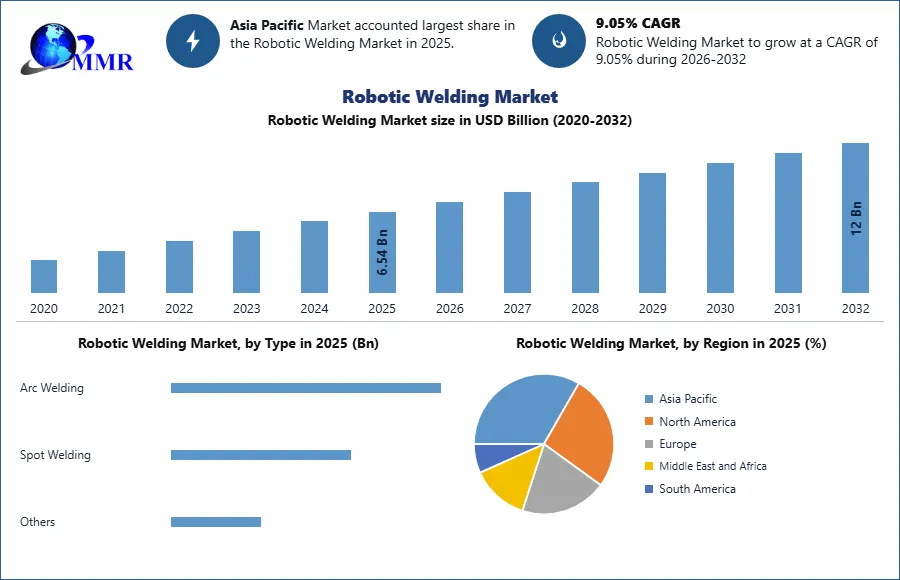
- Robotic Welding Market valued at USD 6.54 billion in 2025 and projected to reach USD 12 billion by 2032.
- Market expected to expand at a CAGR of 9.05% from 2026 to 2032.
- Asia-Pacific remains the leading regional market, supported by automotive production and industrial automation investments.
- Arc welding is the dominant technology segment across automotive, shipbuilding, construction, and heavy machinery applications.
- The 50–150 kg payload category leads adoption due to flexibility and suitability for high-volume manufacturing environments.
- AI, machine vision, IoT integration, digital twins, and predictive maintenance are transforming welding automation capabilities.
Why This Matters Now
Automotive manufacturers are facing simultaneous pressure to improve productivity, reduce labor dependency, and accelerate electric vehicle production. Suppliers that fail to automate welding operations risk losing competitiveness as OEMs demand higher precision, lower defects, and faster production cycles.
The shift is no longer limited to large-scale automotive plants. Smart welding automation is becoming a strategic manufacturing investment across transportation, heavy equipment, and industrial production ecosystems. Companies that scale robotic welding effectively are positioned to capture efficiency gains while protecting margins in increasingly competitive markets.
Market Overview
The Robotic Welding Market is entering a new growth phase as manufacturers prioritize automation, quality consistency, and operational resilience. According to Maximize Market Research, the market was valued at USD 6.54 billion in 2025 and is expected to reach USD 12 billion by 2032, expanding at a CAGR of 9.05%.
The growth story is closely tied to automotive and transportation manufacturing. Vehicle platforms are becoming more complex, quality standards are tightening, and production lines must accommodate both conventional and electric vehicle architectures. Robotic welding delivers the repeatability and precision required to meet these demands while reducing reliance on increasingly scarce skilled welding labor.
Manufacturers are also integrating robotic welding into broader Industry 4.0 initiatives. Welding cells are evolving from standalone automation assets into connected production systems capable of real-time monitoring, predictive maintenance, and adaptive process optimization.
Key Trends Driving Growth
Artificial intelligence is becoming the defining technology layer in robotic welding. AI-powered systems now support seam tracking, adaptive welding control, automated inspection, and predictive maintenance. The result is higher welding accuracy, reduced material waste, and greater production flexibility.
Collaborative robots are also gaining traction. Unlike traditional industrial robots operating in isolated cells, welding cobots can work alongside human operators, helping manufacturers manage labor shortages while maintaining production agility. This is particularly valuable in mixed-volume production environments common across automotive component manufacturing.
The electric vehicle transition is creating additional momentum. The report identifies expanding EV production as a major contributor to robotic welding demand, particularly in Asia-Pacific manufacturing hubs. EV assembly requires high precision and repeatability, making advanced welding automation increasingly essential for OEM competitiveness.
Government support for industrial modernization and smart manufacturing initiatives is accelerating adoption across both developed and emerging economies. As automation becomes a strategic industrial policy priority, robotic welding investments are moving from discretionary spending to core manufacturing infrastructure.
Download Free PDF Sample:https://www.maximizemarketresearch.com/request-sample/48238/
Segment Insights
- Dominant Type Segment: Arc Welding
- Arc welding leads the market due to widespread deployment across automotive, construction, shipbuilding, heavy machinery, and metal fabrication industries. The technology supports strong, continuous welds while improving consistency and reducing operational errors.
- Dominant Payload Segment: 50–150 kg
- The 50–150 kg payload category accounted for the largest share in 2025. Manufacturers favor this range because it balances payload strength, precision, flexibility, and operational reach for automotive and industrial welding applications.
- End-User Focus
- Automotive & Transportation remains one of the core end-user categories driving robotic welding adoption, alongside aerospace, electronics, metals, and machinery sectors.
- Fastest-Growing Segment
- The report does not specify a fastest-growing segment. Therefore, no growth-rate ranking has been published.
Regional Growth Story
Asia-Pacific dominates the global Robotic Welding Market and continues to set the pace for automation investments. The region benefits from extensive automotive manufacturing activity, industrial expansion, and rising deployment of industrial robots.
China remains the largest market within the region. Large-scale manufacturing expansion and smart factory initiatives continue to increase demand for welding automation. For automotive producers, robotic welding has become a critical enabler of production scale and quality consistency.
Japan and South Korea maintain leadership through technology innovation and strong robotics ecosystems. The presence of global automation leaders such as FANUC, Yaskawa, Kawasaki Robotics, and Panasonic creates a competitive environment focused on continuous advancement in robotic welding capabilities.
India is emerging as an important growth market as manufacturers modernize facilities and expand industrial automation adoption. Rising labor costs and increasing focus on manufacturing efficiency are strengthening the business case for robotic welding investments.
Europe and North America remain strategically important due to advanced automotive manufacturing bases and increasing demand for smart factory technologies. Germany, in particular, remains a key market because of its concentration of automotive and industrial manufacturing activity.
Competitive Landscape
Competition is increasingly centered on software intelligence rather than hardware alone. Manufacturers are differentiating through AI integration, machine vision capabilities, predictive maintenance features, and smart factory connectivity.
The market includes global automation leaders such as ABB Ltd., FANUC Corporation, KUKA AG, Yaskawa Electric Corporation, Kawasaki Heavy Industries, Ltd., Panasonic Corporation, and Comau S.p.A..
For OEMs and Tier-1 suppliers, this competitive landscape means greater access to intelligent automation solutions that can improve quality, reduce downtime, and enhance manufacturing flexibility. Vendors capable of integrating robotics with broader digital manufacturing platforms are likely to gain pricing power and long-term customer relationships.
Recent Developments
- March 2025: Kawasaki Heavy Industries expanded its portfolio with AI-enabled arc welding robots featuring real-time seam tracking, adaptive motion control, and intelligent parameter optimization.
- February 2025: Nachi-Fujikoshi launched AI-powered welding robots with machine vision, autonomous path correction, predictive maintenance, and smart monitoring capabilities.
- Both developments signal a broader industry shift toward autonomous welding operations that reduce dependence on manual programming and improve production reliability.
Strategic Implications
The automotive industry’s transition toward digital manufacturing is increasing the strategic importance of robotic welding. Production efficiency is no longer the only objective. Manufacturers now seek real-time visibility, predictive maintenance, and adaptive process control.
For OEMs, welding automation supports faster vehicle production, better quality assurance, and more scalable EV manufacturing. For suppliers, robotic welding creates opportunities to secure long-term contracts by meeting increasingly stringent production standards. For investors, the market offers exposure to both industrial automation growth and automotive modernization trends.
The report identifies labor shortages, rising quality expectations, and government-backed industrial modernization programs as structural drivers likely to sustain demand throughout the forecast period.
Future Outlook
Robotic welding is moving from a manufacturing efficiency tool to a strategic competitive capability. Companies that combine AI-enabled automation, smart factory integration, and scalable production flexibility will define the next generation of automotive manufacturing leaders, while slower adopters risk falling behind on cost, quality, and production performance.
Analyst Perspective
“Robotic welding is becoming a core enabler of industrial competitiveness as manufacturers pursue automation, precision, and smart factory transformation. The convergence of AI, machine vision, and Industry 4.0 technologies is accelerating adoption across automotive and transportation manufacturing, creating long-term opportunities for technology providers and industrial operators alike.” — Dharati Raut
About Maximize Market Research
Maximize Market Research Pvt. Ltd. (MMR) is a global market research and consulting company that provides reliable, data-focused, and practical business insights. The firm serves a wide range of industries, including healthcare, pharmaceuticals, technology, automotive, electronics, chemicals, personal care, and consumer goods. Through market forecasts, competitive analysis, strategic consulting, and industry impact assessments, MMR helps organizations understand changing market conditions, identify growth opportunities, and make informed business decisions for long-term success.
Contact Us:
2nd Floor, Navale IT Park Phase 3
Pune Banglore Highway, Narhe
Pune, Maharashtra 411041, India
+91 9607365656
sales@maximizemarketresearch.com
