Key Highlights
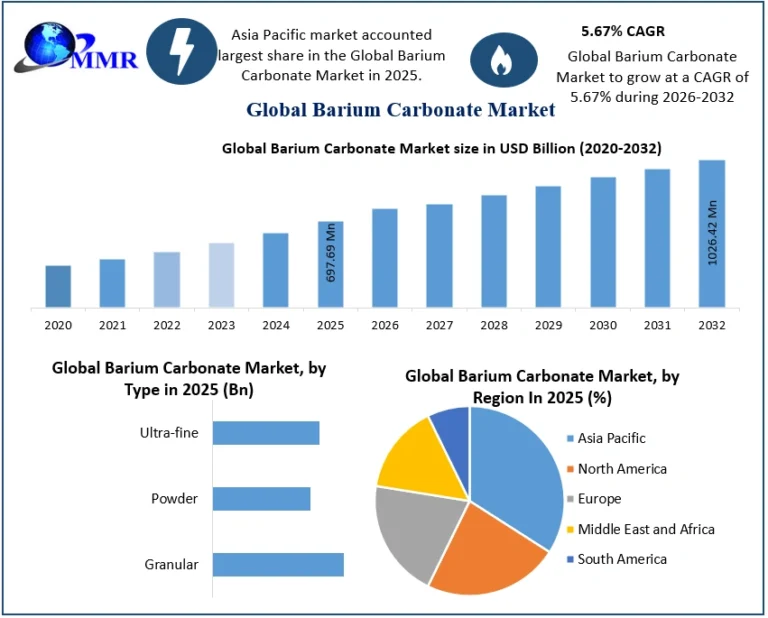
- Market valued at USD 697.69 million in 2025.
- Expected to reach USD 1026.42 million by 2032.
- Forecast CAGR stands at 5.67% from 2026 to 2032.
- Ceramic tiles remain the fastest-growing application segment.
- Glass, brick, and clay applications continue to represent major consumption centers.
- Asia-Pacific remains the industry’s largest production and consumption hub.
- Electronics and electro-ceramic applications are creating new demand opportunities.
- Infrastructure spending and urbanization continue to strengthen downstream consumption.
Why This Matters Now
Chemical producers are facing a rare combination of rising construction activity and accelerating electronics demand. For barium carbonate manufacturers, that translates into expanding opportunities across both traditional building materials and advanced industrial applications.
The shift is important because growth is no longer dependent on a single end market. Demand from ceramic tiles, electro-ceramics, specialty glass, and construction materials is diversifying revenue streams and improving market resilience. Companies positioned across multiple downstream industries are likely to gain stronger pricing leverage and capacity utilization over the coming decade.
Market Overview
The Barium Carbonate Market was valued at USD 697.69 million in 2025 and is projected to reach nearly USD 1026.42 million by 2032, growing at a CAGR of 5.67%.
Barium carbonate remains a critical industrial chemical used to improve glass refractive properties, enhance product durability, and prevent efflorescence in bricks and tiles. Its role in ceramic manufacturing has become increasingly important as construction activity expands across emerging economies.
The market’s growth story is closely linked to infrastructure investment. Governments worldwide continue to increase spending on transportation, housing, and industrial development projects. Every new residential complex, commercial building, or industrial facility creates demand for ceramic tiles, bricks, specialty glass, and related materials that depend on barium carbonate during production.
At the same time, electronics manufacturing is opening a second growth avenue. Electro-ceramic components increasingly require barium carbonate as a key raw material, creating demand that extends beyond construction cycles.
Key Trends Driving Growth
The strongest trend is the expansion of construction activity in developing economies. Rising urbanization, population growth, and higher disposable incomes are supporting residential and commercial building projects, directly increasing consumption of ceramic tiles and construction materials.
Another major trend is the growing use of barium carbonate in electro-ceramic materials. Manufacturers of multilayer ceramic capacitors, thermistors, piezoelectric transducers, sensors, dynamic RAM components, MEMS devices, and optical modulators continue to require high-performance ceramic materials. This shifts part of the market toward higher-value applications.
The market is also experiencing changing demand patterns within the glass sector. While specialty glass applications remain important, declining production of CRT television glass is reducing demand from a historically significant application segment. This transition is accelerating the industry’s move toward advanced ceramics and electronics-related uses.
For manufacturers, the implication is clear: future growth will increasingly depend on specialty and performance-driven applications rather than legacy glass demand.
Explore the latest market dynamics—grab your free sample and uncover key insights today
Segment Insights
- Dominant Application Segment: Glass, brick, and clay applications remain among the largest end-use sectors, supported by broad construction demand.
- Fastest-Growing Application Segment: Ceramic tiles are the fastest-growing application segment due to increasing urbanization, infrastructure development, and rising adoption of ceramic flooring and wall solutions.
- Type Segments: The market is segmented into Granular, Powder, and Ultra-fine grades, serving varying industrial processing requirements.
- Electro-Ceramics Opportunity: Demand from semiconductor and electronics manufacturing is increasing consumption in advanced ceramic applications, creating higher-value growth opportunities.
The rapid growth of ceramic tiles carries strategic significance. Unlike cyclical industrial sectors, tile demand is supported by both new construction and renovation activity, providing a more stable consumption base for suppliers.
Regional Growth Story
Asia-Pacific continues to lead the global market and remains the industry’s most important manufacturing and consumption center.
China and India benefit from extensive construction activity, growing urban populations, and expanding industrial production. Their large-scale ceramic tile manufacturing industries create sustained demand for barium carbonate across multiple downstream sectors.
Japan and South Korea contribute through advanced electronics manufacturing, where electro-ceramic applications require high-quality raw materials. This strengthens the region’s position not only as a volume leader but also as a center for higher-value consumption.
In Europe, Germany remains an important industrial market due to its strong manufacturing base and specialty materials demand. Environmental regulations and efficiency requirements continue to encourage investment in higher-performance industrial materials.
The United States maintains steady demand from construction and industrial manufacturing sectors. Infrastructure modernization initiatives provide additional support for downstream markets such as bricks, tiles, and specialty glass.
The regional picture highlights a broader trend: emerging economies drive volume growth, while developed markets increasingly influence product quality standards and specialty application demand.
Competitive Landscape
The market features a mix of global chemical companies and specialized regional producers.
Key participants include Solvay, Sakai Chemical Industry Co., Ltd., Shaanxi Ankang Jianghua Group Co., Ltd., Chemical Products Corporation, Hebei Xinji Chemical Group Co., Ltd., Hubei Jingshan Chutiam Barium Salt Corporation Limited, Guizhou Red Star Development Co., Ltd., Honeywell International, Hengyang Wanfeng Chemical, American Elements, IBC Limited, Maruti Chemicals Company, Rahul Barium Chemicals, and Chaitanya Chemicals.
Competition increasingly centers on supply reliability, product consistency, and access to growing downstream industries. Producers capable of serving both traditional construction applications and advanced electronics markets are positioned to capture a larger share of future demand.
The presence of regional specialists also indicates that proximity to ceramic manufacturing clusters remains an important competitive advantage. Lower logistics costs and closer customer relationships can improve margins in a market where industrial buyers prioritize dependable supply.
Recent Developments
- Rising government investment in infrastructure is expanding downstream demand for tiles, bricks, and construction materials.
- Electronics manufacturers are increasing the use of electro-ceramic materials containing barium carbonate.
- Ceramic tile production continues to accelerate in developing economies.
- Market participants are focusing on applications with stronger long-term demand profiles as CRT-related consumption declines.
- Growing industrialization across Asia-Pacific is strengthening regional production and consumption networks.
Strategic Implications
The market is entering a transition phase. Traditional construction-related demand remains the largest growth engine, but electronics and electro-ceramic applications are becoming increasingly important.
For producers, this creates a dual opportunity. Volume growth comes from construction materials, while margin expansion is likely to emerge from advanced ceramic and electronics applications.
Procurement leaders should monitor shifts in demand from semiconductor and electro-ceramic industries, as these sectors could influence future supply allocation and pricing dynamics. Manufacturers with diversified customer portfolios are likely to be better positioned against fluctuations in individual end markets.
Future Outlook
The Barium Carbonate Market is evolving from a construction-driven commodity segment into a more diversified industrial materials market. Infrastructure spending, ceramic tile demand, and advanced electronics applications will remain the primary growth catalysts through 2032. Companies that secure positions in both high-volume construction materials and high-value electro-ceramic applications will be best positioned to capture the next phase of industry growth.
Analyst Perspective
“The growing convergence of infrastructure development and electronics manufacturing is reshaping demand patterns across the Barium Carbonate Market. Companies that align production capabilities with both ceramic construction materials and advanced electro-ceramic applications are likely to achieve the strongest competitive positioning over the forecast period.” — Ankita Kagawade, Analyst
About Maximize Market Research
Maximize Market Research Pvt. Ltd. (MMR) is a global market research and consulting company that provides reliable, data-focused, and practical business insights. The firm serves a wide range of industries, including healthcare, pharmaceuticals, technology, automotive, electronics, chemicals, personal care, and consumer goods. Through market forecasts, competitive analysis, strategic consulting, and industry impact assessments, MMR helps organizations understand changing market conditions, identify growth opportunities, and make informed business decisions for long-term success.
Contact Us
2nd Floor, Navale IT Park Phase 3
Pune Banglore Highway, Narhe
Pune, Maharashtra 411041, India
+91 9607365656
sales@maximizemarketresearch.com
