Key Highlights
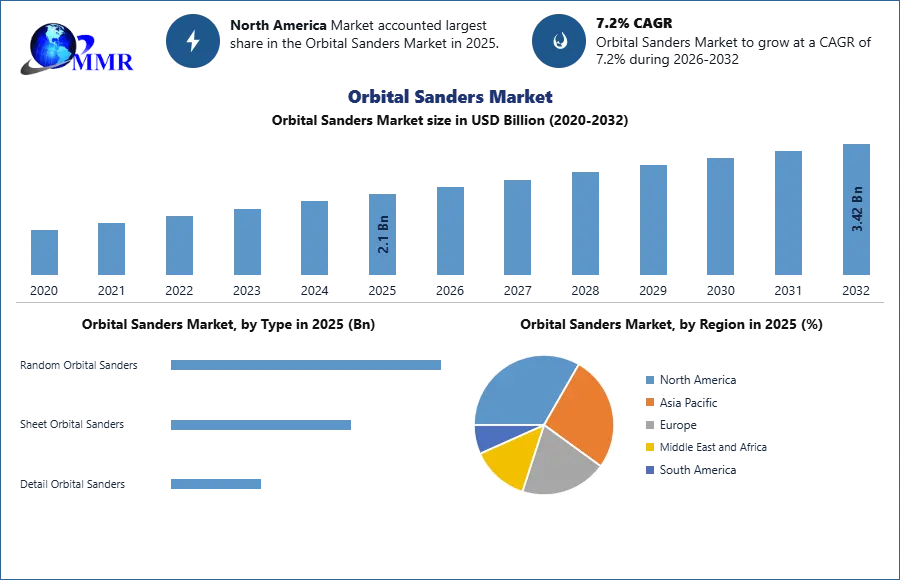
- Orbital Sanders Market was valued at USD 2.1 billion in 2025 and is expected to reach USD 3.42 billion by 2032 at a CAGR of 7.2%.
- Demand is expanding across woodworking, furniture manufacturing, automotive refinishing, construction, and metalworking applications.
- Product innovation is increasingly focused on cordless systems, dust management, ergonomics, and productivity gains.
- Automotive repair and refinishing activities continue to support professional-grade tool demand.
- Competition is intensifying among global tool manufacturers through technology differentiation and distribution expansion.
Why This Matters Now
Manufacturers face growing pressure to improve productivity while controlling labor costs and maintaining finish quality. Surface preparation has become a critical step across automotive, furniture, construction, and industrial production environments.
The orbital sanders market sits at the intersection of these trends. Every efficiency gain achieved through faster sanding, reduced rework, and improved operator comfort directly impacts production economics. As industrial operators modernize equipment fleets, suppliers capable of delivering performance, durability, and workflow integration stand to capture market share.
Market Overview
The global Orbital Sanders Market was valued at USD 2.1 billion in 2025 and is projected to reach USD 3.42 billion by 2032, growing at a CAGR of 7.2% during the forecast period.
Orbital sanders remain essential tools for surface finishing applications across wood, metal, plastics, ceramics, glass, paints, fillers, and automotive coatings. Their ability to deliver smooth finishes while accessing corners and edges continues to make them a preferred solution in professional and industrial environments.
The market’s growth trajectory signals more than rising tool sales. It indicates sustained investment in manufacturing efficiency, construction activity, furniture production, and vehicle refinishing operations. Companies that depend on consistent surface quality increasingly view advanced sanding systems as productivity assets rather than simple workshop equipment.
Key Trends Driving Growth
Industrial users are prioritizing throughput and finish consistency. This is encouraging adoption of higher-performance orbital sanding platforms that reduce operator fatigue and improve production speed.
A major shift is occurring toward cordless solutions. Battery technology improvements are enabling professional users to move beyond corded constraints while maintaining power output. This transition is creating new opportunities for manufacturers with strong battery ecosystems and platform-based product strategies.
Automotive refinishing remains a significant growth catalyst. As vehicle ownership expands and aging fleets require repair and restoration work, body shops continue investing in precision sanding equipment capable of delivering paint-ready finishes.
The rise of DIY renovation and home improvement activities is also broadening the customer base. Manufacturers are increasingly balancing professional-grade performance with consumer-friendly usability, creating a wider addressable market.
Dust extraction and workplace safety are becoming competitive differentiators. End users increasingly evaluate tools based on cleanliness, health compliance, and operator comfort, pushing suppliers toward integrated dust-management systems and ergonomic designs.
Explore detailed analysis, insights, and growth opportunities
Segment Insights
- Dominant Product Segment: Random Orbital Sanders are widely positioned as the leading product category due to their versatility, finish quality, and broad adoption across woodworking, furniture manufacturing, and automotive applications.
- Fastest-Growing Technology Trend: Cordless and battery-powered orbital sanders are emerging as the fastest-growing category as users prioritize mobility, flexibility, and compatibility with broader cordless tool ecosystems.
- Key Application Segment: Automotive refinishing continues to represent a high-value application area where finish quality directly influences repair outcomes and customer satisfaction.
- Industrial Demand Driver: Furniture manufacturing and woodworking remain foundational demand centers due to the extensive use of orbital sanding in finishing processes.
- End-User Opportunity: Commercial and professional users are expected to remain major purchasers because tool reliability and productivity directly affect operating margins.
Regional Growth Story
Asia-Pacific continues to benefit from large-scale manufacturing activity, construction growth, and expanding industrial production ecosystems. China remains a critical production and consumption hub for sanding equipment and related power tools.
North America remains a major market due to established woodworking, automotive, and construction industries. Professional contractors and industrial users continue upgrading to advanced tool platforms that improve productivity and workplace safety.
Europe’s focus on industrial efficiency, sustainability, and workplace standards supports demand for premium sanding technologies and dust-management solutions. Manufacturers operating in these markets increasingly compete on performance, energy efficiency, and ergonomic innovation.
India, Japan, South Korea, and other manufacturing centers are benefiting from industrial modernization and growing demand for professional-grade equipment. As manufacturing output rises, investments in finishing tools and process optimization are expected to strengthen.
Competitive Landscape
Competition is concentrated among established global power-tool manufacturers including Robert Bosch GmbH, Stanley Black & Decker, Makita Corporation, 3M Company, Ingersoll Rand, Festool GmbH, Dynabrade, Milwaukee Tool, DeWalt, and other major brands.
The competitive battle is increasingly centered on platform strategy rather than standalone products. Companies with integrated battery systems can drive customer retention across multiple tool categories while reducing switching behavior.
Technology leadership is becoming a key differentiator. Features such as advanced dust extraction, brushless motors, vibration reduction, and longer runtime capabilities allow suppliers to command premium pricing.
Distribution strength also matters. Manufacturers that secure contractor networks, industrial distributors, and digital sales channels can accelerate adoption while defending market share against lower-cost entrants.
Recent Developments
- Expansion of cordless orbital sanding platforms to address professional mobility requirements.
- Increased focus on battery compatibility across broader tool ecosystems.
- Growing integration of dust-management technologies to improve workplace safety and productivity.
- Product innovation emphasizing ergonomics, runtime, and finishing precision.
- Intensifying competition among global brands through technology differentiation and channel expansion.
Strategic Implications
Unlike automotive supply chains, the orbital sanders market is not directly shaped by EV adoption, autonomous driving technologies, semiconductor shortages, fleet electrification, charging infrastructure investments, or powertrain transitions. These factors were not identified within the source report and therefore cannot be considered material drivers for this market.
Instead, strategic advantage will come from manufacturing efficiency, product innovation, cordless platform expansion, and professional user engagement.
Suppliers that successfully integrate battery ecosystems, improve operator productivity, and strengthen aftermarket relationships will gain pricing power. Those relying primarily on commodity positioning may face margin pressure as competition intensifies.
Future Outlook
The next phase of growth will be defined by cordless adoption, industrial productivity demands, and premium feature differentiation. Companies that convert sanding equipment into connected, high-efficiency workflow solutions will lead the market, while those competing solely on price risk losing relevance.
Analyst Perspective
“The Orbital Sanders Market is entering a phase where productivity, mobility, and finishing precision are becoming the primary purchasing criteria. Manufacturers that align innovation with professional workflow requirements will be best positioned to capture future growth opportunities.” — Dharati Raut
About Maximize Market Research
Maximize Market Research Pvt. Ltd. (MMR) is a global market research and consulting company that provides reliable, data-focused, and practical business insights. The firm serves a wide range of industries, including healthcare, pharmaceuticals, technology, automotive, electronics, chemicals, personal care, and consumer goods. Through market forecasts, competitive analysis, strategic consulting, and industry impact assessments, MMR helps organizations understand changing market conditions, identify growth opportunities, and make informed business decisions for long-term success.
Contact Us :
2nd Floor, Navale IT Park Phase 3
Pune Banglore Highway, Narhe
Pune, Maharashtra 411041, India
+91 9607365656
sales@maximizemarketresearch.com
