Key Highlights
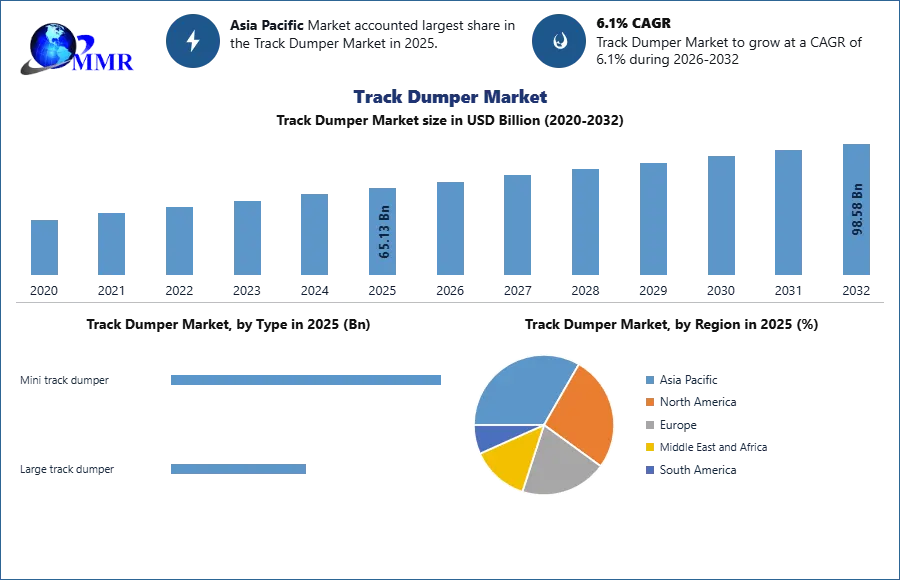
- Global Track Dumper Market is projected to reach USD 98.58 billion by 2032 from USD 65.13 billion in 2025, growing at a 6.1% CAGR.
- Mini-track dumpers remain the dominant product category.
- Construction & mining is the leading application segment.
- Infrastructure investments across China, India, and the United States continue to expand equipment demand.
- Electrification is emerging as a strategic focus through new electric dumper platforms.
- Mining modernization and open-cast mining projects are creating fresh procurement opportunities.
- Alternative fuel adoption and emissions compliance are influencing fleet replacement cycles.
Why This Matters Now
Construction companies, mining operators, equipment manufacturers, and investors are entering a period where capacity decisions made today will determine market position through the next decade. Infrastructure projects are expanding globally while regulators continue tightening emissions requirements.
Demand is no longer driven solely by construction volume. Buyers increasingly evaluate fuel efficiency, operating costs, automation readiness, and sustainability targets. That shift is creating opportunities for manufacturers capable of combining productivity with lower lifecycle costs.
Market Overview
The Track Dumper Market is expected to grow from USD 65.13 billion in 2025 to USD 98.58 billion by 2032, registering a CAGR of 6.1%.
Track dumpers, also known as crawler carriers, have become essential equipment for construction sites, mining projects, railway maintenance, oil and gas operations, and remote industrial applications. Their ability to operate on challenging terrain provides a clear advantage where conventional wheeled equipment faces mobility constraints.
The market’s expansion is closely linked to rising public infrastructure investments, industrial development projects, and modernization of material handling operations. Governments and private developers are committing capital to transportation corridors, ports, mining assets, and urban infrastructure, creating sustained demand for heavy-duty equipment fleets.
For manufacturers, the opportunity extends beyond equipment sales. Service contracts, maintenance programs, fleet upgrades, and technology integration are becoming increasingly important revenue streams.
Key Trends Driving Growth
A major catalyst is the expected expansion of global construction activity. Large-scale infrastructure programs across China, India, and the United States are increasing demand for specialized equipment capable of operating in difficult environments.
Railway maintenance projects, embankment development, landscaping activities, and ground maintenance applications are also supporting adoption. Track dumpers provide maneuverability and terrain access that conventional transport vehicles often cannot match.
Mining remains another significant growth engine. Heavy equipment procurement by major mining operators signals increasing capital expenditure across extraction industries. As mining companies expand open-cast operations and modernize fleets, demand for high-capacity material transportation equipment continues to rise.
Environmental applications are emerging as an additional opportunity. Waste management authorities increasingly require equipment capable of safely transporting hazardous and industrial waste. This trend broadens the market beyond traditional construction and mining customers.
Electrification is beginning to influence product development strategies. The introduction of large electric dumper platforms demonstrates that battery-powered solutions are becoming technically viable in heavy-duty applications. Manufacturers view electrification as both a compliance strategy and a competitive differentiator as fuel costs and emissions regulations intensify.
Download a Sample Report with Detailed Industry Analysis and Forecast Data
Segment Insights
- Dominant Segment – Mini-Track Dumpers
- Mini-track dumpers account for the largest share of market volume.
- Their popularity stems from versatility, compact design, and suitability for construction, landscaping, and maintenance applications.
- Continued product development is supporting long-term demand.
- Leading Application Segment – Construction & Mining
- Construction and mining account for more than 40% of market revenue.
- Rapid urbanization, industrialization, and infrastructure development continue to generate demand for material transportation equipment.
- Large-scale investment in transportation infrastructure is expected to sustain procurement activity.
- Electrification Opportunity
- Electric dumper development is creating a new technology category within the market.
- Fleet operators are evaluating electric alternatives to reduce fuel consumption, maintenance costs, and emissions exposure.
Regional Growth Story
North America
North America is positioned for significant growth due to rising automation adoption and sustained construction activity. Demand spans both large industrial projects and smaller commercial applications.
Equipment buyers increasingly focus on productivity improvements and operating-cost reduction. Alternative fuel adoption is also gaining attention as operators seek protection from fuel-price volatility.
Asia-Pacific
Asia-Pacific remains one of the most attractive growth regions. Massive infrastructure programs, urban expansion, and mining investments continue to create demand for heavy equipment.
India represents a particularly important opportunity. Mining modernization efforts and procurement of heavy-duty equipment are expanding fleet requirements. The transition toward larger-scale open-cast mining operations could generate sustained demand for track dumpers and related machinery.
Europe
European demand is increasingly shaped by sustainability objectives and emissions compliance requirements. Manufacturers operating in the region are likely to accelerate investments in fuel-efficient and low-emission equipment platforms.
Emerging Markets
Developing economies across Latin America, the Middle East, and Africa continue to invest in transportation infrastructure, industrial projects, and resource extraction activities. These markets present long-term expansion opportunities for global equipment suppliers.
Competitive Landscape
Competition is shifting from pure equipment capability toward lifecycle value creation. Manufacturers are increasingly competing on efficiency, durability, operating costs, and environmental performance.
The emergence of electric dumper technology signals an important strategic shift. Companies investing early in electrification are positioning themselves for future regulatory requirements and customer sustainability goals.
Capacity expansion strategies increasingly align with infrastructure growth corridors and mining investment hotspots. Manufacturers that can secure supply chains, maintain production flexibility, and support customers through aftermarket services are likely to strengthen market share.
The competitive environment also favors companies capable of integrating automation, fleet monitoring, and operational efficiency tools into equipment offerings. These capabilities create differentiation beyond hardware specifications.
Recent Developments
- Introduction of a large-scale electric dumper equipped with a 600 kWh battery system.
- Growing investment in infrastructure projects across major economies.
- Expansion of mining equipment procurement programs.
- Rising focus on alternative fuel solutions for heavy-duty applications.
- Increasing adoption of track dumpers in environmental and waste-management operations.
Strategic Implications
For OEMs, the priority is clear: develop equipment platforms that deliver productivity while meeting stricter environmental expectations. Electrification initiatives today could determine competitive positioning tomorrow.
For suppliers, demand growth creates opportunities in batteries, components, tracks, materials, and aftermarket services. Supply-chain resilience will become increasingly important as equipment volumes rise.
For fleet operators, replacement decisions are becoming more strategic. Fuel efficiency, maintenance requirements, emissions compliance, and long-term operating economics are now central purchasing criteria.
For investors, the market offers exposure to infrastructure spending, mining expansion, industrial modernization, and emerging heavy-equipment electrification trends.
Future Outlook
The Track Dumper Market is moving beyond traditional construction demand toward a broader ecosystem driven by infrastructure investment, mining modernization, sustainability targets, and equipment innovation. Companies that combine electrification readiness, operational efficiency, and strong aftermarket support will define the next phase of industry leadership, while slower adopters risk losing relevance in an increasingly technology-driven market.
Analyst Perspective
“The Track Dumper Market is entering a period where infrastructure investment, mining expansion, and equipment electrification are converging. Manufacturers that align product innovation with efficiency, sustainability, and customer productivity requirements will be best positioned to capture long-term growth opportunities.” — Tejaswini Kakade, Analyst
About Maximize Market Research
Maximize Market Research Pvt. Ltd. (MMR) is a global market research and consulting company that provides reliable, data-focused, and practical business insights. The firm serves a wide range of industries, including healthcare, pharmaceuticals, technology, automotive, electronics, chemicals, personal care, and consumer goods. Through market forecasts, competitive analysis, strategic consulting, and industry impact assessments, MMR helps organizations understand changing market conditions, identify growth opportunities, and make informed business decisions for long-term success.
Contact Us
2nd Floor, Navale IT Park Phase 3
Pune Banglore Highway, Narhe
Pune, Maharashtra 411041, India
+91 9607365656
sales@maximizemarketresearch.com
