Key Highlights
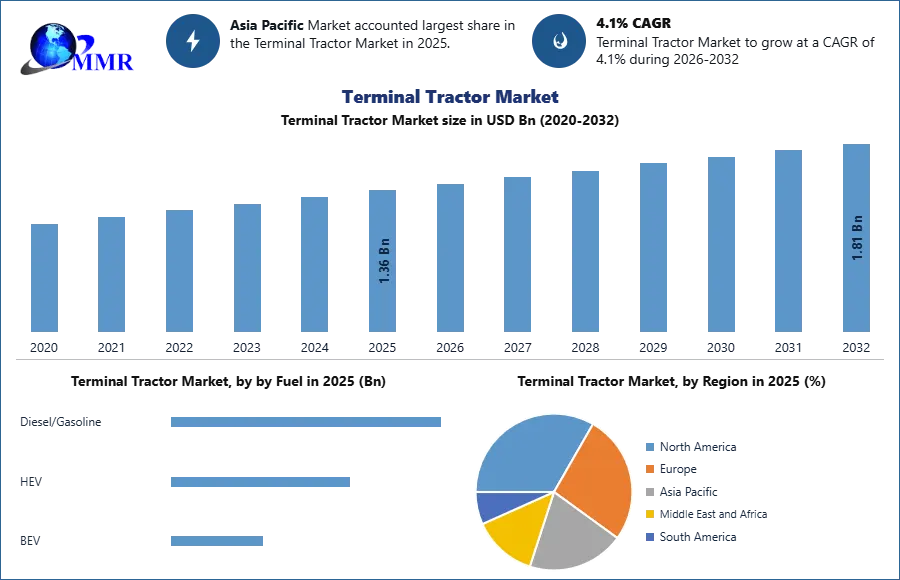
- Global Terminal Tractor Market valued at USD 1.36 billion in 2025 and projected to reach USD 1.81 billion by 2032, growing at a CAGR of 4.1%.
- Diesel/Gasoline segment remains the dominant fuel category.
- Off-road terminal tractors are expected to record significant growth.
- North America holds the largest market position by value and volume.
- Asia-Pacific is projected to be the fastest-growing regional market.
- Port activity expansion, logistics modernization, and industrial cargo movement continue to drive demand.
- OEMs are increasing investments in next-generation terminal tractors designed for efficiency, maneuverability, and lower operating costs.
Why This Matters Now
Port operators, fleet owners, and logistics companies face mounting pressure to move cargo faster while controlling operating costs. Global trade volumes continue to increase, placing greater demands on ports, distribution centers, and industrial logistics hubs.
Terminal tractors have become a critical productivity asset in this transition. Their ability to improve trailer movement, reduce turnaround times, and support high-volume cargo operations is turning them from specialized equipment into strategic infrastructure. Companies that modernize fleets and adopt advanced terminal operations are likely to gain measurable advantages in efficiency, utilization, and operating margins.
Market Overview
The Terminal Tractor Market was valued at USD 1.36 billion in 2025 and is expected to reach USD 1.81 billion by 2032, expanding at a CAGR of 4.1%.
Terminal tractors occupy a unique position within logistics ecosystems. Unlike conventional road trucks, they are designed specifically for short-distance trailer movement in ports, logistics parks, manufacturing facilities, and industrial sites. Their elevated fifth-wheel design, superior visibility, maneuverability, and optimized driveline architecture allow operators to move cargo more efficiently within confined environments.
What has changed is the scale of cargo movement requirements. Ports are handling increasing container volumes, warehouses are processing larger freight flows, and industrial facilities are seeking faster internal transportation solutions. These operational demands are driving renewed investment in terminal tractor fleets.
The result is a market increasingly linked to broader trends in global trade, supply chain resilience, and logistics infrastructure expansion.
Key Trends Driving Growth
The most important growth driver remains rising cargo throughput across seaports. Terminal tractors are essential for loading, unloading, positioning, and transporting containers within terminal environments. As shipping volumes grow, operators require more efficient yard management systems.
A second trend is the expansion of logistics and warehousing networks. Distribution centers increasingly depend on terminal tractors to move trailers rapidly between loading docks, storage yards, and staging areas. Faster movement translates directly into higher throughput and lower operational bottlenecks.
Manufacturing facilities are also emerging as an important demand center. Industrial operators are adopting terminal tractors to improve material flow and reduce transportation delays within large production complexes.
Electrification is beginning to influence long-term procurement strategies. While diesel-powered models continue to dominate because of established infrastructure and operational familiarity, equipment manufacturers are expanding development efforts around electric terminal tractors. Fleet operators evaluating sustainability targets are increasingly monitoring these alternatives.
Automation and smart-terminal initiatives are creating another opportunity. As ports and logistics hubs invest in digital operations, terminal tractors capable of integrating with advanced fleet-management systems become increasingly valuable.
Request a Sample Copy to Evaluate Market Growth Potential and Key Trends
Segment Insights
- Dominant Segment: Diesel/Gasoline
- Diesel/Gasoline terminal tractors continue to dominate the market.
- Strong power delivery, cost efficiency, and limited electric charging infrastructure at smaller terminals support continued adoption.
- Operators prioritize proven performance and fleet compatibility.
- Fastest-Growing Segment: Off-Road Terminal Tractors
- Off-road terminal tractors are expected to witness significant growth during the forecast period.
- Increasing deployment in warehouses, logistics centers, and industrial facilities is expanding demand.
- Enhanced productivity and operational efficiency make them attractive for high-volume cargo environments.
Regional Growth Story
North America remains the largest regional market in both value and volume terms. The region benefits from established logistics networks, advanced port infrastructure, and the presence of major terminal tractor manufacturers. Continuous product development activity among leading OEMs is reinforcing market leadership.
The region’s advantage extends beyond production capacity. Operators are actively pursuing efficiency gains, making terminal tractors an important component of broader logistics modernization efforts.
Asia-Pacific presents the strongest growth opportunity. Expanding seaport activity, rising trade volumes, and increasing infrastructure investments in countries such as India and China are creating substantial demand for cargo-handling equipment.
The region’s industrialization trajectory also supports adoption. As manufacturing output and logistics requirements increase, terminal tractors are becoming essential tools for freight movement across ports, logistics parks, and industrial facilities.
For global manufacturers, Asia-Pacific represents both a demand center and a strategic growth platform for future market expansion.
Competitive Landscape
Competition increasingly centers on operational efficiency, fleet productivity, and geographic reach.
Major participants including Kalmar, Mol CY NV, and Capacity Trucks continue to strengthen their market positions through contracts, agreements, and strategic expansion initiatives. Among these players, Kalmar maintains a particularly strong competitive position due to its presence across major global markets.
The strategic significance of recent contract wins extends beyond immediate revenue generation. Fleet supply agreements strengthen customer relationships, create long-term service opportunities, and reinforce brand visibility within critical logistics hubs.
Competitive advantage is increasingly linked to product innovation. Manufacturers that can deliver improved maneuverability, lower operating costs, enhanced durability, and future-ready technology integration are likely to capture a larger share of fleet replacement cycles.
As terminal operators seek higher productivity and lower total ownership costs, equipment differentiation will become more important than scale alone.
Recent Developments
- Kalmar secured an order for two T2 terminal tractors from HeavyMovement in Spain.
- Kalmar won a contract to supply six T2 terminal tractors to Gulftainer Lebanon.
- In February 2026, Kalmar introduced the TT7 terminal tractor series for the European market.
- The TT7 platform features a heavy-duty galvanized steel frame and reinforced axles designed for demanding operational environments.
- Manufacturers continue investing in specialized terminal tractor designs tailored for terminal operations and cargo-handling efficiency.
Strategic Implications
The market’s trajectory points toward a broader transformation in cargo movement infrastructure.
For OEMs, investment priorities increasingly include electrification readiness, durability enhancements, and smart-terminal compatibility. Companies that align product development with automation and sustainability requirements may secure stronger positioning in future procurement cycles.
For fleet operators, the focus remains on maximizing equipment utilization while reducing operational costs. Faster turnaround times and improved maneuverability directly influence productivity metrics.
For investors, terminal tractors offer exposure to several long-term growth themes, including global trade expansion, logistics infrastructure development, supply chain modernization, and industrial automation.
For regulators and port authorities, fleet modernization supports broader objectives related to operational efficiency and environmental performance.
Future Outlook
The next phase of growth will be shaped by the convergence of port modernization, logistics expansion, fleet electrification, and automation. Demand fundamentals remain tied to cargo movement, but competitive leadership will increasingly depend on technology integration and operational efficiency.
The companies that combine productivity, sustainability, and next-generation fleet capabilities will define the future of the terminal tractor market, while slower adopters risk losing relevance in an increasingly connected logistics ecosystem.
Analyst Perspective
“Terminal tractors are moving beyond their traditional role as specialized yard vehicles and becoming strategic assets within modern logistics operations. Growth will be driven by expanding port activity, industrial freight movement, and the industry’s pursuit of greater operational efficiency. Manufacturers that invest in advanced fleet solutions and future-ready technologies will be best positioned to capture emerging opportunities.” — Tejaswini Kakade
About Maximize Market Research
Maximize Market Research Pvt. Ltd. (MMR) is a global market research and consulting company that provides reliable, data-focused, and practical business insights. The firm serves a wide range of industries, including healthcare, pharmaceuticals, technology, automotive, electronics, chemicals, personal care, and consumer goods. Through market forecasts, competitive analysis, strategic consulting, and industry impact assessments, MMR helps organizations understand changing market conditions, identify growth opportunities, and make informed business decisions for long-term success.
Contact Us
2nd Floor, Navale IT Park Phase 3
Pune Banglore Highway, Narhe
Pune, Maharashtra 411041, India
+91 9607365656
sales@maximizemarketresearch.com
