Key Highlights
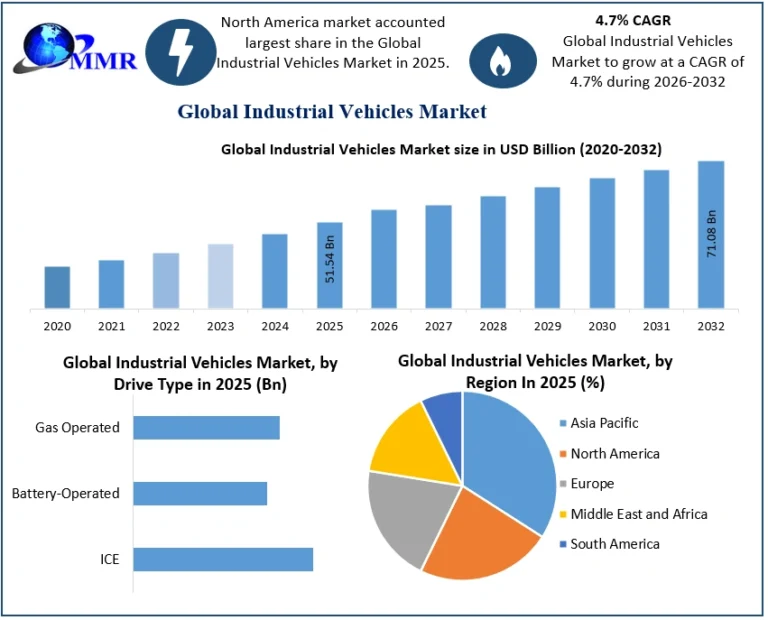
- Global Industrial Vehicles Market valued at USD 51.54 billion in 2025.
- Market projected to reach nearly USD 71.08 billion by 2032.
- CAGR estimated at 4.7% during 2025–2032.
- Warehouse automation continues to accelerate fleet modernization.
- Electrification is gaining traction across material handling operations.
- Logistics expansion and e-commerce growth are increasing equipment demand.
- Smart manufacturing initiatives are driving adoption of connected industrial vehicles.
Why This Matters Now
Industrial vehicle manufacturers are facing a decisive shift. Customers no longer purchase equipment solely for lifting and transport; they are investing in productivity platforms that integrate automation, electrification, connectivity, and operational analytics.
For OEMs, suppliers, fleet operators, and investors, the next phase of competition will be determined by how effectively companies align with warehouse automation, labor shortages, sustainability mandates, and supply chain resilience. Market participants that move early can secure long-term positioning in rapidly modernizing industrial ecosystems.
Market Overview
The Industrial Vehicles Market was valued at USD 51.54 billion in 2025 and is expected to reach nearly USD 71.08 billion by 2032, expanding at a CAGR of 4.7%.
Industrial vehicles play a critical role across manufacturing facilities, warehouses, logistics centers, ports, and distribution hubs. Their primary function is to move materials, products, and industrial equipment efficiently while reducing manual handling requirements and improving operational productivity.
The market is entering a new growth phase as manufacturers and logistics operators pursue automation, higher throughput, and lower operating costs. Industrial vehicles have evolved from standalone equipment into strategic assets that support digital supply chains and intelligent warehouse operations.
As supply chains become more complex, businesses are increasing investments in advanced fleets capable of supporting faster inventory movement, greater accuracy, and improved workplace safety.
Key Trends Driving Growth
Warehouse automation is emerging as one of the strongest demand catalysts. Companies are redesigning fulfillment centers and manufacturing facilities to accommodate higher volumes while minimizing labor dependency. This shift is increasing demand for technologically advanced industrial vehicles capable of operating within automated environments.
Electrification is becoming a central industry theme. Battery-powered industrial vehicles are gaining attention as operators seek lower emissions, reduced maintenance requirements, and compliance with tightening sustainability targets. The transition mirrors broader transportation-sector electrification trends while delivering operational cost advantages.
The rise of e-commerce continues to transform logistics infrastructure. Distribution centers require faster and more flexible material handling capabilities, encouraging investments in modern industrial fleets that improve efficiency and warehouse utilization.
Digitalization is also reshaping vehicle functionality. Fleet management systems, telematics, predictive maintenance solutions, and connected vehicle platforms are enabling operators to optimize asset utilization while reducing downtime.
Meanwhile, manufacturing modernization programs across major industrial economies are creating sustained demand for industrial vehicles. Smart factory initiatives increasingly rely on automated material movement solutions that integrate seamlessly with production workflows.
Access Sample Research Covering Industry Trends, Demand, and Growth Outlook
Segment Insights
- Dominant Segment: Industrial Application
- The industrial application segment leads the market due to extensive deployment across manufacturing facilities, warehouses, assembly operations, and plant logistics.
- Industrial operators continue to invest in productivity-enhancing equipment as automation adoption expands across production environments.
- Fastest-Growing Segment: Cargo Application
- Cargo operations represent the fastest-growing opportunity.
- Growth is supported by increasing global trade activity, expanding logistics infrastructure, and rising cargo volumes handled through ports, airports, and freight terminals.
- Drive Type Dynamics
- Battery-powered industrial vehicles are gaining market attention as companies pursue sustainability objectives and operational efficiency improvements.
- Electrified fleets are increasingly viewed as long-term strategic investments rather than compliance-driven purchases.
- Vehicle Innovation
- Equipment manufacturers are introducing smarter and more automated vehicle platforms capable of supporting advanced warehouse layouts and digital logistics environments.
Regional Growth Story
Asia-Pacific remains a major force in industrial vehicle demand due to its large manufacturing base, expanding logistics infrastructure, and ongoing industrialization.
China continues to benefit from large-scale manufacturing activity, warehouse expansion, and investments in logistics modernization. Industrial vehicle demand is closely tied to the country’s role as a global production and export center.
Japan and South Korea maintain strong positions through advanced manufacturing ecosystems and technology adoption. Industrial operators in these markets increasingly prioritize automation and productivity-enhancing solutions.
India is emerging as an important growth market as industrial expansion, infrastructure development, warehousing investments, and supply chain modernization accelerate. Government-backed manufacturing initiatives and logistics improvements are creating favorable conditions for industrial vehicle adoption.
North America remains a key market supported by warehouse automation investments, e-commerce growth, and fleet modernization programs. Distribution centers continue to deploy advanced equipment to improve operational efficiency and address labor constraints.
Europe’s growth trajectory is increasingly influenced by sustainability regulations, automation investments, and industrial productivity initiatives. Manufacturers are focusing on cleaner technologies and electrified fleets while upgrading material handling infrastructure.
Competitive Landscape
Competition is shifting beyond equipment specifications toward integrated operational solutions.
Industrial vehicle manufacturers are increasingly competing through automation capabilities, software integration, connectivity features, and lifecycle service offerings. Equipment performance remains important, but customers are placing greater emphasis on total cost of ownership and operational efficiency.
OEMs are strengthening their positions through investments in electric vehicle platforms, smart fleet technologies, and automated material handling solutions. These strategies indicate a broader transition from equipment manufacturing toward comprehensive productivity ecosystems.
Tier-1 suppliers are also adapting by expanding capabilities in batteries, power electronics, sensors, connectivity solutions, and fleet management technologies. The result is a more technology-intensive competitive environment where software and data increasingly influence purchasing decisions.
Supply chain resilience has become another differentiator. Manufacturers capable of managing component availability, production continuity, and delivery reliability are positioned to gain market share as customers prioritize dependable supply partners.
Recent Developments
- Growing investments in warehouse automation technologies.
- Increasing adoption of battery-powered industrial vehicles.
- Expansion of smart manufacturing and Industry 4.0 initiatives.
- Rising deployment of connected fleet management systems.
- Continued modernization of logistics and distribution infrastructure.
- Greater focus on operational efficiency and sustainability-driven fleet upgrades.
Strategic Implications
The industrial vehicle sector is moving toward a convergence of automation, electrification, and digital intelligence.
OEMs that invest in connected platforms and electrified portfolios can strengthen customer retention through software-enabled services and lifecycle management offerings. This creates opportunities for recurring revenue streams beyond equipment sales.
Fleet operators benefit from improved productivity, lower maintenance costs, and greater operational visibility. Investors gain exposure to long-term themes including automation, logistics modernization, and industrial digitalization.
Supply chain participants that secure access to critical components, battery technologies, and advanced electronics will be better positioned to navigate future market disruptions and maintain pricing power.
Future Outlook
Industrial vehicles are becoming central infrastructure assets within modern supply chains, and the companies that combine automation, electrification, connectivity, and operational intelligence most effectively will define the next generation of industry leaders.
Analyst Perspective
“Industrial vehicles are transitioning from conventional material-handling equipment to intelligent productivity assets. The strongest opportunities will emerge where automation, electrification, and digital logistics converge, enabling operators to achieve higher efficiency, sustainability, and supply chain resilience,” said Tejaswini Kakade, Analyst.
About Maximize Market Research
Maximize Market Research Pvt. Ltd. (MMR) is a global market research and consulting company that provides reliable, data-focused, and practical business insights. The firm serves a wide range of industries, including healthcare, pharmaceuticals, technology, automotive, electronics, chemicals, personal care, and consumer goods. Through market forecasts, competitive analysis, strategic consulting, and industry impact assessments, MMR helps organizations understand changing market conditions, identify growth opportunities, and make informed business decisions for long-term success.
Contact Us
2nd Floor, Navale IT Park Phase 3
Pune Banglore Highway, Narhe
Pune, Maharashtra 411041, India
+91 9607365656
sales@maximizemarketresearch.com
