Logistics Market: The New Battleground for Global Commerce
Every online order, factory shipment, and cross-border transaction now depends on logistics performance. Companies that control data-rich logistics networks are increasingly controlling customer experience, inventory efficiency, and supply-chain resilience.
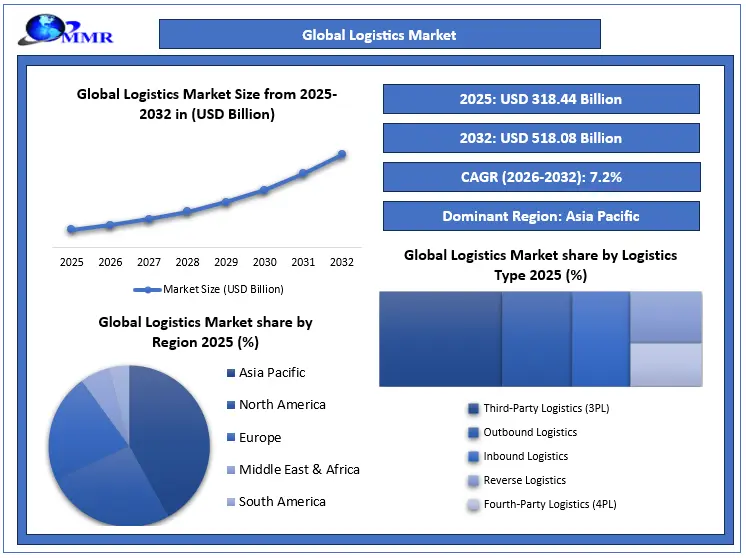
The Logistics Market is no longer defined by trucks, warehouses, and freight routes alone. Artificial intelligence, warehouse robotics, IoT-enabled tracking, digital documentation, and smart multimodal transport systems are reshaping how goods move through the global economy. According to Maximize Market Research, the global logistics market is expected to grow from USD 318.44 billion in 2025 to USD 518.08 billion by 2032, expanding at a CAGR of 7.2%. That growth signals a structural shift toward technology-enabled logistics ecosystems rather than simple transportation services.
Key Highlights
- Global logistics market projected to reach USD 518.08 billion by 2032 from USD 318.44 billion in 2025.
- Market expected to grow at a CAGR of 7.2% between 2026 and 2032.
- Global e-commerce sales increased from USD 4.98 trillion in 2021 to USD 6.86 trillion in 2025. This is expanding demand for last-mile and cross-border logistics services.
- Asia Pacific leads the market with more than 1.8 billion e-commerce parcels handled annually. This strengthens the region’s role as the world’s logistics growth engine.
- 53% of OECD logistics firms have adopted warehouse robotics. This improves throughput and operational efficiency.
- 48% of advanced-economy logistics firms use IoT-based tracking systems. This increases shipment visibility and predictive planning capabilities.
- 67% of cross-border operators utilize digital documentation. This reduces friction in international trade flows.
Why This Matters Now
Supply chains are being redesigned after years of disruption, geopolitical uncertainty, labor shortages, and rising customer expectations. Businesses are shifting from cost-focused logistics models to resilience-focused networks.
At the same time, e-commerce growth continues to increase shipment volumes while compressing delivery windows. Faster delivery expectations are forcing logistics providers to invest in automation, regional fulfillment hubs, predictive analytics, and intelligent route optimization. The result is a market where technology investment increasingly determines competitive advantage.
Market Overview
The logistics industry sits at the center of global trade modernization. Growth is being driven by expanding e-commerce activity, increasing cross-border commerce, automation adoption, and digital supply-chain transformation. AI-powered planning tools, warehouse robotics, and IoT-enabled tracking systems are helping operators improve efficiency while managing rising shipment volumes.
The industry’s role is also expanding. Logistics providers are moving beyond transportation services into integrated supply-chain orchestration. Businesses increasingly expect real-time visibility, predictive inventory management, and seamless multimodal transport coordination.
This evolution is transforming logistics from an operational support function into a strategic business capability.
Key Trends Driving Growth
The strongest growth driver remains e-commerce. Global online sales growth has significantly increased demand for fulfillment centers, parcel handling infrastructure, and last-mile delivery networks. Logistics providers capable of delivering speed and visibility are capturing disproportionate market share.
Automation is reshaping warehouse economics. More than half of OECD logistics firms have implemented robotics technologies, allowing facilities to process high shipment volumes with improved accuracy and lower operational costs. Automation also helps operators address labor shortages while increasing throughput.
Digital logistics is becoming mainstream. IoT-enabled tracking systems, predictive analytics platforms, and digital documentation solutions are improving transparency across supply chains. Companies gain better visibility into inventory movement, shipment status, and delivery performance.
Urban logistics is another major growth area. Average urban delivery times have improved from 2.36 days in 2022 to 2.15 days in 2023 through investments in micro-fulfillment centers and regional distribution hubs. Faster fulfillment directly improves customer retention and service quality.
Get a free sample report now:https://www.maximizemarketresearch.com/request-sample/94795/
Segment Insights
- Dominant Segment: The report identifies Asia Pacific as the dominant regional segment, supported by large-scale e-commerce activity and parcel volumes across China, India, and Southeast Asia. The region’s logistics scale provides a foundation for continued investment in digital infrastructure and automated fulfillment.
- Fastest-Growing Segment: The report highlights rapid growth in digital logistics capabilities, including IoT tracking, AI-driven supply-chain management, digital documentation, and smart multimodal transportation solutions. These technologies are becoming central to competitive differentiation across logistics networks.
- E-commerce logistics continues to expand as online retail volumes increase globally. This creates sustained demand for warehousing, parcel handling, and last-mile delivery infrastructure.
- Warehouse automation adoption is accelerating as operators seek productivity improvements and greater operational resilience.
Regional Growth Story
Asia Pacific remains the industry’s growth center. The region handles more than 1.8 billion e-commerce parcels annually, supported by strong digital commerce adoption across China, India, and Southeast Asia. Scale advantages are encouraging continued investments in fulfillment infrastructure and logistics technology.
China remains a major logistics powerhouse, processing over 900 million parcels annually. The country’s parcel volume leadership reinforces its position as a key driver of global logistics innovation and infrastructure development.
The United States continues to benefit from high parcel volumes and advanced logistics technology adoption. Germany’s logistics activity highlights the importance of European manufacturing and cross-border freight networks. Together, these markets remain central to global supply-chain modernization.
Competitive Landscape
Competition is increasingly shifting from transportation capacity to technology capability. Logistics providers investing in AI-enabled route optimization, predictive analytics, warehouse automation, and digital documentation are creating stronger competitive moats.
The growing use of IoT tracking and digital supply-chain platforms signals an industry transition toward data-driven logistics management. Companies that can provide end-to-end visibility, predictive decision-making, and resilient network design are likely to strengthen pricing power and customer retention.
Automation investments also indicate a broader competitive realignment. As robotics adoption expands, operational efficiency becomes a key differentiator. Logistics companies with highly automated fulfillment networks can improve service quality while reducing cost pressures.
Recent Developments
- Adoption of warehouse robotics reached 53% among OECD logistics firms.
- IoT tracking usage expanded to 48% among advanced-economy logistics operators.
- Digital documentation adoption reached 67% among cross-border logistics providers.
- Urban delivery times improved through deployment of micro-fulfillment centers and regional hubs.
- AI-driven supply-chain management solutions are becoming increasingly integrated into logistics operations.
Strategic Implications
Executives must view logistics as a strategic growth platform rather than a cost center. Supply-chain visibility, fulfillment speed, and operational resilience are increasingly linked to revenue performance and customer loyalty.
Investors should monitor automation adoption, digital logistics deployment, and regional infrastructure expansion as leading indicators of future competitiveness. Organizations that scale these capabilities can improve efficiency while strengthening resilience against supply-chain disruptions.
For manufacturers, retailers, and e-commerce companies, logistics partnerships will increasingly determine market responsiveness and customer experience outcomes.
Future Outlook
The next phase of logistics competition will be defined by intelligence rather than infrastructure. AI-driven planning, automated fulfillment, IoT-enabled visibility, and digitally integrated transport networks will become baseline requirements across global supply chains.
Companies that build predictive, data-centric logistics ecosystems will shape the future of global commerce, while operators that remain dependent on traditional freight models risk losing relevance in an increasingly automated and digital marketplace.
Analyst Perspective
“Logistics is rapidly evolving into a technology-led ecosystem where automation, AI-driven decision-making, and digital visibility are becoming as important as transportation capacity itself. Organizations investing early in intelligent logistics infrastructure will be best positioned to capture the next wave of global trade growth.” — Tejaswini Kakade
About Maximize Market Research
Maximize Market Research Pvt. Ltd. (MMR) is a global market research and consulting company that provides reliable, data-focused, and practical business insights. The firm serves a wide range of industries, including healthcare, pharmaceuticals, technology, automotive, electronics, chemicals, personal care, and consumer goods. Through market forecasts, competitive analysis, strategic consulting, and industry impact assessments, MMR helps organizations understand changing market conditions, identify growth opportunities, and make informed business decisions for long-term success.
Contact Us:
2nd Floor, Navale IT Park Phase 3
Pune Banglore Highway, Narhe
Pune, Maharashtra 411041, India
+91 9607365656
sales@maximizemarketresearch.com
