Key Highlights
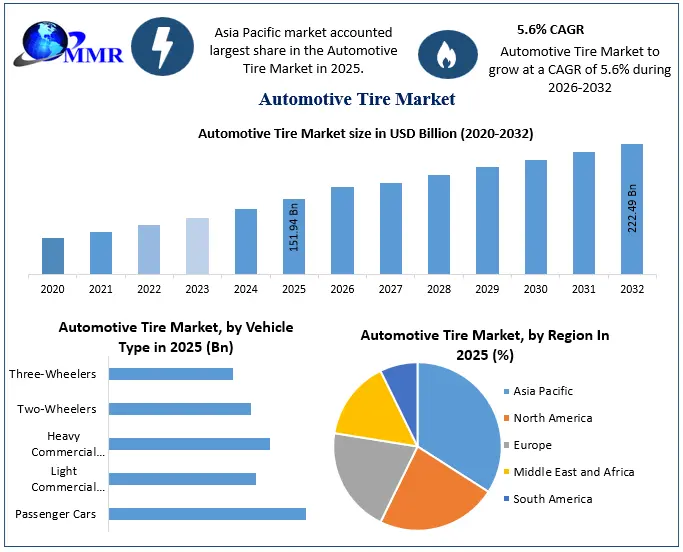
- Asia-Pacific remains the leading automotive tire market.
- Passenger vehicles represent the largest vehicle segment.
- Radial tires continue to dominate global demand.
- The aftermarket channel remains a major revenue contributor due to recurring replacement cycles.
- Electric vehicle adoption is creating demand for specialized low-rolling-resistance and high-durability tires.
- Smart tire technologies incorporating sensors and real-time monitoring are gaining industry attention.
- Fleet operators are increasingly prioritizing durability, predictive maintenance, and total cost of ownership.
- Tire manufacturers are investing in sustainable materials, advanced manufacturing, and premium product portfolios.
Why This Matters Now
The automotive tire industry is entering a new competitive phase. Electrification is changing vehicle weight profiles, torque delivery characteristics, and noise requirements. Connected vehicles and fleet digitization are creating demand for data-enabled tire solutions.
At the same time, replacement demand remains resilient across passenger and commercial vehicle segments. This combination of recurring aftermarket revenue and emerging technology opportunities is altering investment priorities throughout the mobility value chain.
Manufacturers that successfully align products with EV performance requirements, fleet operating economics, and sustainability targets are positioned to gain market share as transportation systems evolve.
Market Overview
According to the Maximize Market Research Automotive Tire Market report, the industry continues to benefit from global vehicle production, expanding vehicle ownership, and sustained replacement demand.
The market serves both original equipment manufacturers (OEMs) and the aftermarket ecosystem. While OEM demand follows vehicle production trends, replacement demand provides recurring revenue opportunities that help stabilize industry performance during economic cycles.
Radial tire technology remains the dominant product category due to its durability, fuel efficiency, ride comfort, and operational performance. Passenger vehicles account for the largest share of tire demand, supported by growing mobility requirements across developed and emerging economies.
The market is also being influenced by the rapid rise of electric mobility. EV manufacturers require tires engineered to withstand higher vehicle weights, deliver improved energy efficiency, and manage instant torque loads. These requirements are accelerating product innovation across the industry.
Key Trends Driving Growth
Electrification represents one of the most significant structural shifts affecting tire manufacturers. EV-specific tires increasingly require specialized compounds, enhanced durability, reduced rolling resistance, and improved acoustic performance. This transition is creating opportunities for manufacturers with advanced research and development capabilities.
Smart tire technology is emerging as another important growth area. Integrated sensors that monitor pressure, temperature, tread wear, and road conditions can support predictive maintenance and improve vehicle safety. For fleet operators, these capabilities can reduce downtime and operating costs.
Fleet electrification is also changing purchasing behavior. Commercial fleet managers are focusing on lifecycle economics rather than upfront acquisition costs. Tire performance, durability, retreadability, and data-driven maintenance capabilities are becoming more important procurement criteria.
Sustainability objectives are influencing manufacturing strategies. Tire companies are increasing investments in recycled materials, bio-based inputs, and energy-efficient production processes to meet environmental targets and customer expectations.
The expansion of e-commerce and logistics networks is generating additional demand for commercial vehicle tires. Growing freight activity increases replacement cycles and creates opportunities for premium tire offerings designed for intensive usage environments.
Get a free sample:https://www.maximizemarketresearch.com/request-sample/11879/
Segment Insights
- Dominant Segment: Passenger Vehicles
Passenger vehicles continue to account for the largest share of tire demand. Rising vehicle ownership, urbanization, and growing mobility requirements support sustained consumption across both OEM and replacement channels. - Dominant Tire Category: Radial Tires
Radial tires remain the preferred choice due to superior fuel efficiency, durability, ride quality, and safety performance. Their widespread adoption across passenger and commercial vehicles reinforces market leadership. - Dominant Distribution Channel: Aftermarket
Replacement demand remains a major revenue driver. Every vehicle on the road eventually requires tire replacement, creating recurring business opportunities independent of new vehicle sales cycles. - Fastest-Growing Opportunity: EV-Specific Tires
The accelerating adoption of electric vehicles is creating demand for specialized tire solutions optimized for battery efficiency, higher vehicle weights, and torque-intensive operating conditions. - Emerging Growth Area: Smart Tires
Sensor-enabled tires capable of transmitting real-time performance data are attracting interest from OEMs, connected vehicle developers, and commercial fleet operators.
Regional Growth Story
Asia-Pacific remains the center of gravity for the automotive tire industry. The region benefits from large-scale vehicle production, growing consumer markets, expanding transportation infrastructure, and strong manufacturing ecosystems.
China continues to lead global automotive manufacturing and EV adoption, creating substantial demand for advanced tire technologies. The country’s scale provides manufacturers with opportunities to commercialize innovative products at high volumes.
India is emerging as an increasingly important market due to rising vehicle ownership, expanding road infrastructure, and growing domestic manufacturing capabilities. Replacement demand and commercial vehicle activity continue to support industry expansion.
Japan and South Korea maintain strategic importance through advanced automotive engineering, premium vehicle production, and technology-driven innovation.
In Germany, regulatory pressure on emissions and strong EV investments are accelerating demand for energy-efficient tire solutions. Premium vehicle manufacturers increasingly require advanced tire technologies aligned with electrification and connected mobility strategies.
The United States remains a major market due to its large vehicle fleet, strong replacement demand, and growing interest in connected vehicle technologies.
Competitive Landscape
Competition is shifting beyond traditional manufacturing scale. Tire companies are increasingly competing on technology leadership, sustainability credentials, digital capabilities, and OEM partnerships.
Investments in EV-specific products signal an industry-wide effort to secure future supply agreements with vehicle manufacturers transitioning toward electrified platforms. Companies that establish strong relationships with leading EV producers may gain long-term advantages in OEM channels.
The growing focus on smart tires indicates a broader move toward software-enabled mobility solutions. Tire manufacturers are positioning themselves not only as component suppliers but also as providers of operational intelligence and predictive maintenance services.
Capacity expansion initiatives signal confidence in long-term demand growth, particularly across Asia-Pacific manufacturing hubs. At the same time, investments in sustainable materials aim to strengthen supply chain resilience and satisfy increasingly stringent environmental expectations.
Recent Developments
- Expansion of EV-focused tire development programs.
- Increased investment in smart tire and sensor-enabled technologies.
- Manufacturing modernization initiatives targeting efficiency and sustainability.
- Growing emphasis on premium replacement tire portfolios.
- Enhanced focus on fleet-oriented products and predictive maintenance solutions.
- Continued investments in advanced materials and low-rolling-resistance technologies.
Strategic Implications
For OEMs, tire selection is becoming increasingly linked to vehicle efficiency, range performance, and customer experience. Tire suppliers capable of delivering differentiated solutions can strengthen their strategic position within vehicle development programs.
For fleet operators, connected tire technologies offer opportunities to reduce maintenance costs and improve asset utilization. Data-driven tire management is likely to become a larger component of fleet optimization strategies.
For investors, the industry’s future growth opportunities increasingly reside in electrification, digitalization, premiumization, and sustainable manufacturing rather than traditional volume expansion alone.
For regulators, tire efficiency and sustainability will remain important elements of broader transportation decarbonization efforts.
Future Outlook
The next generation of market leaders will be defined by their ability to combine EV-ready products, smart tire intelligence, sustainable manufacturing, and strong OEM partnerships into scalable competitive advantages.
Analyst Perspective
“The Automotive Tire Market is entering a phase where innovation, electrification readiness, and advanced mobility requirements will increasingly determine competitive success. Manufacturers that align product development with changing vehicle architectures and customer expectations are expected to capture the greatest long-term value.” — Tejaswini Kakade
About Maximize Market Research
Maximize Market Research Pvt. Ltd. (MMR) is a global market research and consulting company that provides reliable, data-focused, and practical business insights. The firm serves a wide range of industries, including healthcare, pharmaceuticals, technology, automotive, electronics, chemicals, personal care, and consumer goods. Through market forecasts, competitive analysis, strategic consulting, and industry impact assessments, MMR helps organizations understand changing market conditions, identify growth opportunities, and make informed business decisions for long-term success.
2nd Floor, Navale IT Park Phase 3
Pune Banglore Highway, Narhe
Pune, Maharashtra 411041, India
+91 9607365656
sales@maximizemarketresearch.com
