Key Highlights
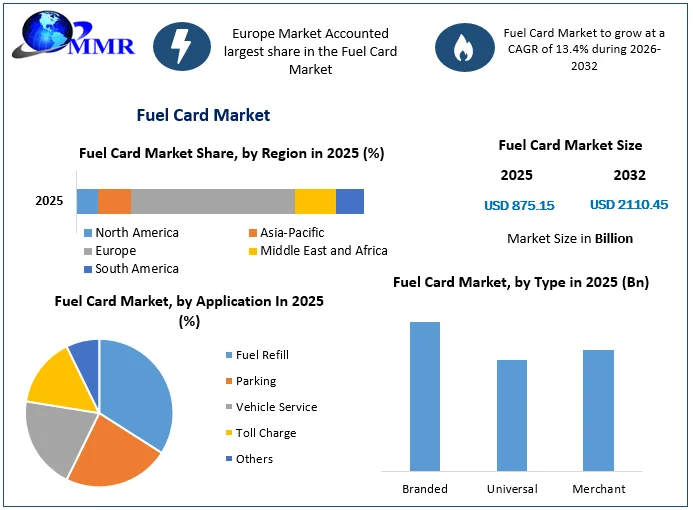
- Fuel Card Market valued at USD 875.15 billion in 2025.
- Market projected to reach nearly USD 2110.45 billion by 2032.
- Expected CAGR of 13.4% during 2026–2032.
- Fleet management expansion remains the primary growth catalyst.
- Digital payment adoption is reshaping fuel transaction ecosystems.
- Fuel cards are increasingly supporting electricity and alternative fuel purchases.
- Cost control and fraud prevention remain core customer priorities.
- Transportation, logistics, leasing, and mobility-on-demand sectors continue driving adoption.
Why This Matters Now
Fleet operators are facing mounting pressure to reduce operating costs while managing increasingly complex vehicle networks. Fuel price volatility, digital compliance requirements, and expanding mobility services are forcing transportation companies to rethink how fuel and energy expenses are managed.
For fleet managers, investors, and mobility strategists, fuel cards have evolved from a payment tool into a data-driven operational platform. The transition is creating new competitive dynamics across transportation, logistics, fleet technology, and payment ecosystems.
Market Overview
The Fuel Card Market is entering a new phase of expansion as transportation companies seek greater visibility into fuel spending and vehicle operating costs. According to Maximize Market Research, the market was valued at USD 875.15 billion in 2025 and is expected to grow to nearly USD 2110.45 billion by 2032, registering a CAGR of 13.4%.
Fuel cards provide businesses with a controlled payment mechanism for fuel purchases while enabling spending oversight, expense tracking, and transaction monitoring. Their role has expanded significantly as fleet operators move away from manual reimbursement processes and cash-based transactions.
The market’s growth is closely tied to rising transportation activity, urbanization, and the rapid adoption of digital payment infrastructure. Businesses increasingly require centralized platforms capable of managing fuel costs across large vehicle fleets while reducing administrative complexity.
What changed is the scale of fleet operations. E-commerce expansion, private leasing growth, and mobility-on-demand services have increased the number of commercial vehicles requiring continuous monitoring and cost management. Fuel cards have become a practical response to this operational challenge.
Key Trends Driving Growth
Fleet management remains the strongest demand driver across the market. As commercial fleets expand, organizations require tools that can monitor fuel usage, establish spending controls, and improve operational efficiency.
The fuel retail sector is also undergoing structural transformation. Fuel stations increasingly offer diversified energy solutions alongside traditional fuels. As a result, fuel card providers are adapting their platforms to support electricity and alternative fuel transactions while delivering enhanced digital experiences.
Digitalization is accelerating adoption. Organizations are seeking real-time visibility into fuel spending patterns, automated expense reporting, and improved financial controls. Fuel cards address these requirements while reducing exposure to unauthorized purchases and fraud.
Fuel price volatility has become another major catalyst. Fluctuating energy costs are making budgeting more difficult for transportation-intensive businesses. Fuel cards provide detailed transaction tracking and centralized oversight, enabling companies to manage fuel expenditure more effectively.
The broader mobility ecosystem is also changing. Mobility-on-demand operators, leasing companies, logistics providers, and transportation firms are all increasing their reliance on fleet management technologies that integrate payment, analytics, and operational reporting.
Request a Free Sample Report for Strategic Business and Investment Planning
Segment Insights
- Dominant Segment: Fleet and commercial vehicle applications continue to represent the primary demand center as businesses seek stronger control over transportation expenses and operational efficiency.
- Fastest-Growing Segment: Digital and multi-energy fuel card solutions supporting evolving fueling requirements, including alternative energy purchases, are gaining momentum as mobility ecosystems diversify.
- Fuel cards are increasingly being used beyond fuel purchases, supporting toll payments, vehicle-related expenses, and other operational costs.
- Demand remains strongest among organizations operating large vehicle fleets where centralized spending oversight delivers measurable operational benefits.
- Digital transaction management and automated reporting capabilities are becoming key differentiators among service providers.
Regional Growth Story
The Fuel Card Market is expanding across major transportation economies as fleet operators modernize payment and expense management systems.
In North America and Europe, mature logistics networks and extensive commercial transportation activity continue to drive adoption. Fleet operators increasingly prioritize fuel cost optimization, transaction transparency, and fraud prevention.
Asia-Pacific presents substantial growth opportunities as urbanization, e-commerce expansion, and transportation demand continue to rise. Growing digital payment penetration and fleet modernization initiatives are supporting broader adoption of fuel card solutions.
India is emerging as an important market as commercial transportation volumes increase and digital financial infrastructure expands. Fleet operators are increasingly seeking technologies that improve operational efficiency and spending visibility.
Across all regions, regulatory focus on transparency, digital payments, and operational efficiency is supporting market development.
Competitive Landscape
Competition is shifting beyond fuel payment capabilities toward integrated mobility management platforms.
Market participants are investing in digital user experiences, analytics capabilities, and broader service offerings that extend beyond conventional fuel transactions. The objective is clear: increase customer retention while capturing a larger share of fleet operating expenditures.
The industry’s competitive direction indicates a move toward platform-based ecosystems rather than standalone payment products. Companies capable of combining fuel management, expense control, reporting, and multi-energy payment capabilities are likely to strengthen their market positions.
Partnership activity across payment providers, fleet technology firms, and mobility service operators is expected to intensify as companies seek scale and broader network reach.
Technology leadership is becoming increasingly important. Providers that can simplify fleet administration while delivering actionable spending insights are gaining strategic advantages in customer acquisition and retention.
Recent Developments
- Fuel card providers are expanding support for electricity and alternative fuel purchases.
- Digital payment functionality continues to advance across fleet management ecosystems.
- Fleet operators are increasingly integrating fuel management into broader operational platforms.
- Service offerings are expanding beyond fuel transactions to include additional vehicle-related expenses.
- Enhanced spending controls and fraud prevention capabilities are becoming standard competitive requirements.
Strategic Implications
For fleet operators, fuel cards are becoming essential operational infrastructure rather than optional financial tools. The ability to manage spending, monitor usage, and simplify reporting directly impacts profitability.
For investors, the market’s growth trajectory highlights increasing demand for transportation digitization and fleet efficiency solutions. Companies positioned at the intersection of payments, mobility services, and fleet technology may benefit from expanding enterprise adoption.
For mobility strategists, the emergence of multi-energy fueling environments creates new opportunities. As transportation energy sources diversify, payment platforms capable of supporting multiple fueling options will become increasingly valuable.
For transportation service providers, operational efficiency and cost transparency are becoming critical competitive factors. Fuel cards provide a scalable mechanism for achieving both objectives.
Future Outlook
The Fuel Card Market is moving toward integrated mobility payment ecosystems where fuel, energy, vehicle services, and fleet analytics operate through a single platform; the companies that build comprehensive mobility management capabilities will define the next phase of industry leadership.
Analyst Perspective
“The Fuel Card Market is experiencing strong momentum as organizations prioritize fleet efficiency, digital expense management, and cost control. The industry’s evolution toward multi-energy payment capabilities and enhanced digital experiences will create significant opportunities for providers that can deliver integrated fleet management solutions.” — Tejaswini Kakade, Analyst
About Maximize Market Research
Maximize Market Research Pvt. Ltd. (MMR) is a global market research and consulting company that provides reliable, data-focused, and practical business insights. The firm serves a wide range of industries, including healthcare, pharmaceuticals, technology, automotive, electronics, chemicals, personal care, and consumer goods. Through market forecasts, competitive analysis, strategic consulting, and industry impact assessments, MMR helps organizations understand changing market conditions, identify growth opportunities, and make informed business decisions for long-term success.
Contact Us
2nd Floor, Navale IT Park Phase 3
Pune Banglore Highway, Narhe
Pune, Maharashtra 411041, India
+91 9607365656
sales@maximizemarketresearch.com
