Key Highlights
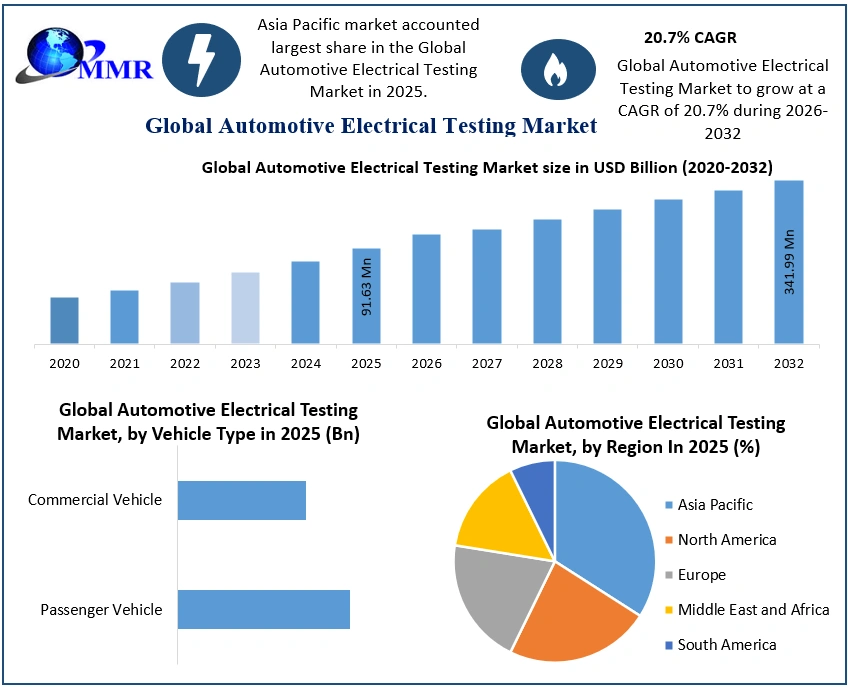
- Automotive Electrical Testing Market valued at USD 91.63 Million in 2025.
- Market expected to reach nearly USD 341.99 Million by 2032.
- Revenue projected to grow at a CAGR of 20.7% during the forecast period.
- Vehicle electrification is increasing demand for advanced testing and validation systems.
- ADAS, connected vehicles, and software-defined architectures are expanding electrical testing requirements.
- OEMs are strengthening quality assurance processes to address growing vehicle electronics complexity.
- Battery systems, semiconductors, and power electronics are emerging as critical testing priorities.
Why This Matters Now
Automotive manufacturers are facing a new quality challenge. Vehicles are becoming software-driven, electrically complex, and increasingly dependent on advanced electronics that must operate flawlessly under every driving condition.
For OEMs, Tier-1 suppliers, fleet operators, and investors, testing capabilities are becoming strategic assets rather than operational functions. As electrification accelerates and autonomous technologies move closer to mainstream deployment, electrical testing determines product reliability, regulatory compliance, warranty performance, and brand reputation.
Market Overview
The Automotive Electrical Testing Market is entering a period of rapid expansion as automakers increase investment in vehicle electronics, electrification platforms, and intelligent mobility technologies. According to Maximize Market Research, the market was valued at USD 91.63 Million in 2025 and is expected to reach nearly USD 341.99 Million by 2032, growing at a CAGR of 20.7%.
The growth rate highlights a major structural shift in automotive engineering. Modern vehicles contain significantly more electronic content than previous generations, ranging from advanced sensors and communication modules to battery management systems and autonomous driving technologies.
Every additional electronic component introduces new validation requirements. Manufacturers must verify performance, reliability, safety, and interoperability across increasingly complex vehicle architectures.
As a result, electrical testing is moving from a quality-control activity to a core component of product development and manufacturing strategy.
Key Trends Driving Growth
Vehicle electrification remains the most significant market catalyst. Electric vehicles depend on sophisticated electrical architectures that include battery systems, charging interfaces, inverters, power distribution units, and thermal management technologies.
These systems must perform reliably under varying environmental conditions and operating scenarios. Testing solutions help manufacturers identify defects, optimize performance, and ensure compliance with evolving safety requirements.
The expansion of Advanced Driver Assistance Systems is creating another major demand driver. Features such as lane-keeping assistance, adaptive cruise control, emergency braking, and driver monitoring systems rely on interconnected electronic components that require extensive validation before deployment.
Connected vehicle technologies are also increasing testing requirements. Modern vehicles exchange information with cloud platforms, mobile applications, infrastructure systems, and external networks. Ensuring secure and reliable communication requires comprehensive electrical and software testing procedures.
Software-defined vehicles represent another transformative trend. Automotive manufacturers are increasingly adopting centralized computing architectures capable of supporting over-the-air updates and digital feature upgrades. These architectures require rigorous validation processes to ensure software and hardware compatibility throughout the vehicle lifecycle.
Automotive cybersecurity is emerging as an important testing category. As vehicles become increasingly connected, manufacturers are expanding validation frameworks to address security vulnerabilities and protect vehicle systems from unauthorized access.
Semiconductor dependence is also shaping testing priorities. Automotive electronics increasingly rely on advanced semiconductor technologies that must meet strict reliability standards. Testing solutions play a critical role in validating semiconductor performance across automotive applications.
To know about the Research Methodology:https://www.maximizemarketresearch.com/request-sample/77881/
Segment Insights
- Dominant Segment: Electrical Component Testing
- Electrical component testing continues to account for a significant share of market demand as manufacturers focus on validating vehicle electronics, sensors, control modules, and communication systems.
- Fastest-Growing Segment: EV and Battery Testing Applications
- Electric vehicle expansion is accelerating demand for battery testing, charging system validation, and power electronics assessment solutions.
- Technology Focus
- Testing solutions support validation of electronic control units, battery management systems, powertrain electronics, ADAS technologies, and connected vehicle platforms.
- Industry Opportunity
- Growing vehicle electronics content is creating long-term demand for automated testing platforms capable of supporting high-volume automotive production environments.
Regional Growth Story
Asia-Pacific continues to lead automotive electronics manufacturing and remains a major growth center for electrical testing solutions. The region benefits from large-scale vehicle production, expanding EV manufacturing capacity, and increasing investment in automotive innovation.
China remains a central force in market expansion. Its aggressive push toward vehicle electrification and advanced automotive technologies is increasing demand for testing systems capable of validating batteries, power electronics, and intelligent vehicle functions.
Japan and South Korea maintain strong positions through advanced electronics expertise, semiconductor capabilities, and leadership in automotive technology development. Their focus on quality assurance and manufacturing excellence continues to support adoption of sophisticated testing solutions.
India is emerging as an attractive growth market as automakers expand production capacity and introduce more electronically advanced vehicles. Rising adoption of safety systems, connected technologies, and electric mobility solutions is increasing demand for testing infrastructure.
Europe remains strategically important due to stringent safety regulations, emission standards, and investments in electrification. Germany’s automotive manufacturing ecosystem continues to drive adoption of advanced validation and testing technologies.
North America benefits from growing investment in electric vehicle manufacturing, autonomous driving research, and connected mobility platforms. Testing capabilities are becoming increasingly important as automakers accelerate product development cycles while maintaining quality standards.
Competitive Landscape
Competition is increasingly centered on testing automation, software integration, and advanced diagnostics capabilities. Automotive manufacturers and suppliers are seeking solutions that improve testing efficiency while reducing product development timelines.
Technology providers that combine electrical testing expertise with software analytics, artificial intelligence, and predictive diagnostics are gaining competitive advantages. These capabilities help manufacturers identify issues earlier in the development process, reducing costs and improving reliability.
The market is also benefiting from closer collaboration between OEMs, testing equipment providers, semiconductor manufacturers, and software companies. These partnerships support faster innovation while addressing growing complexity across vehicle electronics ecosystems.
For suppliers, advanced testing capabilities are becoming a differentiator that can strengthen customer relationships and support long-term contract opportunities.
Recent Developments
- Automotive manufacturers are expanding investment in EV validation and battery testing infrastructure.
- Growing deployment of ADAS technologies is increasing demand for advanced electrical verification systems.
- Connected vehicle adoption is creating new requirements for communication and cybersecurity testing.
- Software-defined vehicle programs are accelerating demand for integrated hardware and software validation solutions.
- Semiconductor-intensive vehicle architectures are increasing the need for sophisticated electronics testing capabilities.
Strategic Implications
The Automotive Electrical Testing Market is becoming a critical enabler of automotive transformation. Electrification, autonomous driving, connectivity, and software-defined mobility all depend on reliable electrical systems.
For OEMs, testing investments help reduce warranty costs, accelerate product launches, and maintain regulatory compliance. For Tier-1 suppliers, advanced testing capabilities strengthen competitiveness and support participation in next-generation vehicle programs.
Investors increasingly view testing technologies as an indirect beneficiary of automotive electrification and digitalization trends. As vehicle complexity increases, demand for validation and quality assurance solutions is expected to expand across the automotive value chain.
Manufacturers that establish scalable testing infrastructures today will be better positioned to manage future vehicle architectures and emerging mobility technologies.
Future Outlook
The companies that master high-speed, data-driven electrical testing will define the next generation of automotive quality leadership, while slower adopters risk falling behind in an industry increasingly governed by software reliability, electronic performance, and safety assurance.
Analyst Perspective
“Automotive electrical testing is becoming a strategic requirement as vehicles evolve into highly connected, software-intensive, and electrified platforms. Manufacturers that invest in advanced testing capabilities will be better positioned to deliver reliability, safety, and innovation at scale.” — Tejaswini Kakade
About Maximize Market Research
Maximize Market Research Pvt. Ltd. (MMR) is a global market research and consulting company that provides reliable, data-focused, and practical business insights. The firm serves a wide range of industries, including healthcare, pharmaceuticals, technology, automotive, electronics, chemicals, personal care, and consumer goods. Through market forecasts, competitive analysis, strategic consulting, and industry impact assessments, MMR helps organizations understand changing market conditions, identify growth opportunities, and make informed business decisions for long-term success.
Contact Us:
2nd Floor, Navale IT Park Phase 3
Pune Banglore Highway, Narhe
Pune, Maharashtra 411041, India
+91 9607365656
sales@maximizemarketresearch.com
