Key Highlights
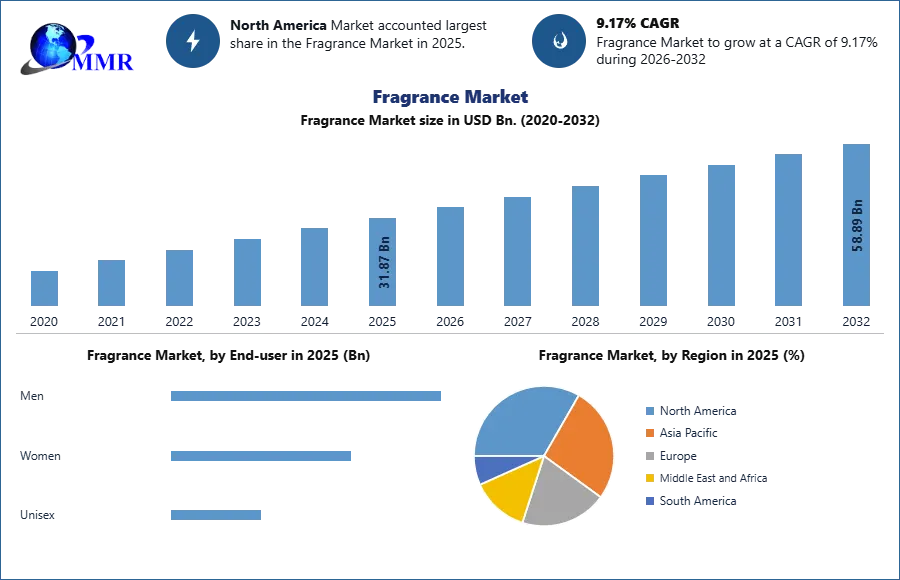
- Global fragrance market value stood at USD 31.87 billion in 2025.
- Market revenue is projected to reach nearly USD 58.89 billion by 2032.
- The industry is expected to expand at a 9.17% CAGR from 2026 to 2032.
- Premiumization is accelerating value creation across fragrance categories.
- Younger consumers are entering the market earlier and purchasing multiple fragrances rather than a single signature scent.
- Digital discovery and omnichannel retail are reshaping customer acquisition.
- Luxury and niche fragrances are attracting increased consumer attention.
- Companies are investing in advanced formulations, responsible sourcing, refillable formats, and consumer analytics.
Why This Matters Now
The fragrance industry is no longer competing only for shelf space. It is competing for identity, attention, and emotional relevance.
A market valued at USD 31.87 billion in 2025 is on track to nearly double by 2032. That growth signals more than rising consumption. It indicates that fragrance has evolved from an occasional purchase into a recurring lifestyle category with increasing pricing power. Every percentage point of growth translates into stronger incentives for brands to invest in innovation, premium positioning, and direct consumer relationships.
Market Overview
The Fragrance Market generated USD 31.87 billion in 2025 and is forecast to reach nearly USD 58.89 billion by 2032, expanding at a CAGR of 9.17%. For manufacturers, retailers, and investors, this trajectory points to a category delivering both volume growth and value expansion.
What makes the current cycle different is the role fragrance now plays in consumer behavior. Scent is increasingly associated with self-expression, daily rituals, and emotional engagement rather than simple personal grooming. This transition gives brands greater room for premium pricing, product extensions, and loyalty-building strategies.
Key Trends Driving Growth
Premiumization remains one of the strongest forces reshaping the market. Consumers are increasingly willing to pay for higher fragrance concentrations, distinctive scent profiles, and prestige brand associations. As a result, value growth is outpacing simple unit expansion.
Consumer behavior is also shifting rapidly. Younger buyers are entering the category earlier than previous generations and are building fragrance wardrobes instead of relying on a single scent. This behavior increases purchase frequency and expands opportunities for brands to launch multiple products targeting different moods, occasions, and lifestyles.
Digital platforms have become powerful demand generators. Social media-driven fragrance discovery, online reviews, and influencer-led recommendations are accelerating trial and shortening product adoption cycles. Digital commerce is transforming how brands build awareness and convert interest into purchases.
Sustainability is emerging as another competitive battleground. Companies are investing in responsibly sourced ingredients, refillable packaging, and environmentally conscious product development. These initiatives are increasingly tied to brand equity rather than compliance alone.
Health and wellness themes are also influencing formulation strategies. Consumers are paying closer attention to ingredient transparency, safety standards, and product authenticity. Regulatory scrutiny around allergens and labeling is accelerating the industry’s focus on cleaner and more transparent formulations.
Download a Market Sample Report Featuring Growth Drivers and Opportunities
Segment Insights
- Dominant Segment: Information not available in the supplied MMR source.
- Fastest-Growing Segment: Information not available in the supplied MMR source.
- Premium and luxury fragrance categories continue attracting consumer attention due to higher perceived value, exclusivity, and personalization opportunities.
- Refillable formats, travel-size products, and limited-edition launches are becoming important portfolio expansion tools for manufacturers.
- Omnichannel distribution strategies are helping brands reach consumers across specialty retail, department stores, and direct-to-consumer platforms.
Regional Growth Story
The supplied MMR report confirms global market growth but does not provide detailed regional dominance or fastest-growing regional data in the accessible source material. Therefore, regional rankings and comparative regional forecasts are omitted.
What is clear is that fragrance demand is benefiting from rising consumer spending, premium beauty adoption, and expanding digital retail channels across major global markets. These structural drivers continue to support long-term industry expansion.
Competitive Landscape
Competition is shifting from product creation to ecosystem creation.
Leading fragrance companies are investing in advanced formulation technologies, improved fixation systems, data-driven consumer analytics, and responsible sourcing programs. These moves indicate that future competitive advantage will depend as much on consumer intelligence and supply-chain resilience as on scent creation itself.
The growing emphasis on refillable formats and portfolio diversification signals that companies expect consumer purchasing behavior to become more fragmented. Rather than relying on blockbuster fragrances, brands are preparing for a market driven by collections, personalization, and continuous product discovery.
Luxury-focused launches also reveal where industry investment is heading. The expansion of ultra-premium fragrance collections suggests companies see stronger margins and higher loyalty in prestige segments. Rivals that remain concentrated in traditional mass-market offerings may face increasing pressure to differentiate beyond price.
Over the next 12–24 months, expect more investment in niche positioning, digital-first brand building, premium storytelling, and consumer data capabilities. The companies that own customer relationships rather than simply products are likely to capture the greatest value.
Recent Developments
- Companies are expanding portfolios with refillable products, travel formats, and limited-edition collections.
- Data-driven scent profiling and consumer analytics are increasingly guiding product development decisions.
- Luxury fragrance launches are targeting consumers seeking exclusivity, craftsmanship, and premium experiences.
- Digital and social-media-led discovery channels continue influencing fragrance purchasing behavior among younger consumers.
Strategic Implications
Executives should view fragrance as a high-engagement category rather than a traditional consumer product segment.
Growth opportunities increasingly sit at the intersection of premiumization, personalization, sustainability, and digital commerce. Brands capable of integrating these capabilities can strengthen pricing power while expanding customer lifetime value.
Supply-chain resilience will also become more important. Regulatory requirements, ingredient transparency expectations, and responsible sourcing initiatives are increasing operational complexity across the industry. Companies that adapt early may gain both compliance advantages and consumer trust.
Future Outlook
The fragrance market is entering a phase where emotional relevance carries as much weight as product performance.
With global revenue expected to approach USD 58.89 billion by 2032, competitive intensity will rise alongside opportunity. Growth will increasingly favor brands that combine premium positioning, digital engagement, sustainability commitments, and consumer insight capabilities.
The winners will build ecosystems around identity and experience; the losers will continue selling scent alone.
Analyst Perspective
“The fragrance industry is evolving from a product-driven category into a consumer-driven experience economy. Companies that align premium innovation, sustainability, and digital engagement strategies will be best positioned to capture the next phase of growth in the global fragrance market.” — Siddhi Dole, Analyst
About Maximize Market Research
Maximize Market Research Pvt. Ltd. (MMR) is a global market research and consulting company that provides reliable, data-focused, and practical business insights. The firm serves a wide range of industries, including healthcare, pharmaceuticals, technology, automotive, electronics, chemicals, personal care, and consumer goods. Through market forecasts, competitive analysis, strategic consulting, and industry impact assessments, MMR helps organizations understand changing market conditions, identify growth opportunities, and make informed business decisions for long-term success.
Contact Us
2nd Floor, Navale IT Park Phase 3
Pune Banglore Highway, Narhe
Pune, Maharashtra 411041, India
+91 9607365656
sales@maximizemarketresearch.com
