Key Highlights
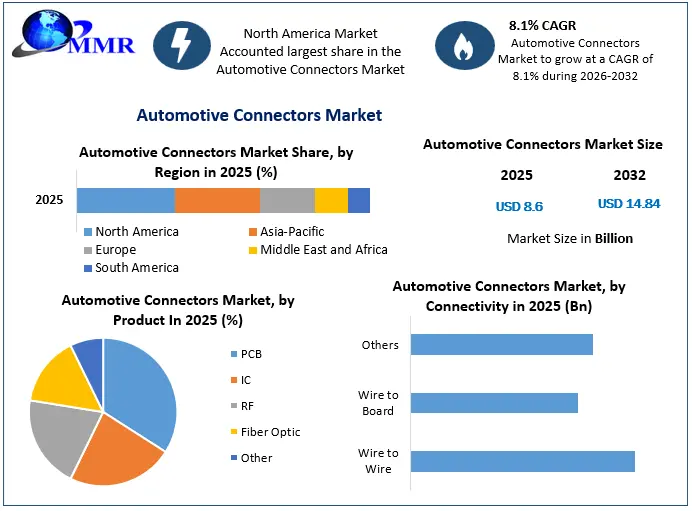
- Automotive Connectors Market valued at USD 8.6 Billion in 2025.
- Market expected to reach nearly USD 14.84 Billion by 2032.
- Revenue projected to grow at a CAGR of 8.1% from 2026 to 2032.
- Vehicle electrification is increasing demand for high-performance connector systems.
- Connected vehicles and ADAS technologies are expanding electronic architecture complexity.
- Automotive manufacturers are investing in advanced connectivity infrastructure to support software-defined vehicles.
- Rising semiconductor content per vehicle is creating new opportunities for connector suppliers.
Why This Matters Now
The modern automobile is becoming a rolling data center. Every new sensor, battery module, control unit, communication network, and software-driven feature depends on reliable electrical connectivity.
For OEMs, Tier-1 suppliers, investors, and mobility strategists, connectors are no longer commodity components. They are critical infrastructure that determines vehicle reliability, safety performance, electrification readiness, and digital functionality. As vehicle electronics become more sophisticated, connector technology is emerging as a strategic differentiator across the automotive value chain.
Market Overview
The Automotive Connectors Market is entering a period of sustained growth as vehicle architectures become increasingly electrified, connected, and software-centric. According to Maximize Market Research, the market was valued at USD 8.6 Billion in 2025 and is expected to reach nearly USD 14.84 Billion by 2032, expanding at a CAGR of 8.1%.
The growth trajectory highlights a fundamental shift in automotive engineering priorities. Historically, mechanical systems defined vehicle performance. Today, electronics, connectivity, and software capabilities increasingly determine competitive advantage.
This transformation is driving a sharp increase in the number of connectors installed per vehicle. Modern vehicles require reliable transmission of power, signals, and data across increasingly complex electrical architectures. From battery systems and powertrains to infotainment platforms and advanced safety technologies, connectors serve as the physical foundation of vehicle communication networks.
The result is a market benefiting from multiple structural growth drivers simultaneously, including electrification, connectivity, autonomous technologies, and regulatory requirements for safety and efficiency.
Key Trends Driving Growth
Vehicle electrification remains one of the most important catalysts for connector demand. Electric vehicles require significantly more sophisticated electrical architectures than conventional internal combustion engine vehicles.
Battery management systems, charging infrastructure interfaces, power distribution units, thermal management controls, and high-voltage powertrains all rely on specialized connector technologies. As automakers expand EV portfolios, connector suppliers are seeing increased demand for high-voltage, lightweight, and high-reliability solutions.
The rise of Advanced Driver Assistance Systems is creating another major opportunity. Features such as adaptive cruise control, lane departure warning, automatic emergency braking, and driver monitoring systems require extensive sensor networks and high-speed data transmission capabilities.
Each additional sensor, radar system, camera module, and electronic control unit increases connector requirements. As automakers move toward higher levels of driving automation, connectivity density within vehicles continues to expand.
Connected vehicle adoption is further accelerating market growth. Vehicles increasingly communicate with cloud platforms, infrastructure systems, mobile devices, and external networks. These capabilities depend on secure and reliable connector solutions capable of supporting high-speed data transfer and uninterrupted communication.
Software-defined vehicle architectures are also reshaping connector design requirements. Automotive manufacturers are transitioning toward centralized computing systems that support over-the-air updates, feature upgrades, and digital services throughout a vehicle’s lifecycle.
This shift increases demand for connectors capable of supporting higher bandwidth, greater reliability, and enhanced durability across increasingly sophisticated electronic ecosystems.
Download Free PDF Sample:https://www.maximizemarketresearch.com/request-sample/11106/
Segment Insights
- Dominant Segment: Wire-to-Wire Connectors
- Wire-to-wire connectors continue to account for a significant share of market demand due to their extensive use across vehicle electrical systems, communication networks, and power distribution applications.
- Fastest-Growing Segment: High-Speed Data Connectors
- Growing adoption of connected vehicle technologies, ADAS systems, and software-defined architectures is accelerating demand for high-speed data transmission connectors.
- Application Leadership
- Powertrain, body electronics, safety systems, infotainment platforms, and advanced communication modules remain key application areas driving connector deployment.
- Electrification Opportunity
- Electric vehicle platforms are creating sustained demand for high-voltage connectors capable of supporting battery systems, charging infrastructure, and power electronics integration.
Regional Growth Story
Asia-Pacific remains the largest growth engine for the Automotive Connectors Market. The region benefits from large-scale automotive production, expanding electric vehicle manufacturing capacity, and strong investments in automotive electronics.
China continues to strengthen its position as a global automotive technology hub. Rapid EV adoption, extensive manufacturing capacity, and investments in connected vehicle ecosystems are driving substantial connector demand across passenger and commercial vehicle segments.
Japan and South Korea remain leaders in automotive electronics innovation. Their advanced semiconductor industries, strong automotive supply chains, and focus on vehicle technology development support continuous growth in connector adoption.
India is emerging as an increasingly important market. Rising vehicle production, growing demand for safety technologies, and increasing integration of connected features are creating new opportunities for connector manufacturers and suppliers.
Europe remains a critical region due to stringent emission regulations, aggressive electrification targets, and strong investment in advanced automotive technologies. Germany continues to play a central role through its concentration of global automotive manufacturers and technology suppliers.
North America benefits from rising investments in electric vehicle production, connected mobility platforms, and autonomous driving development programs. Increasing vehicle electronics content is supporting long-term connector demand across the region.
Competitive Landscape
Competition is increasingly shifting toward innovation rather than scale alone. Connector manufacturers are focusing on miniaturization, lightweight designs, high-voltage performance, and enhanced durability to meet evolving automotive requirements.
As vehicles become more software-driven, connector suppliers are investing in technologies capable of supporting higher-speed communication networks and more complex electrical architectures. This transition is creating opportunities for suppliers with advanced engineering capabilities and strong automotive relationships.
Strategic partnerships between automakers, electronics companies, and connector manufacturers are becoming increasingly important. These collaborations help accelerate product development while ensuring compatibility with next-generation vehicle platforms.
The competitive environment also highlights the growing importance of semiconductor ecosystems. As automotive electronics content rises, connector suppliers positioned within advanced semiconductor and electronics supply chains are gaining stronger market influence.
Recent Developments
- Automotive manufacturers continue increasing investments in vehicle electrification programs.
- Growing deployment of ADAS technologies is expanding demand for high-performance connectivity solutions.
- Connected vehicle adoption is accelerating requirements for high-speed data transmission infrastructure.
- Software-defined vehicle development is driving demand for advanced electronic architecture solutions.
- Rising semiconductor integration is increasing connector complexity and performance requirements.
Strategic Implications
The Automotive Connectors Market sits at the center of automotive digital transformation. Electrification, autonomous driving, connectivity, and intelligent mobility all require increasingly sophisticated connector technologies.
For OEMs, advanced connector solutions support vehicle reliability, performance, and long-term platform scalability. For Tier-1 suppliers, the market offers opportunities to move beyond component supply and become strategic technology partners.
Investors are paying closer attention because connectors benefit from nearly every major automotive technology trend. Unlike niche technologies, connectors participate in electrification, connectivity, ADAS deployment, and software-defined vehicle growth simultaneously.
Manufacturers capable of delivering high-performance connectivity solutions at scale will be well positioned as automotive electronics content continues to rise.
Future Outlook
The next generation of automotive leaders will be defined by their ability to build intelligent, connected, and electrified vehicles supported by resilient connectivity architectures, while laggards struggle to manage the complexity of increasingly digital automotive ecosystems.
Analyst Perspective
“Automotive connectors are becoming increasingly important as vehicles transition toward electrified, connected, and software-defined architectures. Manufacturers that invest in advanced connectivity technologies will be better positioned to support future mobility platforms and evolving customer expectations.” — Tejaswini Kakade
About Maximize Market Research
Maximize Market Research Pvt. Ltd. (MMR) is a global market research and consulting company that provides reliable, data-focused, and practical business insights. The firm serves a wide range of industries, including healthcare, pharmaceuticals, technology, automotive, electronics, chemicals, personal care, and consumer goods. Through market forecasts, competitive analysis, strategic consulting, and industry impact assessments, MMR helps organizations understand changing market conditions, identify growth opportunities, and make informed business decisions for long-term success.
Contact Us:
2nd Floor, Navale IT Park Phase 3
Pune Banglore Highway, Narhe
Pune, Maharashtra 411041, India
+91 9607365656
sales@maximizemarketresearch.com
