Key Highlights
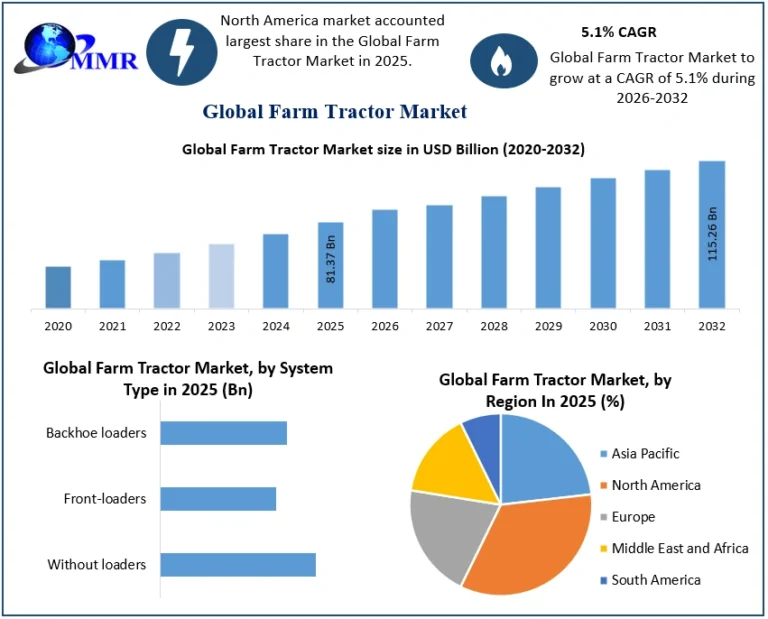
- Global Farm Tractor Market valued at USD 81.37 billion in 2025.
- Market projected to reach nearly USD 115.26 billion by 2032.
- CAGR estimated at 5.1% from 2025 to 2032.
- Farm mechanization remains the primary growth catalyst.
- Precision agriculture technologies are gaining traction across major farming regions.
- OEM competition is increasingly focused on technology differentiation and productivity gains.
- Asia-Pacific continues to represent a major production and consumption hub.
Why This Matters Now
Agriculture is facing a structural labor challenge. Rising labor costs, rural workforce migration, and pressure to improve yields are forcing farms to adopt mechanized solutions faster than before. Tractors remain the foundation of this transition because they serve as the central power source for multiple farming activities.
The market is also entering a technology cycle. Farmers increasingly expect equipment to deliver operational efficiency, fuel optimization, precision guidance, and digital connectivity. Manufacturers that can integrate these capabilities into scalable platforms are positioned to capture future market share.
For investors and suppliers, the shift creates opportunities across components, electronics, telematics, software, aftermarket services, and agricultural automation ecosystems.
Market Overview
The Farm Tractor Market is evolving from a machinery market into a technology-enabled productivity market. Traditional demand drivers such as land cultivation and farm expansion remain important, but new growth is increasingly tied to precision agriculture and operational efficiency.
Mechanization is becoming essential for both large-scale commercial farming operations and smaller farms seeking higher output per hectare. Tractors are no longer viewed solely as agricultural vehicles; they are becoming integrated productivity assets capable of supporting multiple operations throughout the farming cycle.
Government support for agricultural modernization, growing awareness of precision farming practices, and increased investment in agricultural infrastructure continue to strengthen long-term demand fundamentals.
Key Trends Driving Growth
One of the most significant changes is the growing adoption of precision farming technologies. GPS guidance systems, automated steering functions, and smart monitoring tools are improving field accuracy and reducing resource wastage. Farmers are increasingly investing in equipment capable of supporting data-driven decisions.
Automation is emerging as another strategic trend. While widespread autonomous deployment remains in the early stages, manufacturers are developing advanced tractor platforms that support automated operations and enhanced productivity. This development is particularly relevant in regions experiencing persistent labor shortages.
Connectivity is also becoming a competitive differentiator. Equipment manufacturers are integrating telematics and remote monitoring capabilities that allow operators to track machine performance, maintenance requirements, and operational efficiency in real time.
Sustainability objectives are influencing equipment design as well. Manufacturers are focusing on fuel efficiency improvements, emissions reduction, and alternative powertrain research to align with evolving environmental expectations.
Get a Preview of Industry Trends, Market Share, and Revenue Forecasts
Segment Insights
- Dominant Segment: Utility and multipurpose tractor categories continue to command significant market demand because of their versatility across cultivation, transportation, planting, and field preparation activities.
- Fastest-Growing Segment: Technology-enabled and precision farming-compatible tractors are witnessing increasing adoption as farms seek higher productivity and resource efficiency.
- Powertrain Dynamics: Internal combustion engine platforms continue to dominate current market revenues due to established infrastructure, reliability, and operational familiarity. However, interest in alternative powertrains and electrification initiatives is gradually increasing.
- Connectivity Trend: GPS-enabled and digitally connected tractors are gaining market attention as precision agriculture expands globally.
- Application Trend: Multifunctional tractors capable of supporting diverse agricultural operations remain preferred due to their ability to maximize return on investment.
Regional Growth Story
Asia-Pacific remains one of the most influential regions in the global farm tractor industry. Large agricultural populations, increasing mechanization rates, and government initiatives supporting farm modernization continue to drive demand.
India remains a critical growth market due to its extensive agricultural base and ongoing mechanization efforts. Rising rural productivity initiatives and increasing awareness of advanced farming equipment continue to support long-term expansion.
China is witnessing growing demand for higher-capacity and technologically advanced tractors as agricultural operations become more commercialized. The country’s modernization agenda is encouraging adoption of efficient and productive machinery.
North America continues to benefit from large-scale farming operations and rising investment in precision agriculture. Demand for advanced equipment capable of improving productivity and reducing labor dependency remains strong.
Europe’s market is influenced by sustainability goals, efficiency requirements, and modernization initiatives. Manufacturers are increasingly focusing on advanced technologies and emissions-conscious solutions to meet regional expectations.
Japan and South Korea continue to emphasize agricultural efficiency and technology integration, creating opportunities for compact, smart, and high-performance tractor solutions.
Competitive Landscape
Competition is increasingly centered on technology leadership rather than solely on production scale. Manufacturers are investing in automation capabilities, connected platforms, digital services, and precision agriculture compatibility to strengthen competitive positioning.
OEMs are expanding product portfolios to address diverse farm sizes and operational requirements. Companies that can deliver integrated ecosystems combining machinery, software, analytics, and service support are likely to secure stronger customer loyalty.
The competitive environment also highlights growing collaboration across machinery manufacturers, component suppliers, software providers, and agricultural technology firms. These partnerships accelerate innovation while creating barriers to entry for less technologically advanced competitors.
For suppliers, this trend increases opportunities in sensors, telematics modules, electronic control systems, software integration, and precision farming technologies.
Recent Developments
- Growing integration of GPS guidance and precision agriculture technologies.
- Increased investment in automation and autonomous farming capabilities.
- Expansion of connected equipment offerings through telematics platforms.
- Continued focus on improving fuel efficiency and operational productivity.
- Rising OEM investments in advanced machinery platforms designed for modern farming requirements.
Strategic Implications
The next stage of market competition will be shaped by software, connectivity, and automation as much as by horsepower and manufacturing scale.
OEMs that successfully combine equipment reliability with digital intelligence will strengthen pricing power and customer retention. Suppliers capable of supporting precision agriculture ecosystems stand to benefit from rising technology content per vehicle.
Investors should monitor developments in smart farming, autonomous operations, telematics adoption, and alternative powertrain innovation, as these areas are likely to attract future capital allocation across the agricultural equipment value chain.
Future Outlook
The Farm Tractor Market is moving toward a future where connected, precision-enabled, and increasingly automated equipment becomes the standard rather than the exception. As food production demands rise and labor availability tightens, mechanization will remain a strategic necessity across global agriculture.
The companies that lead in digital integration, automation capability, and productivity enhancement will define the next generation of agricultural mobility, while those relying solely on conventional equipment strategies risk losing relevance.
Analyst Perspective
“The Farm Tractor Market is entering a period where productivity, connectivity, and precision farming technologies will increasingly determine competitive success. Manufacturers that align product development with evolving farmer expectations for efficiency and data-driven operations will be best positioned to capture future growth opportunities.” — Tejaswini Kakade, Analyst
About Maximize Market Research
Maximize Market Research Pvt. Ltd. (MMR) is a global market research and consulting company that provides reliable, data-focused, and practical business insights. The firm serves a wide range of industries, including healthcare, pharmaceuticals, technology, automotive, electronics, chemicals, personal care, and consumer goods. Through market forecasts, competitive analysis, strategic consulting, and industry impact assessments, MMR helps organizations understand changing market conditions, identify growth opportunities, and make informed business decisions for long-term success.
Contact Us
2nd Floor, Navale IT Park Phase 3
Pune Banglore Highway, Narhe
Pune, Maharashtra 411041, India
+91 9607365656
sales@maximizemarketresearch.com
