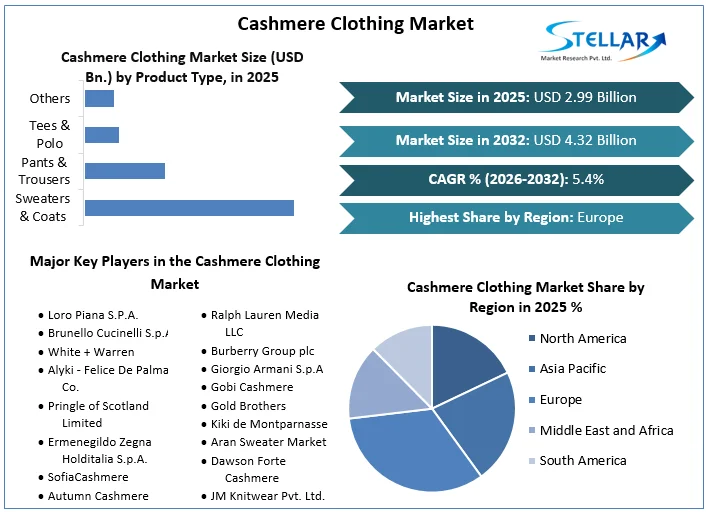
Premiumization and ethical sourcing trends drive the global cashmere clothing industry, projected to grow from USD 2.99 billion in 2025 at a CAGR of 5.4% during 2026-2032.
PUNE, India, June 22, 2026 – The Cashmere Clothing Market, according to a new study by Stellar Market Research, is entering a new growth phase as luxury fashion brands, sustainability initiatives, and digital retail expansion redefine consumer demand. The market was valued at USD 2.99 billion in 2025 and is forecast to reach nearly USD 4.32 billion by 2032, growing at a CAGR of 5.4%.
Market Opportunity Overview
The cashmere apparel industry is undergoing a structural transformation driven by premiumization and responsible sourcing. Consumers are increasingly prioritizing high-quality natural fibers, traceable supply chains, and long-lasting garments over fast fashion alternatives.
Brands are investing in regenerative sourcing programs, blockchain-enabled traceability, omnichannel retail strategies, and innovative yarn technologies. Rising disposable incomes and growing demand for sustainable luxury apparel are creating new opportunities for manufacturers and investors worldwide.
Download Free PDF Brochure: https://www.stellarmr.com/report/req_sample/cashmere-clothing-market/2474
Key Findings from the Report
Global market size stood at USD 2.99 billion in 2025.
Market revenue is expected to reach USD 4.32 billion by 2032.
CAGR during 2026-2032 is projected at 5.4%.
By product type, sweaters and coats represent the dominant segment.
Women’s apparel accounts for the largest consumption share.
Europe remains the leading regional market owing to strong luxury fashion ecosystems.
Asia-Pacific is emerging as the fastest-growing region due to rising disposable income and expanding premium apparel consumption.
Market Drivers and Restraints
Drivers
Rising Demand for Premium Fashion
Consumers are increasingly seeking luxury apparel made from natural fibers with superior comfort and durability, supporting sustained demand for cashmere garments.
Sustainability and Ethical Sourcing
Greater awareness regarding environmental impact and animal welfare is encouraging brands to adopt traceable and responsible sourcing practices.
Expansion of E-commerce Channels
Luxury brands are leveraging direct-to-consumer platforms and digital retail ecosystems to reach younger consumers and global markets.
Restraints
High Raw Material Costs
Limited supply of premium-grade cashmere fibers contributes to elevated production costs and premium pricing.
Availability of Alternative Fibers
Merino wool, alpaca, and blended fabrics provide lower-cost substitutes, limiting wider adoption among price-sensitive consumers.
Technology, Regulation, and Sustainability Trends
Technology is playing a larger role in the luxury apparel industry. Brands are utilizing AI-driven demand forecasting, digital traceability solutions, and advanced yarn processing techniques to improve product quality and supply chain visibility.
Environmental regulations and ESG requirements are encouraging companies to adopt regenerative grazing practices and transparent sourcing standards. Sustainability certifications and circular fashion initiatives are increasingly influencing purchasing decisions.
Blockchain-enabled traceability and responsible sourcing frameworks are becoming important competitive differentiators across the premium apparel sector.
Regional Insights
Europe Leads Global Demand
Europe maintains its leadership position, supported by Italy, France, and the United Kingdom. The region benefits from strong luxury fashion brands, established craftsmanship, and affluent consumers willing to spend on premium clothing.
Asia-Pacific Emerges as Growth Engine
China, India, Japan, and South Korea are witnessing rising demand for premium apparel. Growing middle-class populations and increasing luxury spending are creating favorable conditions for market expansion.
China also remains one of the world’s major sources of raw cashmere fiber, strengthening the region’s strategic importance.
Recent Industry Developments
Loro Piana (2025): Launched the five-year “Resilient Threads” initiative in Mongolia to strengthen herder livelihoods and improve biodiversity conservation, supporting long-term supply chain resilience.
Everbloom (2025): Commercialized a new technology platform designed to produce fine natural cashmere at scale after seven years of development, improving sustainability and efficiency.
Brunello Cucinelli (2025): Invested approximately €145 million in artisanal manufacturing expansion and craftsmanship development, reinforcing premium positioning.
Loro Piana (2025): Expanded digital traceability initiatives through the Aura Blockchain Consortium platform to improve transparency across luxury textile products.
Brunello Cucinelli (2026): Strengthened global trade compliance procedures to align with evolving European regulatory requirements and enhance supply chain governance.
Competitive Landscape
Competition within the global cashmere clothing industry remains intense. Major participants focus on product innovation, premium craftsmanship, sustainability, and international expansion.
Leading companies include:
Loro Piana
Brunello Cucinelli
Ermenegildo Zegna
Pringle of Scotland
Autumn Cashmere
SofiaCashmere
TSE Cashmere
Gobi Cashmere
Companies are increasingly emphasizing vertically integrated sourcing models, exclusive collections, digital commerce capabilities, and sustainability programs to strengthen market positioning.
Download Free PDF Brochure: https://www.stellarmr.com/report/req_sample/cashmere-clothing-market/2474
Analyst Commentary
“The cashmere clothing industry is evolving beyond traditional luxury. Traceability, responsible sourcing, and digital commerce are becoming equally important as craftsmanship and brand heritage. Companies that combine sustainability with premium experiences are expected to capture the strongest growth opportunities through 2032,” said a Senior Research Analyst at Stellar Market Research.
Future Outlook
Demand for premium natural fibers is expected to remain robust through 2032. Investments in regenerative agriculture, AI-enabled supply chains, and omnichannel retail ecosystems are likely to shape the next phase of market development.
Increasing consumer preference for sustainable luxury products, coupled with evolving regulatory frameworks and technological innovations, will continue to influence competitive dynamics. Asia-Pacific is expected to deliver significant incremental growth opportunities, while Europe will retain its position as the industry’s premium hub.
About Stellar Market Research
Stellar Market Research is a global market research and business consulting firm delivering strategic intelligence across industries including healthcare, consumer goods, chemicals, automotive, energy, technology, and manufacturing. The company provides comprehensive market forecasts, competitive analysis, industry trends, and business advisory services that help organizations make informed decisions and identify growth opportunities. Through rigorous primary and secondary research methodologies, Stellar Market Research offers actionable insights to investors, manufacturers, policymakers, and enterprises seeking sustainable competitive advantages. Its reports are designed to support innovation, strategic planning, and long-term business growth in rapidly evolving global markets.
Media Contact
Stellar Market Research
Website: http://stellarmr.com/
Email: sales@stellarmr.com
