Key Highlights
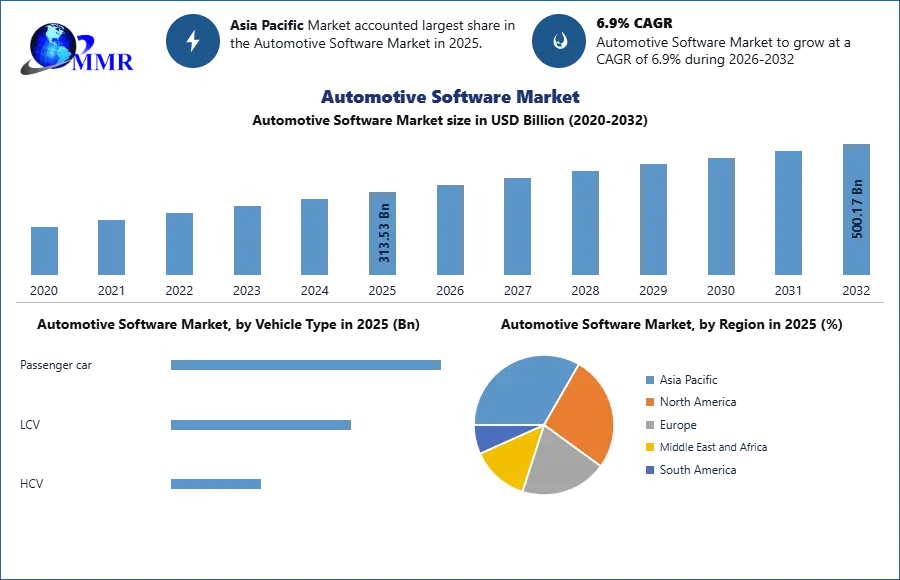
- Automotive Software Market valued at USD 313.53 Billion in 2025
- Market projected to reach nearly USD 500.18 Billion by 2032
- CAGR of 6.9% expected during 2026–2032
- Connected and software-defined vehicles are reshaping automotive competition
- AI-enabled vehicle intelligence is becoming a critical differentiator
- Software platforms are emerging as long-term revenue engines for automakers
- Digital vehicle architectures are increasing demand for automotive software ecosystems
Why This Matters Now
The automotive industry is undergoing its biggest transformation since mass vehicle manufacturing. Competitive advantage is shifting away from mechanical engineering alone and toward software capabilities, digital platforms, connectivity, and artificial intelligence.
Vehicles are rapidly becoming software-defined products that can receive upgrades, add features, improve performance, and deliver new customer experiences throughout their lifecycle. This shift is changing how automakers build vehicles, how suppliers create value, and how technology companies participate in the mobility ecosystem.
For technology leaders, investors, software vendors, and automotive executives, the Automotive Software Market has become a strategic battleground rather than a supporting function.
Market Overview
The Automotive Software Market was valued at USD 313.53 Billion in 2025 and is expected to grow at a CAGR of 6.9% from 2026 to 2032, reaching nearly USD 500.18 Billion.
The market’s expansion reflects a broader industry transition toward intelligent, connected, and digitally managed vehicles. Software is increasingly controlling critical vehicle functions, from infotainment and connectivity to powertrain optimization, safety systems, diagnostics, and autonomous capabilities.
What changed is the role software plays inside vehicles. Previously viewed as a supporting component, software is now becoming the foundation for innovation, differentiation, and recurring revenue generation.
The industry’s focus has shifted from building vehicles to building digital platforms on wheels.
Key Trends Driving Growth
Artificial intelligence is emerging as a major force across automotive software ecosystems. AI-powered systems are improving vehicle diagnostics, driver assistance, predictive maintenance, and operational efficiency. As vehicles generate increasing volumes of data, machine learning capabilities are becoming essential for extracting value from connected mobility platforms.
Software-defined vehicle architectures are also changing development priorities. Automakers are investing in centralized computing systems that allow software updates and feature enhancements to be deployed throughout a vehicle’s lifecycle. This creates opportunities for subscription-based business models and continuous customer engagement.
Connected vehicle adoption continues to accelerate software demand. Navigation systems, telematics, vehicle-to-everything communication, infotainment platforms, and digital services require increasingly sophisticated software stacks.
Automation is another powerful catalyst. Automotive manufacturers are adopting agile software development models and digital engineering practices to shorten product development cycles and bring new capabilities to market faster.
Cybersecurity has become a boardroom issue as vehicle connectivity expands. The growth of connected ecosystems increases exposure to software vulnerabilities, pushing automakers to invest in secure software architectures, threat detection systems, and lifecycle security management.
Access Key Market Statistics and Industry Developments Through a Sample
Segment Insights
- Dominant Segment: The report identifies passenger vehicles as a leading contributor to software adoption, supported by growing integration of digital features, connectivity platforms, safety systems, and intelligent vehicle technologies.
- Fastest-Growing Opportunity: Electric vehicle software ecosystems are emerging as a major growth area, supported by increasing software requirements for battery management, energy optimization, charging systems, and vehicle intelligence.
- Advanced Driver Assistance Systems (ADAS) continue to increase software complexity and content per vehicle.
- Connected mobility applications are expanding software demand across navigation, diagnostics, communication, and user experience functions.
- Automotive operating systems and middleware platforms are becoming strategic layers that enable future software innovation.
- Vehicle lifecycle management is increasingly dependent on over-the-air software update capabilities and digital service delivery.
The significance of these trends extends beyond revenue growth. Every additional software layer increases opportunities for monetization, customer retention, and ecosystem expansion.
Regional Growth Story
North America remains a critical market due to its leadership in automotive technology innovation, software engineering capabilities, and advanced vehicle development programs.
The United States continues to benefit from strong participation by automotive technology companies, cloud providers, semiconductor firms, and software platform developers. Investments in connected mobility, AI-enabled vehicles, and digital automotive ecosystems are accelerating software adoption.
Europe remains a major innovation center, particularly in Germany, where premium vehicle manufacturers are expanding software-defined vehicle initiatives and investing heavily in digital transformation programs.
Asia-Pacific represents one of the most dynamic opportunities. China continues to lead in electric vehicle adoption, connected vehicle deployment, and digital mobility innovation. Automotive software is becoming a strategic capability for Chinese manufacturers competing in global markets.
India is emerging as an important software development hub for automotive innovation. Growing vehicle digitization, engineering talent availability, and increasing investment in mobility technology are strengthening the country’s position within the global automotive software ecosystem.
Japan and South Korea continue to advance intelligent mobility platforms, connected vehicle technologies, and next-generation automotive electronics.
Competitive Landscape
Competition is increasingly centered on software platforms rather than traditional automotive components.
Automakers are competing to establish software-defined vehicle ecosystems capable of supporting continuous feature deployment, customer personalization, and recurring digital services. This signals a fundamental shift in industry economics.
Technology companies are expanding their influence as automotive software becomes more complex. Platform providers, cloud vendors, semiconductor companies, and AI developers are moving closer to the center of automotive value creation.
The competitive landscape also reflects growing convergence between automotive and information technology sectors. Software expertise is becoming as important as manufacturing scale. Companies with strong software engineering capabilities, cloud integration strategies, and AI readiness are positioned to capture disproportionate value.
The industry is moving toward platform ecosystems where operating systems, application frameworks, developer communities, and digital services create long-term competitive advantages.
Recent Developments
- Growing adoption of software-defined vehicle architectures across major automotive manufacturers.
- Increased deployment of AI-powered vehicle intelligence and predictive maintenance capabilities.
- Expansion of connected vehicle services and digital mobility platforms.
- Rising investment in over-the-air software update technologies.
- Greater focus on automotive cybersecurity and secure software development frameworks.
- Accelerating integration of cloud-based automotive software development environments.
- Continued advancement of ADAS and autonomous driving software capabilities.
Strategic Implications
For CIOs and CTOs, automotive software is becoming a strategic growth engine rather than a cost center. Organizations that successfully integrate software development, cloud infrastructure, AI capabilities, and cybersecurity practices will gain stronger competitive positioning.
For investors, software content per vehicle continues to increase, creating attractive long-term opportunities across automotive technology ecosystems.
For software vendors, the market is evolving toward platform-based relationships rather than one-time software deployments. Vendors capable of supporting vehicle lifecycle services will be positioned to capture recurring revenue streams.
For automakers, the challenge is no longer whether to become software companies. The challenge is how quickly they can build software capabilities that match customer expectations and emerging digital business models.
Future Outlook
The next phase of automotive competition will be defined by software intelligence, AI integration, connected mobility services, and digital vehicle ecosystems. As software becomes the primary interface between automakers and customers, value creation will increasingly shift from hardware differentiation to platform innovation.
The companies that master AI-enabled software-defined vehicles will shape the future of mobility, while those that treat software as a supporting function risk becoming commodity manufacturers in a platform-driven industry.
Analyst Perspective
“The automotive industry is entering a software-first era where vehicle intelligence, connectivity, and digital capabilities are becoming central to competitive advantage. Organizations that invest early in scalable software platforms and digital ecosystems will be best positioned to capture future value creation opportunities across the mobility landscape.” — Yash Ghosalkar, Analyst
About Maximize Market Research
Maximize Market Research Pvt. Ltd. (MMR) is a global market research and consulting company that provides reliable, data-focused, and practical business insights. The firm serves a wide range of industries, including healthcare, pharmaceuticals, technology, automotive, electronics, chemicals, personal care, and consumer goods. Through market forecasts, competitive analysis, strategic consulting, and industry impact assessments, MMR helps organizations understand changing market conditions, identify growth opportunities, and make informed business decisions for long-term success.
Contact Us
2nd Floor, Navale IT Park Phase 3
Pune Banglore Highway, Narhe
Pune, Maharashtra 411041, India
+91 9607365656
sales@maximizemarketresearch.com
