Key Highlights
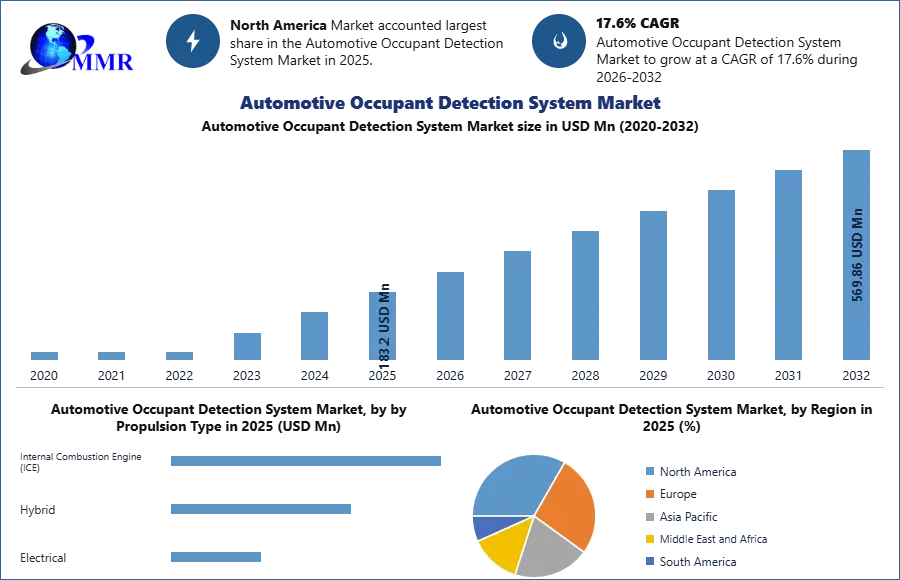
- Automotive Occupant Detection System Market valued at USD 183.2 million in 2025.
- Market expected to reach USD 569.86 million by 2032.
- Forecast CAGR stands at 17.6% between 2026 and 2032.
- Vehicle safety regulations remain the primary growth catalyst.
- ADAS integration is expanding the role of occupant detection beyond airbag deployment.
- Radar- and vision-based cabin monitoring technologies are gaining momentum.
- Asia-Pacific identified as a future manufacturing and investment hotspot.
- OEMs are increasingly adopting child presence detection and occupant classification systems.
Why This Matters Now
Vehicle safety standards are tightening faster than many automakers anticipated. At the same time, advanced driver assistance systems are moving from premium vehicles into mainstream platforms, forcing OEMs and Tier-1 suppliers to rethink cabin intelligence strategies.
Occupant detection systems are no longer limited to airbag deployment decisions. They are becoming critical components of connected, autonomous, and software-defined vehicles. Companies that invest early in intelligent cabin sensing technologies are positioning themselves for regulatory compliance, higher safety ratings, and stronger competitive differentiation.
Market Overview
The Automotive Occupant Detection System Market was valued at USD 183.2 million in 2025 and is expected to reach USD 569.86 million by 2032, growing at a CAGR of 17.6%.
Occupant detection systems help improve passenger safety by identifying seat occupancy, monitoring seat belt usage, supporting airbag deployment decisions, and assisting ADAS functions. The technology also contributes to battery management and electronic brake engagement by detecting driver presence.
What changed is the industry’s shift from basic seat occupancy sensing toward sophisticated cabin monitoring. Governments are implementing stricter safety regulations, while consumers increasingly expect advanced safety features even in mid-range vehicles.
For OEMs, occupant detection has become a strategic safety technology rather than a compliance feature. For suppliers, it opens opportunities in sensors, software algorithms, radar modules, and vision systems.
Key Trends Driving Growth
The strongest growth driver remains the global push toward enhanced vehicle safety. Regulatory agencies are demanding more accurate occupant classification and monitoring capabilities, creating new requirements across passenger and commercial vehicle platforms.
ADAS adoption is expanding the role of occupant detection systems. Driver monitoring, occupant classification, child presence detection, and posture recognition are increasingly integrated into broader vehicle safety architectures.
Premium vehicle sales continue to influence technology adoption. Features that were once limited to luxury models are steadily moving into higher-volume vehicle segments.
The transition toward autonomous and connected vehicles is also changing technology requirements. Future mobility platforms require real-time understanding of cabin occupants, creating demand for advanced sensing technologies that can monitor posture, attention levels, and occupant health indicators.
Another significant trend is the move from pressure-based sensing toward radar- and camera-based solutions. These systems deliver higher accuracy and support multiple safety functions through a single sensing architecture.
Request Your Free Sample Report and Discover Emerging Market Opportunities
Segment Insights
- Dominant Segment: Vehicle safety applications linked to occupant classification, seat belt monitoring, and airbag deployment continue to represent the core demand base for occupant detection systems.
- Fastest-Growing Segment: Advanced cabin monitoring solutions incorporating radar, vision sensing, and child presence detection are witnessing the strongest growth momentum due to evolving regulatory requirements and autonomous vehicle development.
- Technology Shift: Manufacturers are transitioning from traditional seat-based pressure sensors toward integrated radar and camera-based systems capable of monitoring occupant posture, movement, and vital signs.
- ADAS Integration: Occupant detection is increasingly becoming part of larger ADAS and vehicle intelligence ecosystems, creating higher software content per vehicle.
- OEM Opportunity: Intelligent cabin sensing platforms allow automakers to consolidate multiple safety functions while reducing hardware complexity.
Regional Growth Story
Asia-Pacific is emerging as a critical growth center for the Automotive Occupant Detection System Market. The report identifies the region as a future hotspot due to manufacturing advantages, supplier ecosystems, technology availability, and investment activity.
China continues to influence global automotive technology adoption through rapid vehicle production and increasing deployment of advanced safety technologies. As Chinese automakers move aggressively into connected and electric vehicles, demand for intelligent occupant monitoring is expected to strengthen.
Japan and South Korea remain important innovation centers due to their strong automotive electronics and sensor manufacturing capabilities. These countries continue to play a significant role in next-generation cabin sensing technologies.
Europe’s growth is strongly linked to vehicle safety regulations. New safety mandates are accelerating the deployment of advanced occupant monitoring systems, particularly in premium and high-volume passenger vehicle segments.
North America remains an important market because of increasing adoption of child presence detection systems and advanced occupant classification technologies.
India is gradually strengthening its vehicle safety ecosystem, creating long-term opportunities for occupant detection suppliers as regulatory frameworks evolve and vehicle safety awareness increases.
Competitive Landscape
Competition is shifting from hardware supply toward integrated safety intelligence platforms.
Automotive suppliers are increasingly combining occupant detection, driver monitoring, radar sensing, camera technologies, and ADAS software into unified cabin safety solutions. This creates higher switching costs for OEMs and strengthens supplier positioning.
Technology leadership is becoming a critical differentiator. Suppliers capable of delivering real-time occupant classification, posture detection, and child presence monitoring gain an advantage as automakers pursue higher safety ratings and regulatory compliance.
The market is also seeing stronger collaboration between sensor companies, software developers, and automotive electronics suppliers. These partnerships are accelerating innovation while reducing development timelines.
For OEMs, supplier selection is increasingly tied to software capability, sensor fusion expertise, and long-term platform scalability rather than component pricing alone.
Recent Developments
- Continental AG (February 2026): Introduced the Allround Protection system integrating Pre-Crash Safety data with Occupant Safety Monitoring. The development enables seat repositioning and optimized airbag deployment before impact.
- Aptiv PLC (January 2026): Unveiled a Cabin Monitoring System using vision and radar sensing technologies, reducing reliance on traditional pressure-based seat sensors.
- Valeo and Seeing Machines (January 2026): Expanded their partnership to launch advanced in-cabin monitoring solutions featuring gaze-based hazard detection and occupant classification capabilities.
- Magna International (July 2025): Secured five major OEM programs for integrated interior sensing systems featuring Child Presence Detection technology.
- European Commission (January 2025): Began enforcement of new General Safety Regulation requirements for occupant attention monitoring and living-being detection systems.
Strategic Implications
For automakers, occupant detection systems are becoming essential for regulatory compliance, safety ratings, and autonomous vehicle readiness.
Tier-1 suppliers face growing pressure to move beyond standalone sensors and provide complete cabin intelligence platforms. Companies that combine sensing hardware with software analytics are likely to capture greater value.
Investors should monitor firms positioned around radar sensing, vision systems, and AI-driven cabin monitoring. Regulatory mandates are creating durable demand that extends beyond traditional automotive cycles.
Fleet operators and mobility providers also stand to benefit as advanced occupant monitoring improves safety outcomes, reduces liability risks, and supports future autonomous mobility models.
Future Outlook
The Automotive Occupant Detection System Market is moving rapidly from basic occupancy sensing to intelligent cabin awareness, with safety regulations, ADAS deployment, and autonomous vehicle development driving the transition. The companies that master sensor fusion, software intelligence, and regulatory compliance will define the next generation of automotive safety leadership.
Analyst Perspective
“The automotive industry is entering a new phase where occupant detection systems are evolving into intelligent cabin monitoring platforms. Regulatory pressure, ADAS adoption, and increasing safety expectations are accelerating technology deployment across vehicle segments, creating significant opportunities for both OEMs and advanced sensing solution providers.” — Tejaswini Kakade, Analyst
About Maximize Market Research
Maximize Market Research Pvt. Ltd. (MMR) is a global market research and consulting company that provides reliable, data-focused, and practical business insights. The firm serves a wide range of industries, including healthcare, pharmaceuticals, technology, automotive, electronics, chemicals, personal care, and consumer goods. Through market forecasts, competitive analysis, strategic consulting, and industry impact assessments, MMR helps organizations understand changing market conditions, identify growth opportunities, and make informed business decisions for long-term success.
Contact Us
2nd Floor, Navale IT Park Phase 3
Pune Banglore Highway, Narhe
Pune, Maharashtra 411041, India
+91 9607365656
sales@maximizemarketresearch.com
