Key Highlights
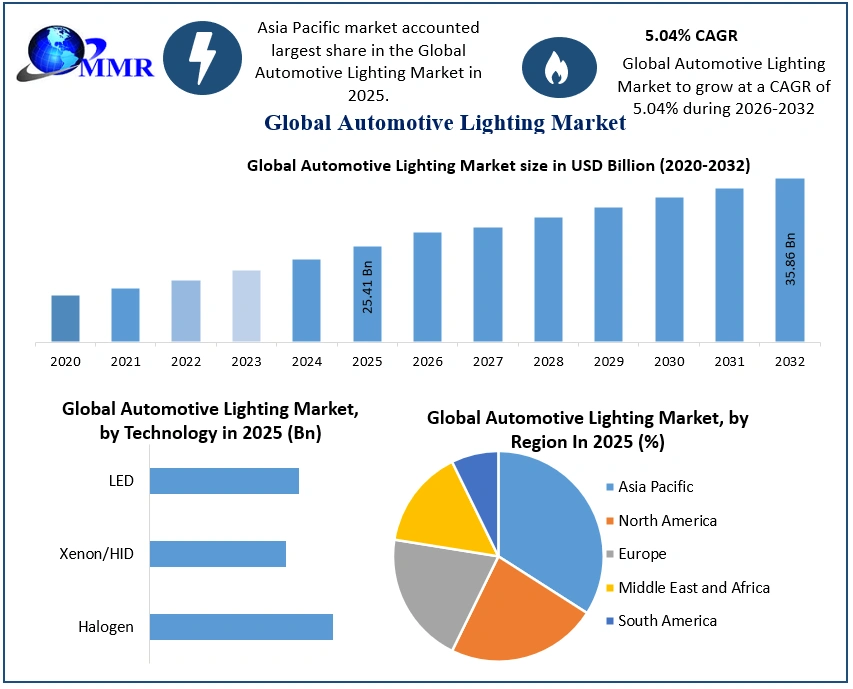
- Automotive Lighting Market valued at USD 25.41 Billion in 2025.
- Market projected to reach USD 35.86 Billion by 2032.
- Expected CAGR of 5.04% from 2026 to 2032.
- Asia Pacific holds the largest regional market share at nearly 35.8%.
- Front lighting and headlamp systems remain the dominant application category.
- Interior lighting is emerging as the fastest-growing segment.
- EV adoption is accelerating demand for premium LED and adaptive lighting technologies.
- Matrix LED and Adaptive Front-Lighting Systems (AFS) are becoming key differentiators for OEMs.
Why This Matters Now
Automakers are competing on software, electrification, and vehicle intelligence. Lighting has moved from a functional component to a strategic technology platform that influences safety, energy efficiency, vehicle branding, and consumer purchasing decisions.
For suppliers, the transition from conventional halogen systems to LED, OLED, Matrix LED, and adaptive lighting creates a new value pool. For investors and OEM executives, lighting is becoming a high-margin technology category closely linked to premiumization and electric vehicle adoption.
Market Overview
The Automotive Lighting Market is entering a new growth phase as vehicle manufacturers integrate intelligent lighting systems into next-generation mobility platforms. The market was valued at USD 25.41 Billion in 2025 and is expected to reach nearly USD 35.86 Billion by 2032, expanding at a CAGR of 5.04%.
The growth story is no longer limited to vehicle production volumes. Increasing safety regulations, rising consumer expectations, advanced driver-assistance systems (ADAS), and electric vehicle adoption are transforming lighting into a technology-intensive segment.
Modern lighting systems now support vehicle communication, driver assistance, energy optimization, and brand differentiation. OEMs are increasingly investing in adaptive headlights, dynamic turn indicators, ambient lighting, and digital lighting architectures that improve visibility while reducing power consumption.
Key Trends Driving Growth
The strongest growth catalyst remains the shift toward electric vehicles. EV manufacturers frequently integrate advanced lighting systems as standard equipment, creating higher content value per vehicle compared with traditional internal combustion engine models. Advanced LED architectures also align with EV requirements for energy efficiency and battery optimization.
Adaptive Front-Lighting Systems and Matrix LED technologies are gaining momentum across premium and mid-range vehicle categories. These technologies dynamically adjust illumination patterns according to traffic and road conditions, improving safety and supporting autonomous driving functions.
Vehicle personalization is creating another growth avenue. Interior ambient lighting, customizable cabin environments, and digital lighting experiences are becoming important differentiators, particularly in premium and connected vehicles. This trend explains the rapid growth of interior lighting applications.
The industry is also benefiting from stricter road safety regulations across major automotive markets. Governments and regulators are encouraging the adoption of advanced lighting technologies that improve visibility and reduce accident risks during nighttime driving.
Meanwhile, semiconductor integration is increasing. Smart lighting systems rely on sensors, control units, and electronic components, creating stronger dependencies on semiconductor supply chains. As vehicle electronics become more complex, lighting suppliers are evolving into software-enabled technology partners rather than component manufacturers.
Get a free sample:https://www.maximizemarketresearch.com/request-sample/26778/
Segment Insights
- Dominant Segment: Front Lighting / Headlamps
- Headlamp systems continue to generate the largest revenue share due to their critical role in vehicle safety, design differentiation, and technology integration.
- Matrix LED and adaptive headlamp technologies are driving premium value creation within this category.
- Fastest-Growing Segment: Interior Lighting
- Interior lighting is experiencing the highest growth rate as OEMs focus on personalized cabin experiences and premium vehicle features.
- LED and OLED technologies are enabling customizable lighting environments across passenger vehicles.
- Technology Leadership
- LED technology remains the dominant lighting technology because of energy efficiency, long operational life, and design flexibility.
- Advanced LED systems support adaptive functions and smart vehicle architectures.
- Sales Channel Dynamics
- OEM channels continue to dominate market demand as advanced lighting technologies are increasingly integrated at the manufacturing stage.
- The aftermarket segment is expanding as consumers seek LED upgrades and customization solutions.
Regional Growth Story
Asia Pacific remains the largest Automotive Lighting Market, accounting for nearly 35.8% of global market share in 2025. China, India, Japan, and Taiwan continue to serve as major automotive manufacturing hubs, supported by rising vehicle production, expanding middle-class populations, and growing EV adoption.
China remains a strategic center for electric vehicle production and advanced automotive technologies. As domestic OEMs scale EV manufacturing, demand for intelligent lighting systems continues to increase.
India is emerging as an important growth market due to rising vehicle ownership, manufacturing investments, and increasing adoption of LED-based lighting solutions. Local production expansion is strengthening regional supply chains.
Japan and South Korea continue to lead innovation in advanced automotive electronics, creating opportunities for next-generation lighting technologies integrated with ADAS and autonomous driving systems.
Competitive Landscape
Competition is increasingly focused on technology leadership rather than production scale alone. OEMs and Tier-1 suppliers are investing in adaptive lighting, digital lighting architectures, and software-driven vehicle systems.
Lighting suppliers that can integrate hardware, sensors, semiconductors, and software are positioned to capture greater value as vehicles become connected and autonomous. The shift toward EVs further favors suppliers with expertise in energy-efficient LED systems and advanced lighting modules.
Supplier relationships are also evolving. Automakers increasingly seek strategic technology partners capable of supporting global production programs while meeting regulatory requirements across multiple regions.
Recent Developments
- Growing adoption of Adaptive Front-Lighting Systems (AFS).
- Increased deployment of Matrix LED technology in premium vehicles.
- Rising integration of advanced LED systems in electric vehicles.
- Expansion of interior ambient lighting solutions for personalized vehicle experiences.
- Strong OEM investment in intelligent and energy-efficient lighting architectures.
Strategic Implications
For OEMs, advanced lighting systems are becoming a brand differentiator and safety feature rather than a commodity component.
For Tier-1 suppliers, technology innovation creates opportunities to expand margins through intelligent lighting solutions integrated with sensors and vehicle software.
For investors, the market offers exposure to several structural growth trends, including electrification, autonomous driving, ADAS deployment, vehicle premiumization, and connected mobility.
Companies that successfully combine lighting hardware with digital functionality will gain stronger pricing power and long-term competitive advantages.
Future Outlook
The next phase of market growth will be driven by intelligent, software-enabled lighting systems that support electrified, connected, and autonomous vehicles; companies that innovate fastest will define the future competitive hierarchy of automotive mobility.
Analyst Perspective
“Automotive lighting is evolving from a safety component into a strategic technology platform. As EV adoption accelerates and vehicle intelligence increases, manufacturers that invest in adaptive, energy-efficient, and digitally integrated lighting systems will be best positioned to capture future growth opportunities.” — Tejaswini Kakade, Analyst.
About Maximize Market Research
Maximize Market Research Pvt. Ltd. (MMR) is a global market research and consulting company that provides reliable, data-focused, and practical business insights. The firm serves a wide range of industries, including healthcare, pharmaceuticals, technology, automotive, electronics, chemicals, personal care, and consumer goods. Through market forecasts, competitive analysis, strategic consulting, and industry impact assessments, MMR helps organizations understand changing market conditions, identify growth opportunities, and make informed business decisions for long-term success.
2nd Floor, Navale IT Park Phase 3
Pune Banglore Highway, Narhe
Pune, Maharashtra 411041, India
+91 9607365656
sales@maximizemarketresearch.com
