Key Highlights
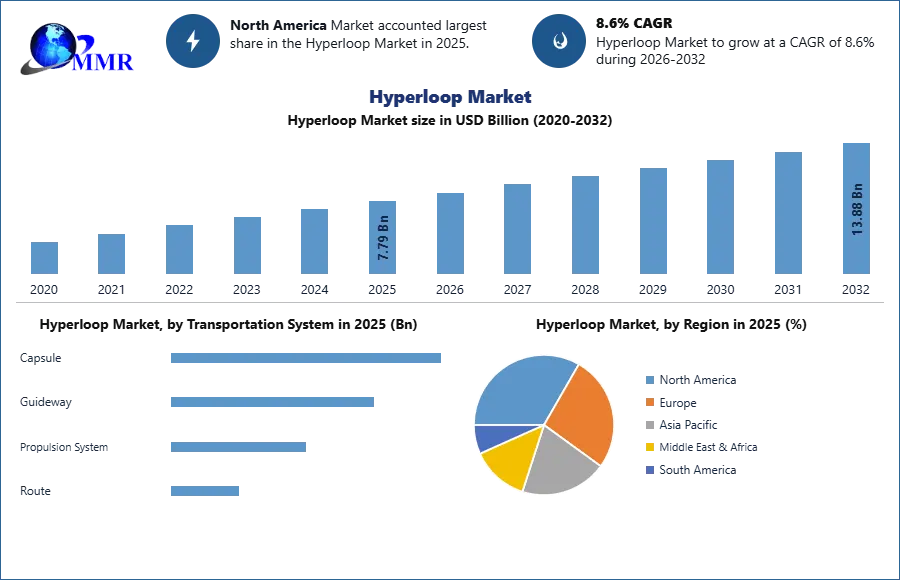
- Global Hyperloop Market valued at USD 7.79 billion in 2025
- Market projected to reach USD 13.88 billion by 2032
- Forecast CAGR of 8.6% from 2026 to 2032
- Passenger transportation remains a primary commercialization focus
- Significant investments continue across technology development and infrastructure planning
- Sustainability and carbon-emission reduction remain major growth drivers
- Asia-Pacific leads market development activity through infrastructure investments and mobility demand
Why This Matters Now
Transportation networks worldwide are confronting three simultaneous challenges: urban congestion, carbon reduction mandates, and growing demand for faster intercity travel. Conventional transport systems require substantial modernization, while aviation faces increasing scrutiny over environmental impact.
Hyperloop technology positions itself as a potential solution by combining near-airline speeds with lower emissions and renewable energy integration. For investors, the opportunity extends beyond transportation services into infrastructure construction, propulsion systems, digital controls, station development, and ecosystem partnerships.
The next phase of competition is shifting from concept promotion toward engineering execution, regulatory engagement, and commercial feasibility.
Market Overview
The Hyperloop Market represents what many industry participants describe as the third major revolution in transportation after road and air travel. The technology utilizes low-pressure tubes and advanced propulsion systems to move passenger or cargo capsules at extremely high speeds while reducing friction and energy consumption.
The market’s growth is being driven by increasing interest in sustainable transportation systems capable of reducing fuel costs, minimizing emissions, and improving travel efficiency. Governments and private investors are directing capital toward research, testing, infrastructure planning, and commercialization initiatives.
Unlike conventional transport modes, Hyperloop projects are being developed with sustainability integrated into the core design philosophy. Renewable energy sources such as solar and wind power are increasingly considered within future deployment strategies. This positions the technology within broader global decarbonization initiatives and long-term mobility transformation agendas.
Key Trends Driving Growth
Several structural trends are shaping market expansion.
First, infrastructure investment is increasing as countries evaluate future transportation networks capable of supporting economic growth while meeting climate objectives. Hyperloop proposals are increasingly being assessed alongside high-speed rail and next-generation transit alternatives.
Second, sustainability has become a central investment criterion. Hyperloop systems are designed to reduce direct emissions while improving energy efficiency compared with conventional transportation modes. This alignment with environmental priorities is attracting policy attention and long-term funding interest.
Third, technological advancements continue to improve the feasibility of commercial deployment. Development efforts are focusing on propulsion systems, safety mechanisms, passenger experience, operational efficiency, and route optimization.
Fourth, public-private partnerships are becoming increasingly important. Governments provide regulatory support and infrastructure planning, while private companies contribute technology development, engineering expertise, and capital investment.
The result is an emerging ecosystem where transportation innovation, infrastructure modernization, and climate objectives converge.
Get Instant Access to Market Insights with a Complimentary Sample Report
Segment Insights
- Dominant Segment: Passenger-Only Hyperloop
- Passenger transportation remains the primary commercial focus due to strong demand for rapid intercity mobility and mass transit solutions.
- Reduced travel times create significant economic value for both commuters and regional economies.
- Fastest-Growing Segment: Passenger-Plus-Vehicle Hyperloop
- Interest is growing in systems capable of transporting both passengers and vehicles.
- The segment offers opportunities to expand use cases while increasing infrastructure utilization rates.
- Transportation systems continue to evolve around capacity enhancement, safety improvements, and operational efficiency.
- Infrastructure-related investments remain critical as commercial deployment depends on large-scale route construction and station development.
Regional Growth Story
Asia-Pacific
Asia-Pacific represents the leading regional growth story for the Hyperloop Market. Rapid urbanization, expanding transportation demand, and large-scale infrastructure investment programs create favorable conditions for next-generation transit systems.
Countries such as China and India continue exploring advanced transportation technologies to address population growth, congestion, and economic connectivity requirements. Government-backed infrastructure initiatives further strengthen regional momentum.
North America
North America remains a major innovation center for Hyperloop development. The region benefits from strong private-sector participation, technology leadership, and significant research and development activity.
Commercial viability studies, prototype testing, and strategic partnerships continue to shape market progress.
Europe
European interest is closely tied to sustainability objectives and carbon reduction targets. Policymakers increasingly evaluate transportation technologies capable of supporting environmental commitments while enhancing regional connectivity.
Investment activity across engineering, infrastructure planning, and mobility innovation continues to support market development.
Competitive Landscape
Competition within the Hyperloop Market remains centered on technology readiness, engineering capability, infrastructure partnerships, and funding access.
Hundreds of millions of dollars have been directed toward Hyperloop development globally. The industry’s strategic objective has shifted from generating awareness to reducing deployment costs and improving commercial feasibility.
A key competitive theme involves affordability. Companies that successfully lower infrastructure and operational costs will gain stronger positioning as governments evaluate transportation investment priorities.
The competitive environment also demonstrates a transition from standalone technology development toward ecosystem creation. Success increasingly depends on coordinating infrastructure providers, engineering firms, policymakers, investors, and mobility operators.
Development efforts by organizations such as TUM Hyperloop illustrate how academic institutions and technology developers are accelerating commercialization pathways. The company’s expectation that technology could be ready by the end of the decade signals increasing confidence in long-term market potential.
Recent Developments
- Continued investment from governments, private companies, and investment firms in Hyperloop initiatives
- Growing focus on cost reduction strategies to improve mass-market viability
- Expansion of research and development programs focused on propulsion and safety systems
- Increased emphasis on infrastructure planning and station design optimization
- Ongoing efforts to improve passenger capacity and operational efficiency
- Strengthening collaboration among technology developers, engineering specialists, and mobility stakeholders
Strategic Implications
For infrastructure developers, Hyperloop presents a long-duration investment opportunity linked to transportation modernization and economic development.
For technology providers, the market offers opportunities in propulsion systems, digital controls, safety technologies, renewable energy integration, and operational software.
For governments, Hyperloop could support broader objectives related to emissions reduction, economic connectivity, and transportation capacity expansion.
For investors, the market remains a high-potential but execution-dependent opportunity. Competitive advantage will increasingly be determined by engineering feasibility, regulatory alignment, and cost efficiency rather than conceptual innovation alone.
The industry’s next phase will be defined by pilot projects, infrastructure commitments, and commercial validation.
Future Outlook
The future of the Hyperloop Market depends on translating technological promise into scalable infrastructure, with future leaders defined by their ability to deliver commercially viable systems rather than visionary concepts alone.
Analyst Perspective
“Hyperloop technology is progressing from a futuristic transportation concept toward a serious infrastructure and mobility discussion. The market’s long-term success will depend on balancing innovation, affordability, safety, and large-scale deployment feasibility while meeting growing sustainability expectations.” — Siddhi Dole
About Maximize Market Research
Maximize Market Research Pvt. Ltd. (MMR) is a global market research and consulting company that provides reliable, data-focused, and practical business insights. The firm serves a wide range of industries, including healthcare, pharmaceuticals, technology, automotive, electronics, chemicals, personal care, and consumer goods. Through market forecasts, competitive analysis, strategic consulting, and industry impact assessments, MMR helps organizations understand changing market conditions, identify growth opportunities, and make informed business decisions for long-term success.
Contact Us
2nd Floor, Navale IT Park Phase 3
Pune Banglore Highway, Narhe
Pune, Maharashtra 411041, India
+91 9607365656
sales@maximizemarketresearch.com
