Key Highlights
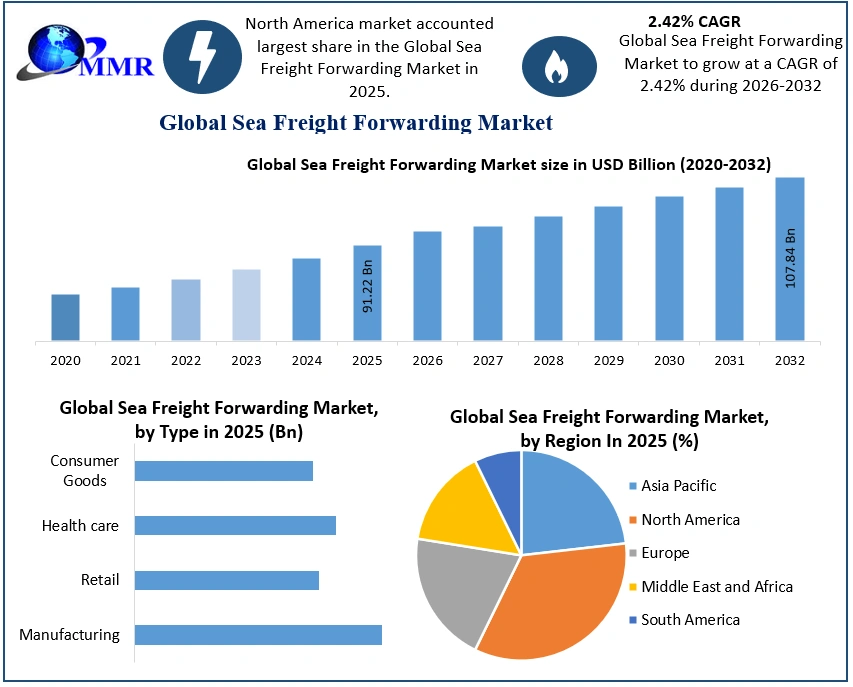
- Global Sea Freight Forwarding Market valued at USD 91.22 billion in 2025.
- Market projected to reach USD 107.84 billion by 2032.
- CAGR of 2.42% during 2026–2032.
- Asia Pacific expected to remain the leading regional market.
- Manufacturing remains the dominant end-user segment.
- Full Container Load (FCL) and Less-than Container Load (LCL) continue to shape service demand.
- Digital technologies including automation, predictive analytics, and real-time tracking are transforming operations.
- Competition is intensifying among global logistics providers through service expansion and technology investments.
Why This Matters Now
Global supply chains are entering a period where execution matters more than capacity alone. Freight forwarders that can provide visibility, reliability, and integrated logistics services are gaining strategic importance for manufacturers, retailers, and multinational exporters.
For automotive manufacturers, industrial suppliers, and fleet operators, sea freight forwarding has become a critical enabler of inventory optimization and global sourcing strategies. As trade corridors become more complex, logistics providers are increasingly influencing cost structures, delivery performance, and supply chain resilience.
Market Overview
The Sea Freight Forwarding Market was valued at USD 91.22 billion in 2025 and is expected to reach nearly USD 107.84 billion by 2032, registering a CAGR of 2.42% during the forecast period.
Sea freight forwarding encompasses a broad range of logistics services, including transportation management, customs clearance, warehousing, packaging, inventory management, documentation, and distribution. These services enable the efficient movement of components, spare parts, and finished products across international maritime trade routes.
The market serves diverse industries including manufacturing, automotive, aerospace, healthcare, electronics, industrial machinery, and consumer goods. Demand is being driven by the increasing complexity of global supply chains and the need for dependable transportation solutions that support uninterrupted industrial operations.
Growth remains steady rather than explosive. That shift signals a maturing industry where operational excellence, technology adoption, and service integration increasingly determine competitive advantage.
Key Trends Driving Growth
Digital transformation is becoming a defining competitive factor across the sea freight forwarding industry. Companies are investing in automation, predictive analytics, and real-time shipment tracking to improve operational visibility and reduce delays.
Customers are demanding end-to-end logistics solutions rather than standalone transportation services. This is pushing freight forwarders to expand capabilities across warehousing, customs management, inventory control, and multimodal logistics.
Supply chain resilience has also become a board-level priority. Manufacturers are looking for logistics partners capable of managing disruptions while maintaining service continuity across international trade routes.
The continued requirement for just-in-time delivery models across industrial sectors is increasing the importance of sophisticated freight management solutions. Forwarders that can combine global reach with operational flexibility are positioned to capture greater market share.
Request a Sample Copy to Evaluate Market Potential and Future Growth Trends
Segment Insights
- Dominant End-User Segment: Manufacturing
- Manufacturing represents the leading market segment.
- Global production networks depend heavily on reliable movement of components, machinery parts, and industrial materials.
- Manufacturers increasingly rely on freight forwarders to support inventory efficiency and minimize operational downtime.
- Key Service Categories
- Full Container Load (FCL)
- Less-than Container Load (LCL)
- Fastest-Growing Segment
- The report does not specify the fastest-growing segment. Therefore, no growth ranking can be confirmed.
- Industry Applications
- Manufacturing
- Retail
- Healthcare
- Consumer Goods
Manufacturing’s dominance highlights the growing integration between logistics providers and industrial production ecosystems. Freight forwarders are no longer simply transportation intermediaries; they are becoming strategic supply chain partners.
Regional Growth Story
Asia Pacific is expected to lead the global Sea Freight Forwarding Market throughout the forecast period.
The region’s leadership is supported by extensive manufacturing activity, export-oriented economies, and strong participation in global trade networks. Countries including China, Japan, South Korea, India, Australia, Vietnam, Indonesia, Malaysia, Taiwan, Bangladesh, and Pakistan collectively strengthen the region’s logistics ecosystem.
For global manufacturers, Asia Pacific remains central to sourcing strategies and production networks. This concentration of industrial activity creates sustained demand for efficient maritime logistics services.
Europe continues to represent an important market due to its established industrial base and international trade activity. Germany, France, the United Kingdom, Italy, Spain, Sweden, and Austria remain significant contributors to regional freight volumes.
North America benefits from extensive cross-border trade and advanced logistics infrastructure. The United States, Canada, and Mexico continue to generate substantial demand for integrated freight forwarding solutions.
Meanwhile, the Middle East, Africa, and South America are strengthening their roles in global trade connectivity through ongoing logistics and transportation development.
Competitive Landscape
The market remains highly competitive, combining large global operators with regional specialists.
Major participants include DHL Global Forwarding, Kuehne + Nagel, DB Schenker, Expeditors, and C.H. Robinson. These companies leverage global networks, customs expertise, transportation capabilities, and value-added logistics services to maintain market leadership.
Competition is increasingly centered on technology, service integration, and operational efficiency rather than scale alone.
Investments in digital platforms signal a broader strategic shift. Real-time tracking, automated workflows, and predictive analytics are helping providers improve customer experience while lowering operational complexity.
The presence of numerous regional logistics providers also creates pricing pressure and market fragmentation. This dynamic encourages larger players to differentiate through network reach, specialized services, and technology-enabled solutions.
Recent Developments
- Adoption of automation technologies across freight forwarding operations.
- Increased deployment of real-time cargo tracking capabilities.
- Expansion of predictive analytics tools for logistics planning.
- Growing emphasis on integrated warehousing and inventory management services.
- Continued investment in end-to-end logistics platforms by major global providers.
These developments indicate that the next phase of competition will be driven by data visibility, service reliability, and supply chain intelligence rather than transportation capacity alone.
Strategic Implications
For manufacturers, freight forwarding partners are becoming increasingly important in managing inventory efficiency and supply chain continuity.
For logistics providers, technology investment is no longer optional. Companies that fail to modernize operational processes risk losing market share to digitally enabled competitors.
Investors should monitor firms that successfully combine global network strength with advanced logistics technologies. These organizations are better positioned to capture value from growing customer demand for integrated supply chain services.
For automotive suppliers and industrial exporters, the ability to secure dependable maritime logistics support will remain a critical factor in maintaining competitiveness across international markets.
Future Outlook
The Sea Freight Forwarding Market is entering a period of disciplined growth where operational visibility, technology adoption, and integrated logistics capabilities will determine market leadership more than transportation scale alone.
Analyst Perspective
“The Sea Freight Forwarding Market continues to evolve as customers demand greater efficiency, visibility, and end-to-end logistics support. Companies that combine digital capabilities with strong global networks will be best positioned to capitalize on future opportunities across international trade and supply chain management.” — Siddhi Dole, Analyst
About Maximize Market Research
Maximize Market Research Pvt. Ltd. (MMR) is a global market research and consulting company that provides reliable, data-focused, and practical business insights. The firm serves a wide range of industries, including healthcare, pharmaceuticals, technology, automotive, electronics, chemicals, personal care, and consumer goods. Through market forecasts, competitive analysis, strategic consulting, and industry impact assessments, MMR helps organizations understand changing market conditions, identify growth opportunities, and make informed business decisions for long-term success.
Contact Us
2nd Floor, Navale IT Park Phase 3
Pune Banglore Highway, Narhe
Pune, Maharashtra 411041, India
+91 9607365656
sales@maximizemarketresearch.com
