Key Highlights
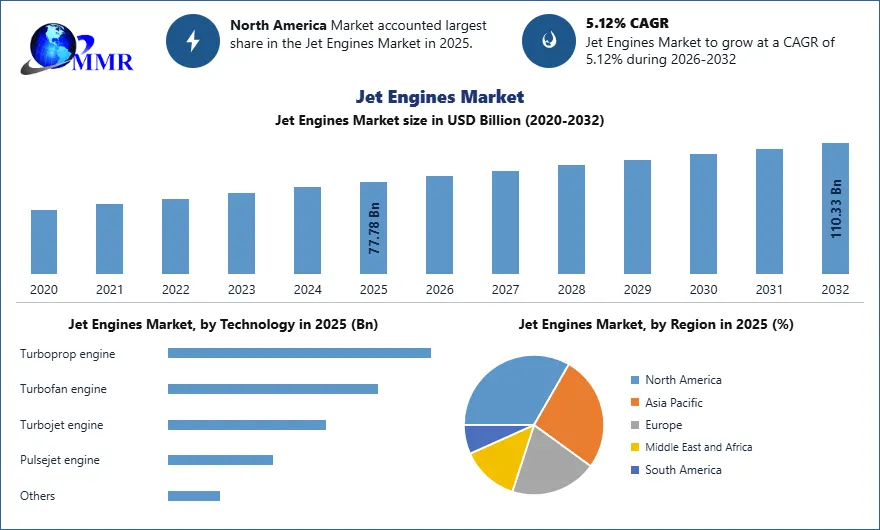
- Jet Engines Market valued at USD 77.78 Billion in 2025.
- Market expected to reach USD 110.33 Billion by 2032.
- Forecast CAGR stands at 5.12% from 2026 to 2032.
- Commercial aviation remains a primary demand generator.
- Fleet modernization is accelerating demand for fuel-efficient propulsion systems.
- Defense procurement programs continue supporting long-term engine investments.
- Sustainability goals are influencing next-generation engine development.
- Aftermarket maintenance and overhaul services remain a major revenue contributor.
Why This Matters Now
The aviation industry has shifted from recovery to expansion. Airlines are rebuilding networks, increasing fleet utilization, and placing orders for more efficient aircraft capable of reducing fuel consumption and emissions.
For engine manufacturers, this creates a strategic opportunity to strengthen long-term service agreements, expand aftermarket revenues, and secure positions on next-generation aircraft platforms. For investors, the market’s growth trajectory signals sustained capital expenditure across aerospace manufacturing, maintenance infrastructure, and propulsion technologies.
Governments are also tightening emissions requirements and supporting aviation decarbonization efforts. These developments are increasing demand for advanced propulsion systems that deliver both operational efficiency and environmental compliance.
Market Overview
The Jet Engines Market remain the technological backbone of modern aviation. Commercial airlines, military organizations, cargo operators, and business aviation companies depend on continuous innovation in propulsion systems to improve performance, reduce operating costs, and meet evolving regulatory standards.
The market’s projected rise from USD 77.78 Billion in 2025 to USD 110.33 Billion by 2032 indicates that demand extends beyond new aircraft production. A significant share of value creation is emerging from maintenance, repair, and overhaul activities as airlines seek to maximize fleet availability.
Aircraft manufacturers continue introducing platforms designed around higher-efficiency engines. Engine suppliers are responding with investments in advanced materials, improved combustion technologies, digital monitoring systems, and enhanced maintenance capabilities.
The result is a market increasingly defined by lifecycle value rather than initial equipment sales alone.
Key Trends Driving Growth
Fleet Modernization Accelerates
Many airlines are replacing aging aircraft with newer models offering improved fuel economy and lower emissions. Engine efficiency has become a major purchasing criterion as fuel remains one of the largest operating expenses for carriers.
The shift benefits engine manufacturers capable of delivering measurable reductions in fuel burn and maintenance requirements.
Sustainability Moves to the Center of Aerospace Strategy
Pressure to reduce aviation emissions is reshaping product development priorities. Aerospace companies are investing in propulsion technologies compatible with sustainable aviation fuels and future low-carbon operating models.
This trend is influencing both commercial and defense procurement decisions.
Aftermarket Services Gain Strategic Importance
Engine manufacturers increasingly generate revenue through long-term maintenance contracts. As fleets expand globally, operators require predictable maintenance schedules, digital diagnostics, and rapid service support.
Companies with strong global service networks gain greater pricing power and customer retention.
Defense Modernization Supports Stable Demand
Military aviation programs continue generating demand for advanced propulsion systems. Governments are investing in fighter aircraft, surveillance platforms, and transport fleets to strengthen defense capabilities.
This provides a relatively resilient demand stream independent of commercial aviation cycles.
Digital Technologies Improve Engine Performance
Data analytics, predictive maintenance, and connected engine monitoring systems are transforming asset management. Airlines can identify performance issues earlier, reduce downtime, and optimize maintenance planning.
The integration of digital capabilities is becoming a competitive differentiator for engine suppliers.
Get a free sample : https://www.maximizemarketresearch.com/request-sample/76380/
Segment Insights
- Dominant Segment: Commercial aviation applications continue to account for a significant share of market demand due to rising passenger traffic, aircraft deliveries, and fleet expansion activities worldwide.
- Fastest-Growing Segment: Advanced fuel-efficient engine technologies are gaining momentum as airlines pursue lower operating costs and regulatory compliance requirements.
- Growing demand from military aviation programs supports long-term engine procurement.
- Business aviation recovery contributes additional opportunities for engine manufacturers and maintenance providers.
- Engine aftermarket services remain a critical value-generation segment due to recurring maintenance and overhaul requirements throughout the engine lifecycle.
Regional Growth Story
North America
North America remains a major aerospace hub supported by strong aircraft manufacturing capabilities, defense spending, and established maintenance infrastructure.
The region benefits from continuous investment in commercial fleet modernization and advanced propulsion technologies.
Europe
European aerospace companies continue prioritizing sustainability and emissions reduction. Regulatory frameworks are encouraging investment in next-generation propulsion systems and sustainable aviation initiatives.
Aircraft operators across the region are actively upgrading fleets to improve efficiency and environmental performance.
Asia-Pacific
Asia-Pacific represents one of the most important growth engines for the global aviation sector. Rising air travel demand, expanding middle-class populations, and airline network growth continue driving aircraft procurement.
Countries including India, China, Japan, and South Korea are strengthening aerospace manufacturing capabilities while investing heavily in aviation infrastructure.
Middle East
The Middle East remains a strategic aviation hub connecting global passenger and cargo routes. Airlines continue expanding fleets to support long-haul operations and international connectivity.
Rest of the World
Emerging aviation markets across Latin America and Africa are gradually increasing aircraft investments, creating additional opportunities for engine suppliers and aftermarket service providers.
Competitive Landscape
Competition in the Jet Engines Market extends far beyond engine performance specifications. Industry leaders are competing across technology innovation, service networks, production capacity, digital capabilities, and sustainability initiatives.
The most successful companies are pursuing integrated business models that combine engine manufacturing with long-term maintenance agreements and digital support services. This approach creates recurring revenue streams while strengthening customer relationships.
Capacity expansion strategies also remain critical. Aircraft delivery backlogs continue creating opportunities for suppliers capable of maintaining production efficiency while meeting quality and certification requirements.
Partnerships across aerospace ecosystems are becoming increasingly important as manufacturers seek access to advanced materials, digital technologies, and next-generation propulsion research.
The competitive focus has shifted from selling engines to delivering complete lifecycle performance solutions.
Recent Developments
- Aerospace manufacturers continue investing in fuel-efficient propulsion technologies.
- Airlines are accelerating fleet replacement programs to reduce operating costs.
- Defense organizations are increasing procurement of advanced aviation platforms.
- Digital engine monitoring and predictive maintenance solutions are gaining adoption.
- Sustainability initiatives are driving research into lower-emission propulsion systems.
- Global maintenance, repair, and overhaul networks continue expanding to support growing fleet requirements.
Strategic Implications
For airlines, engine selection increasingly determines long-term operating economics. Fuel savings, maintenance efficiency, and lifecycle reliability now carry greater strategic value than acquisition costs alone.
For OEMs and Tier-1 suppliers, technology leadership remains the primary path to differentiation. Companies capable of delivering measurable efficiency improvements will capture a larger share of future aircraft programs.
Investors should monitor developments in sustainable aviation technologies, aftermarket expansion, and digital maintenance platforms. These areas are likely to generate significant value creation as the industry evolves.
Governments and regulators will continue influencing market direction through emissions standards, defense budgets, and aviation infrastructure investments.
Future Outlook
The Jet Engines Market is positioned for sustained expansion as commercial aviation growth, defense modernization, sustainability requirements, and technological innovation converge to create a new generation of aerospace propulsion demand. The companies that combine efficiency, digital intelligence, and low-emission capabilities will define the next era of aviation leadership, while those that delay innovation risk losing relevance in an increasingly performance-driven market.
Analyst Perspective
“The Jet Engines Market is entering a period where operational efficiency, sustainability goals, and long-term service capabilities will determine competitive success. Organizations that align technology investment with evolving aviation requirements are expected to capture the strongest growth opportunities over the forecast period.” — Tejaswini Kakade, Analyst
About Maximize Market Research
Maximize Market Research Pvt. Ltd. (MMR) is a global market research and consulting company that provides reliable, data-focused, and practical business insights. The firm serves a wide range of industries, including healthcare, pharmaceuticals, technology, automotive, electronics, chemicals, personal care, and consumer goods. Through market forecasts, competitive analysis, strategic consulting, and industry impact assessments, MMR helps organizations understand changing market conditions, identify growth opportunities, and make informed business decisions for long-term success.
2nd Floor, Navale IT Park Phase 3
Pune Banglore Highway, Narhe
Pune, Maharashtra 411041, India
+91 9607365656
sales@maximizemarketresearch.com
