Two Wheeler Market Forecast Signals New Growth Cycle Driven by EV Adoption, Smart Connectivity, and Premiumization; Market Expected to Reach USD 410.36 Billion by 2032 at 3.46% CAGR
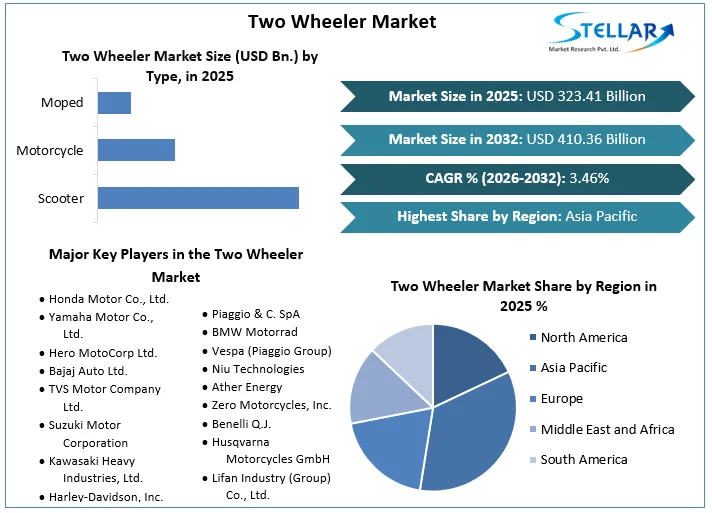
PUNE, India, June 22, 2026 — The Two Wheeler Market is entering a new phase of transformation as electrification, premium motorcycles, connected mobility technologies, and evolving urban transportation needs reshape consumer demand worldwide. According to the latest Two Wheeler Market Report published by Stellar Market Research, the global market was valued at USD 323.41 billion in 2025 and is projected to reach nearly USD 410.36 billion by 2032, expanding at a CAGR of 3.46% during 2026–2032. The study highlights how changing mobility preferences, sustainability mandates, and digital innovation are creating long-term growth opportunities across developed and emerging economies.
Market Opportunity Overview
The global two-wheeler industry is no longer driven solely by affordability. A significant transition is underway as consumers increasingly seek fuel-efficient, connected, and environmentally sustainable mobility solutions. Rapid urbanization, traffic congestion, and last-mile transportation requirements are accelerating demand for motorcycles, scooters, and electric two-wheelers across Asia-Pacific, Latin America, and parts of Africa.
The emergence of electric scooters, battery-swapping ecosystems, connected dashboards, AI-enabled diagnostics, and subscription-based mobility models is changing the competitive landscape. Manufacturers are investing heavily in EV platforms, digital retail channels, and premium product portfolios to capture higher-margin customer segments. At the same time, governments are strengthening emissions regulations and offering incentives that encourage adoption of low-emission transportation solutions.
Download Free PDF Brochure: https://www.stellarmr.com/report/req_sample/Two-Wheeler-Market/1925
Key Findings from the Report
The global Two Wheeler Market was valued at USD 323.41 billion in 2025 and is forecast to reach USD 410.36 billion by 2032, growing at a CAGR of 3.46%.
The market is segmented by Type, Engine Capacity, Technology, Fuel Type, and Distribution Channel.
Motorcycles continue to represent the dominant revenue-generating category due to their extensive use in personal and commercial transportation.
Electric two-wheelers and smart scooters are emerging as the fastest-growing segment as governments intensify clean mobility initiatives and charging infrastructure deployment.
Asia-Pacific remains the leading regional market owing to strong demand from India, China, Indonesia, Vietnam, and Thailand.
Africa and Latin America are emerging as high-potential growth regions due to expanding urban populations and increasing demand for affordable transportation.
Investors are increasingly focusing on battery technology, EV manufacturing, charging infrastructure, and premium motorcycle categories.
Market Drivers and Restraints
Key Drivers
Urban Mobility and Traffic Congestion
Increasing congestion in metropolitan areas is driving consumers toward compact, fuel-efficient transportation alternatives. Two-wheelers offer superior maneuverability, lower ownership costs, and reduced parking challenges.
Electrification of Personal Mobility
Government incentives, lower operating costs, and growing environmental awareness are accelerating electric two-wheeler adoption globally. New battery technologies and charging ecosystems are improving consumer confidence and reducing range anxiety.
Rising Disposable Income and Premiumization
Growing middle-class populations in emerging economies are supporting demand for premium motorcycles, performance bikes, and connected scooters equipped with advanced safety and infotainment features.
Key Restraints
Lithium-Ion Battery Design and Manufacturing Challenges
Battery cost volatility, raw material dependence, and supply chain complexity continue to constrain large-scale EV adoption and profitability.
Supply Chain and Component Constraints
Global shortages of critical materials and electronic components have increased production costs and delivery timelines for manufacturers. Recent rare-earth magnet shortages have also affected EV production planning.
Technology, Regulation, and Sustainability Trends
Digital transformation is becoming a key differentiator across the Two Wheeler Market. Connected vehicle technologies, smartphone integration, over-the-air software updates, predictive maintenance systems, and AI-driven diagnostics are improving user experience and fleet efficiency.
Regulatory developments are also reshaping product strategies. Stricter emission standards, safety mandates, and electric mobility incentives are encouraging manufacturers to accelerate electrification roadmaps. Government-backed EV incentive programs and battery localization initiatives continue to attract investments into manufacturing ecosystems.
Sustainability has moved from a compliance requirement to a competitive advantage. Companies are focusing on recyclable battery materials, renewable energy-powered manufacturing facilities, and circular economy practices to strengthen ESG performance.
Regional Insights
Asia-Pacific Leads Global Demand
Asia-Pacific continues to dominate the Two Wheeler Market due to high population density, strong manufacturing capabilities, and widespread consumer adoption. India, China, Indonesia, and Vietnam remain among the largest contributors to global demand.
Africa and Latin America Gain Momentum
Emerging economies across Africa and Latin America are witnessing growing demand for affordable mobility solutions. Expanding urban infrastructure, increasing workforce mobility, and improving financing availability are supporting market expansion.
Europe and North America
While smaller in volume, Europe and North America are experiencing growth in premium motorcycles and electric two-wheelers driven by sustainability policies and consumer preference for alternative mobility solutions.
Recent Industry Developments
Honda (2025): Launched the Activa e and QC1 electric scooters, marking a major expansion into the electric two-wheeler segment while introducing battery-swapping infrastructure in key Indian cities.
TVS Motor Company (2025): Introduced an upgraded iQube portfolio featuring enhanced battery capacity and ranges reaching up to 212 km, strengthening its position in electric mobility.
TVS Motor Company (2025): Showcased future mobility concepts including the world’s first CNG scooter and next-generation electric mobility platforms at Bharat Mobility Global Expo.
Hero MotoCorp (2025): Expanded its international footprint through new distribution partnerships in Europe while benefiting from strong export growth and demand recovery.
Government EV Incentive Programs (2025): Continued support for electric mobility through subsidy and clean transportation initiatives has accelerated investment in electric two-wheeler ecosystems across major markets.
Competitive Landscape
The market remains highly competitive with established manufacturers pursuing product innovation, electrification, localization, and global expansion strategies. Key participants include Honda Motor Co., Ltd., Hero MotoCorp, TVS Motor Company, Bajaj Auto, Yamaha Motor Co., Ltd., Suzuki Motor Corporation, and Piaggio Group.
Leading companies are focusing on electric vehicle development, strategic partnerships, digital sales channels, premium product launches, and manufacturing expansion to strengthen market share.
Download Free PDF Brochure: https://www.stellarmr.com/report/req_sample/Two-Wheeler-Market/1925
Analyst Commentary
“The next decade of growth in the Two Wheeler Market will be defined by the convergence of electrification, digital connectivity, and premium mobility experiences. Companies capable of balancing affordability with technology innovation will be best positioned to capture emerging demand across both developed and developing economies,” said a Senior Research Analyst at Stellar Market Research.
Future Outlook
Through 2032, the market is expected to benefit from rising urbanization, increasing EV penetration, supportive regulatory frameworks, and continued investment in advanced mobility technologies. Premium motorcycles, connected scooters, battery-swapping solutions, and sustainable manufacturing initiatives are likely to become central competitive differentiators.
As manufacturers continue to diversify propulsion technologies and expand geographic footprints, the industry is expected to witness stronger competition, accelerated innovation cycles, and increased investment in digital mobility ecosystems.
About Stellar Market Research
Stellar Market Research is a global market research and business consulting firm delivering actionable intelligence across diverse industries including automotive, healthcare, information technology, manufacturing, energy, consumer goods, and industrial sectors. The company combines advanced analytical methodologies, primary research, and data-driven forecasting models to provide organizations with strategic insights that support investment decisions, market entry planning, competitive benchmarking, and growth strategy development. Stellar Market Research serves corporations, investors, government agencies, and industry stakeholders worldwide with customized research solutions designed to help clients identify opportunities, mitigate risks, and achieve sustainable business growth in rapidly evolving markets.
Media Contact
Stellar Market Research
Website: http://stellarmr.com/
Email: sales@stellarmr.com
