Key Highlights
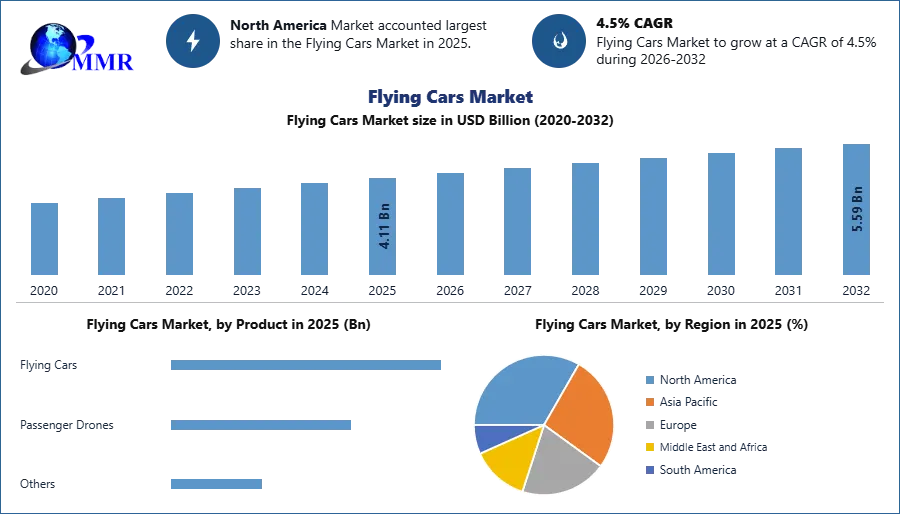
- Global Flying Cars Market valued at USD 4.11 billion in 2025.
- Market projected to reach USD 5.59 billion by 2032.
- Forecast CAGR stands at 4.5% between 2026 and 2032.
- Flying Cars segment leads product-type adoption.
- Passenger drones are expanding urban mobility opportunities.
- Urban congestion and demand for faster transportation remain key growth catalysts.
- Regulatory frameworks and infrastructure readiness continue shaping commercialization timelines.
Why This Matters Now
Transportation executives are confronting a new competitive reality. Congested cities, rising mobility demand, and increasing pressure for sustainable transportation are forcing governments, aerospace innovators, automotive manufacturers, and infrastructure developers to rethink how people move.
Flying cars have shifted from concept demonstrations to strategic mobility investments. What was once considered futuristic transportation is increasingly becoming part of urban mobility planning, creating opportunities for aircraft manufacturers, automotive OEMs, software developers, and infrastructure providers seeking early leadership in advanced air mobility ecosystems.
Market Overview
The global Flying Cars Market is entering a critical commercialization phase. According to Maximize Market Research, the market is expected to grow from USD 4.11 billion in 2025 to USD 5.59 billion by 2032, registering a CAGR of 4.5% during the forecast period.
The industry’s growth trajectory is being shaped by rising urbanization, worsening traffic congestion, and technological progress in aviation systems. Governments and mobility planners increasingly view flying vehicles as a long-term solution for reducing pressure on conventional transportation infrastructure.
Unlike traditional automotive markets that are largely driven by replacement demand, flying cars represent an entirely new transportation category. This creates opportunities across vehicle manufacturing, software integration, air traffic management, charging and landing infrastructure, maintenance services, and mobility-as-a-service business models.
The business implications are significant. Companies that establish certification pathways, infrastructure partnerships, and scalable production capabilities today may secure first-mover advantages as urban air mobility ecosystems mature.
Key Trends Driving Growth
One of the most important developments is the growing convergence between automotive engineering and aerospace innovation. Traditional transportation boundaries are disappearing as manufacturers pursue vehicles capable of both ground and aerial mobility.
Urban mobility pressures remain a powerful market driver. Major metropolitan regions face increasing congestion, creating demand for transportation alternatives capable of reducing travel times and improving connectivity between business districts, airports, and suburban areas.
Autonomous navigation technologies are also becoming increasingly important. Although full autonomy remains subject to regulatory approval and safety validation, advances in artificial intelligence, sensor integration, and flight management systems are supporting the development of next-generation flying vehicles.
Investment activity continues to accelerate across the broader advanced air mobility ecosystem. Companies are expanding research initiatives, testing programs, and prototype development efforts to establish technological leadership and prepare for future commercialization opportunities.
Infrastructure planning is emerging as another strategic focus area. Governments and urban planners are evaluating air mobility corridors, vertiports, air traffic management systems, and supporting regulatory frameworks needed to enable large-scale deployment.
The market is also benefiting from growing interest in sustainable transportation solutions. As environmental targets become more stringent, electric and hybrid propulsion technologies are receiving greater attention from manufacturers and policymakers seeking lower-emission mobility alternatives.
Get a free sample:https://www.maximizemarketresearch.com/request-sample/70432/
Segment Insights
Dominant Segment
- Flying Cars remain the dominant product segment, accounting for the largest share of industry activity and investment focus. Their ability to combine road and air mobility capabilities makes them the primary commercialization target for developers and investors.
Emerging Growth Segment
- Passenger Drones are gaining momentum as urban air mobility platforms, particularly for short-distance transportation applications and future air taxi services. Their simpler operational models may support faster deployment in selected urban environments.
Capacity Analysis
- The market includes 2-person sitter, 3–4 person sitter, and more than 4-person sitter categories, enabling manufacturers to address diverse use cases ranging from personal mobility to commercial passenger transport.
Strategic Takeaway
- Commercial transportation applications are expected to generate stronger long-term revenue opportunities than purely personal ownership models due to higher utilization rates and scalable business economics.
Regional Growth Story
North America
North America remains at the forefront of flying car innovation due to its strong aerospace ecosystem, technological capabilities, and active investment environment. The region benefits from extensive aviation expertise, research institutions, and venture capital participation supporting advanced mobility programs.
Europe
European markets are emphasizing sustainability, urban mobility transformation, and regulatory coordination. Governments and industry stakeholders are actively exploring advanced air mobility frameworks as part of broader transportation decarbonization strategies.
Asia-Pacific
Asia-Pacific presents substantial long-term potential driven by rapid urbanization, growing population density, and smart city investments. Countries across the region are increasingly evaluating advanced transportation systems to address future mobility challenges.
Middle East and Latin America
These regions are emerging as potential adoption markets, particularly in cities seeking innovative transportation solutions and investments that support economic diversification and smart infrastructure development.
Competitive Landscape
Competition in the flying cars market extends beyond vehicle manufacturing. Success increasingly depends on ecosystem development, certification expertise, software integration, infrastructure partnerships, and regulatory engagement.
Industry participants are pursuing strategies focused on technology development, strategic alliances, prototype validation, and commercialization readiness. The competitive landscape is expected to evolve as aviation companies, automotive manufacturers, technology providers, and mobility operators seek leadership positions within emerging urban air mobility networks.
For investors, the most valuable companies may not necessarily be those producing vehicles alone. Firms capable of integrating hardware, software, infrastructure, and operational services are likely to capture a larger share of future value creation.
The market’s next phase will likely be defined by certification milestones, production scalability, operational safety records, and successful deployment of supporting infrastructure.
Recent Developments
- Increased investment activity across advanced air mobility programs.
- Expansion of research and prototype development initiatives.
- Growing focus on autonomous flight technologies and intelligent navigation systems.
- Continued discussions around regulatory frameworks for urban air mobility deployment.
- Rising interest in passenger drone platforms and future air taxi applications.
- Infrastructure planning efforts supporting future commercialization pathways.
Strategic Implications
For automotive OEMs, flying cars represent an opportunity to diversify beyond traditional vehicle markets and participate in future mobility ecosystems.
For aerospace suppliers, the market creates demand for lightweight materials, advanced propulsion systems, flight-control software, and next-generation avionics technologies.
For investors, the sector remains a long-term growth opportunity where technology validation, certification progress, and ecosystem partnerships may determine future winners.
For governments and regulators, establishing clear certification standards and infrastructure frameworks will be essential to accelerating commercial adoption while maintaining safety requirements.
Companies that invest early in ecosystem positioning rather than standalone products may secure stronger competitive advantages as commercialization progresses.
Future Outlook
The Flying Cars Market is moving steadily from experimental innovation toward commercial reality, and the organizations that build scalable mobility ecosystems today will define tomorrow’s urban transportation networks while slower competitors struggle to gain relevance.
Analyst Perspective
“The Flying Cars Market is entering a transformative phase where technological innovation, urban mobility demand, and infrastructure development are converging. The next decade will be defined by commercialization readiness, regulatory progress, and the ability of industry participants to create integrated mobility ecosystems rather than standalone transportation products.” — Tejaswini Kakade, Analyst
About Maximize Market Research
Maximize Market Research Pvt. Ltd. (MMR) is a global market research and consulting company that provides reliable, data-focused, and practical business insights. The firm serves a wide range of industries, including healthcare, pharmaceuticals, technology, automotive, electronics, chemicals, personal care, and consumer goods. Through market forecasts, competitive analysis, strategic consulting, and industry impact assessments, MMR helps organizations understand changing market conditions, identify growth opportunities, and make informed business decisions for long-term success.
2nd Floor, Navale IT Park Phase 3
Pune Banglore Highway, Narhe
Pune, Maharashtra 411041, India
+91 9607365656
sales@maximizemarketresearch.com
