Waste to Energy Market Set for Strong Growth Through 2032 Amid Renewable Energy Expansion and Landfill Reduction Initiatives
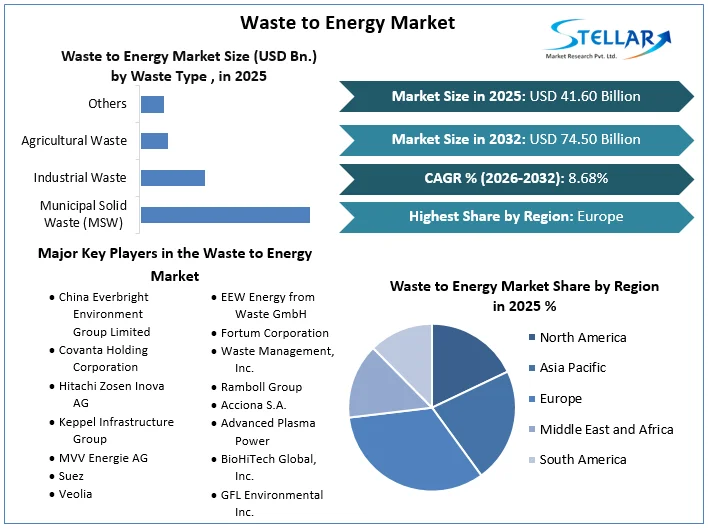
PUNE, India, June 22, 2026 – The Waste to Energy Market is entering a new phase of growth as governments, municipalities, and energy developers increasingly prioritize circular economy strategies, landfill diversion targets, and low-carbon power generation. According to a recent study by Stellar Market Research, the global Waste to Energy Market was valued at USD 41.60 billion in 2025 and is projected to reach USD 74.50 billion by 2032, expanding at a CAGR of 8.68% during the forecast period (2026–2032). The report highlights how technological innovation, environmental regulations, and growing municipal waste volumes are transforming waste streams into strategic energy assets.
Market Opportunity Overview
The global waste management landscape is undergoing a structural shift. Rising urbanization, increasing municipal solid waste generation, and mounting pressure on landfill infrastructure are compelling governments to accelerate investment in waste-to-energy (WtE) facilities.
What was once viewed primarily as a waste disposal solution is increasingly becoming a critical component of energy security and decarbonization strategies. Advanced thermal conversion technologies, biogas generation systems, and resource recovery solutions are enabling municipalities and private operators to generate electricity, heat, and renewable fuels while reducing environmental impact.
As nations pursue net-zero commitments and circular economy objectives, waste-to-energy facilities are emerging as strategic infrastructure investments capable of addressing both waste management and renewable energy challenges simultaneously.
Download Free PDF Brochure: https://www.stellarmr.com/report/req_sample/Waste-to-Energy-Market/1644
Key Findings from the Report
The global Waste to Energy Market was valued at USD 41.60 billion in 2025 and is forecast to reach USD 74.50 billion by 2032.
The market is expected to expand at a CAGR of 8.68% between 2026 and 2032.
Thermal technology accounted for approximately 80% of total market revenue, making it the dominant technology segment.
Biological waste-to-energy technologies are witnessing accelerated adoption due to growing interest in biogas and anaerobic digestion projects.
Municipal Solid Waste (MSW) remains the largest waste type segment and continues to represent the primary feedstock for commercial WtE facilities.
Europe held 43.8% of the global market share in 2025, supported by stringent landfill restrictions and renewable energy mandates.
Asia-Pacific is projected to be the fastest-growing regional market, driven by rapid urbanization, population growth, and infrastructure investments in China and India.
Market Drivers and Restraints
Key Drivers
Growing Renewable Energy Demand
Governments worldwide are expanding renewable energy portfolios to reduce dependence on fossil fuels. Waste-to-energy facilities provide reliable baseload energy while supporting carbon reduction goals.
Stringent Environmental Regulations
Landfill diversion mandates, emissions regulations, and circular economy frameworks are encouraging municipalities to adopt advanced waste treatment technologies.
Technological Advancements
Innovations in advanced incineration, hydrothermal carbonization, plasma gasification, and waste sorting systems are improving energy conversion efficiency and reducing operational costs.
Key Restraints
High Capital Requirements
Large-scale waste-to-energy facilities require significant upfront investment, often creating financing challenges for municipalities and private operators.
Regulatory and Permitting Complexity
Project developers frequently face lengthy approval processes, environmental compliance requirements, and community acceptance concerns that can delay implementation.
Technology, Regulation, and Sustainability Trends
The Waste to Energy Market is increasingly influenced by technology modernization and ESG-driven investment strategies.
Advanced combustion systems, artificial intelligence-enabled waste sorting, digital plant monitoring, and emissions-control technologies are improving facility performance while helping operators meet stricter environmental standards.
Governments across Europe, North America, and Asia-Pacific are introducing policies that support landfill diversion, renewable electricity generation, and resource recovery. Carbon reduction targets and circular economy initiatives are further strengthening the business case for waste-to-energy projects.
From a sustainability perspective, WtE facilities help reduce methane emissions from landfills, recover valuable materials, and contribute to energy diversification strategies.
Regional Insights
Europe Leads Global Adoption
Europe remains the largest Waste to Energy Market globally, accounting for 43.8% of total market share in 2025. Countries including Germany, Sweden, Denmark, and the United Kingdom continue to benefit from mature waste management infrastructure, strict landfill regulations, and renewable energy incentives.
Asia-Pacific Emerges as High-Growth Hub
Asia-Pacific is expected to deliver the fastest growth through 2032. Rapid urbanization, increasing waste generation, and government-backed investments in waste management infrastructure are accelerating adoption across China, India, Japan, and Southeast Asia.
North America Expands Modernization Efforts
The United States and Canada are witnessing increasing investment in next-generation waste conversion technologies as municipalities seek alternatives to aging landfill infrastructure.
Recent Industry Developments
Veolia (2025): Expanded multiple waste-to-energy and resource recovery initiatives across Europe, strengthening circular economy infrastructure and increasing renewable energy generation capacity.
Covanta (2025): Continued modernization of energy-from-waste facilities through emissions reduction technologies and operational efficiency upgrades, enhancing environmental compliance and energy output.
Fortum (2024): Introduced a Green Finance Framework to support future investments in clean energy and sustainable waste management infrastructure.
China Everbright Environment (2025): Expanded investment in integrated waste treatment and waste-to-energy projects across Asia, reinforcing its position as one of the industry’s largest operators.
GFL Environmental (2024–2025): Advanced strategic acquisitions and environmental services expansion initiatives to strengthen waste collection, processing, and energy recovery capabilities.
Competitive Landscape
The Waste to Energy Market remains highly competitive and fragmented, with global and regional participants focusing on technology innovation, project development, capacity expansion, and strategic partnerships.
Leading companies include China Everbright Environment Group Limited, Covanta Holding Corporation, Hitachi Zosen Inova AG, Keppel Infrastructure Group, MVV Energie AG, Suez, Veolia, Viridor Limited, Wheelabrator Technologies Inc., EEW Energy from Waste GmbH, Fortum Corporation, Waste Management, Inc., Ramboll Group, Acciona S.A., Advanced Plasma Power, BioHiTech Global, GFL Environmental Inc., Herz GmbH, and Keppel Seghers.
Industry participants are increasingly pursuing partnerships with municipalities, utilities, and technology providers to expand project pipelines and improve operational efficiency.
Download Free PDF Brochure: https://www.stellarmr.com/report/req_sample/Waste-to-Energy-Market/1644
Analyst Commentary
“The waste-to-energy industry is transitioning from a traditional waste management model toward a strategic role within the circular economy. Organizations that successfully integrate advanced conversion technologies, emissions management systems, and resource recovery capabilities will be best positioned to capture long-term value as sustainability regulations continue to evolve,” said a Senior Research Analyst at Stellar Market Research.
Future Outlook
Looking ahead, the Waste to Energy Market is expected to benefit from rising global waste generation, increasing renewable energy demand, and stronger policy support for landfill diversion.
Investment activity is likely to accelerate across Asia-Pacific and emerging economies where waste management infrastructure gaps remain significant. At the same time, technology advancements in gasification, pyrolysis, biogas production, and carbon capture are expected to improve project economics and environmental performance.
As governments pursue climate targets and circular economy objectives, waste-to-energy infrastructure will increasingly become a critical component of integrated resource management strategies through 2032.
About Stellar Market Research
Stellar Market Research is a global market research and business consulting firm delivering actionable intelligence across industries including energy, manufacturing, healthcare, chemicals, consumer goods, information technology, and advanced materials. The company provides strategic market assessments, competitive intelligence, growth forecasting, and industry trend analysis that help organizations make informed business decisions. Through a combination of primary research, data analytics, and industry expertise, Stellar Market Research supports corporate leaders, investors, policymakers, and stakeholders in identifying emerging opportunities, evaluating market risks, and developing sustainable growth strategies across global and regional markets.
Media Contact
Stellar Market Research
Website: http://stellarmr.com/
Email: sales@stellarmr.com
