Key Highlights
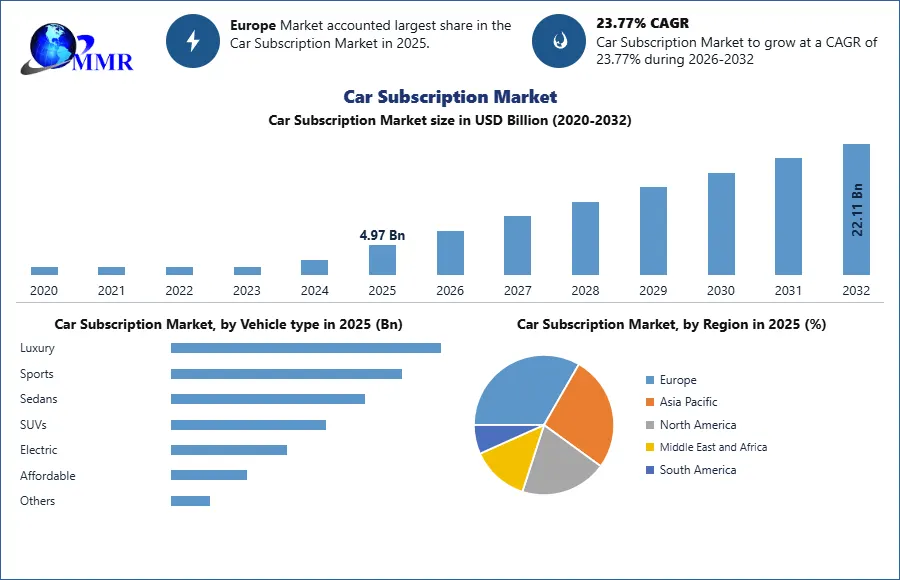
- Car Subscription Market valued at USD 4.97 Billion in 2025
- Market projected to reach USD 22.11 Billion by 2032
- Expected CAGR of 23.77% from 2026 to 2032
- Flexible mobility models are gaining traction over traditional ownership
- EV subscription offerings are emerging as a major growth engine
- OEMs are expanding direct-to-consumer subscription platforms
- Corporate fleet demand continues to drive market expansion
- Europe remains a leading adoption hub while Asia-Pacific accelerates growth
- Digital platforms, telematics, and connected vehicle technologies are enhancing customer experience
Why This Matters Now
Automakers face mounting pressure to generate recurring revenue while consumers increasingly reject long-term ownership commitments. The rise of subscription-based mobility is creating a new competitive battleground where customer retention, digital platforms, fleet management, and EV adoption matter as much as vehicle sales.
For fleet operators, investors, and mobility strategists, the shift signals a structural change in how vehicles are consumed. Subscription models provide flexibility, predictable costs, and faster access to new technologies while allowing OEMs to maintain long-term customer relationships beyond the initial vehicle sale.
Market Overview
The global Car Subscription Market is entering a period of rapid transformation. According to Maximize Market Research, the market was valued at USD 4.97 Billion in 2025 and is expected to reach USD 22.11 Billion by 2032, growing at a CAGR of 23.77% during the forecast period.
Unlike traditional ownership or leasing, subscription services bundle vehicle access, maintenance, insurance, roadside assistance, and digital services into a single monthly payment. The model aligns with broader consumer preferences toward access-based consumption, similar to trends seen across digital media, software, and mobility services.
The business case is becoming increasingly compelling. Rising vehicle prices, higher financing costs, urbanization, and evolving consumer expectations are encouraging both individuals and enterprises to adopt flexible transportation solutions. Subscription platforms reduce commitment while giving customers access to multiple vehicle categories and newer technologies.
For OEMs, subscriptions create recurring revenue streams, improve fleet utilization, and provide direct customer engagement data. These advantages are becoming strategically important as automotive manufacturers navigate electrification and software-defined vehicle transitions.
Key Trends Driving Growth
The strongest growth catalyst is the expanding demand for mobility flexibility. Consumers increasingly seek transportation solutions that can adapt to changing lifestyles, work patterns, and economic conditions.
EV adoption is accelerating another major trend. Many consumers remain interested in electric vehicles but hesitate to commit to ownership due to concerns about battery performance, resale values, and charging infrastructure. Subscription models lower these barriers by offering short-term access to EVs without long-term risk.
Corporate fleet electrification is also reshaping demand. Businesses pursuing sustainability targets are using subscription programs to test and scale EV deployments while avoiding significant capital expenditures.
Digitalization is further strengthening market growth. Advanced telematics, AI-driven fleet management, mobile applications, and seamless onboarding processes are improving customer experiences and reducing operational complexity.
Automotive manufacturers are increasingly positioning subscriptions as part of broader Mobility-as-a-Service (MaaS) strategies. This evolution connects vehicle subscriptions with ride-sharing, connected services, and future autonomous mobility ecosystems.
Get a free sample : https://www.maximizemarketresearch.com/request-sample/187723/
Segment Insights
- Dominant Segment: Internal Combustion Engine (ICE) vehicles continue to hold the largest share due to extensive availability, established refueling infrastructure, and lower subscription costs.
- Fastest-Growing Segment: Electric Vehicle (EV) subscriptions are recording the strongest growth as governments incentivize electrification and consumers seek low-risk EV adoption pathways.
- Dominant End-User Segment: Corporate customers remain the primary demand source, leveraging subscriptions for workforce mobility, operational flexibility, and fleet management efficiency.
- Fastest-Growing End-User Segment: Private consumers are increasingly adopting subscriptions as an alternative to vehicle ownership, particularly in urban environments.
- Subscription Duration Trend: Mid-term subscription models are gaining popularity by balancing affordability with flexibility.
The segment landscape indicates a market transitioning from traditional mobility solutions toward technology-enabled, service-oriented transportation models.
Regional Growth Story
Europe continues to play a leading role in the development of subscription-based mobility. Strong emissions regulations, widespread EV adoption, mature automotive ecosystems, and consumer acceptance of shared mobility models have supported rapid market expansion.
Germany remains particularly influential due to the presence of major automotive manufacturers actively experimenting with subscription platforms. Regulatory pressure tied to carbon reduction goals is further accelerating adoption across the region.
North America is witnessing growing demand as consumers seek alternatives to increasingly expensive vehicle ownership. Subscription services appeal to urban professionals, corporate users, and technology-focused consumers looking for flexibility.
Asia-Pacific represents one of the most promising growth opportunities. China, Japan, South Korea, and India are investing heavily in connected mobility, digital automotive services, and EV infrastructure. Rapid urbanization and rising middle-class populations are creating favorable conditions for subscription-based transportation models.
India is emerging as an important market where consumers increasingly prioritize convenience, affordability, and flexible vehicle access. Digital-first mobility platforms are expected to play a critical role in scaling adoption.
Competitive Landscape
Competition is intensifying as OEMs, mobility startups, leasing companies, and fleet operators pursue market share.
Automotive manufacturers view subscriptions as a strategic extension of customer lifecycle management. By offering direct subscription services, OEMs can strengthen brand loyalty, gather usage data, and create recurring revenue streams independent of traditional vehicle sales cycles.
Third-party subscription providers are responding by expanding vehicle choices, enhancing digital experiences, and developing multi-brand offerings. Their competitive advantage lies in flexibility and broad fleet access.
The competitive environment increasingly rewards companies capable of integrating vehicle supply, financing, insurance, maintenance, and digital platform capabilities into a seamless customer experience.
Technology partnerships are becoming particularly important. Connected vehicle technologies, telematics, predictive maintenance, and AI-powered fleet optimization are emerging as differentiators that improve operational efficiency and customer satisfaction.
Recent Developments
- OEMs continue expanding direct-to-consumer subscription programs
- EV-focused subscription fleets are gaining investment attention
- Digital onboarding and mobile-first platforms are improving user acquisition
- Fleet operators are increasing electrification initiatives
- Connected vehicle technologies are enhancing service personalization
- Subscription providers are expanding multi-brand vehicle offerings
- Corporate mobility programs are integrating sustainability objectives
Strategic Implications
For automakers, the subscription model represents more than a new sales channel. It creates a pathway toward recurring revenues in an industry traditionally dependent on one-time vehicle transactions.
Tier-1 suppliers stand to benefit as connected services, telematics, software platforms, and fleet management technologies become central to subscription ecosystems.
Fleet operators gain flexibility to scale operations without significant capital commitments. This advantage is particularly valuable during periods of economic uncertainty and rapid technology change.
Investors are closely watching the sector because subscription models offer predictable revenue streams and exposure to long-term mobility trends including electrification, digitalization, and shared transportation.
Regulators may also benefit as subscription services accelerate adoption of cleaner vehicles and support broader transportation sustainability objectives.
Future Outlook
The Car Subscription Market is moving from a niche mobility concept toward a mainstream automotive business model. As EV adoption accelerates, digital platforms mature, and consumers prioritize flexibility over ownership, subscription services are expected to become an increasingly important part of the automotive value chain.
The companies that combine scalable fleets, strong digital capabilities, EV expertise, and recurring customer engagement will define the next era of automotive mobility, while traditional ownership-centric models risk losing relevance.
Analyst Perspective
“The car subscription industry is evolving from an alternative mobility option into a strategic growth platform for automotive companies. Rising demand for flexibility, accelerating EV adoption, and increasing digitalization are creating significant opportunities for OEMs, fleet operators, and mobility providers to redefine customer engagement and long-term revenue generation.” — Tejaswini Kakade, Analyst
About Maximize Market Research
Maximize Market Research Pvt. Ltd. (MMR) is a global market research and consulting company that provides reliable, data-focused, and practical business insights. The firm serves a wide range of industries, including healthcare, pharmaceuticals, technology, automotive, electronics, chemicals, personal care, and consumer goods. Through market forecasts, competitive analysis, strategic consulting, and industry impact assessments, MMR helps organizations understand changing market conditions, identify growth opportunities, and make informed business decisions for long-term success.
2nd Floor, Navale IT Park Phase 3
Pune Banglore Highway, Narhe
Pune, Maharashtra 411041, India
+91 9607365656
sales@maximizemarketresearch.com
