Key Highlights
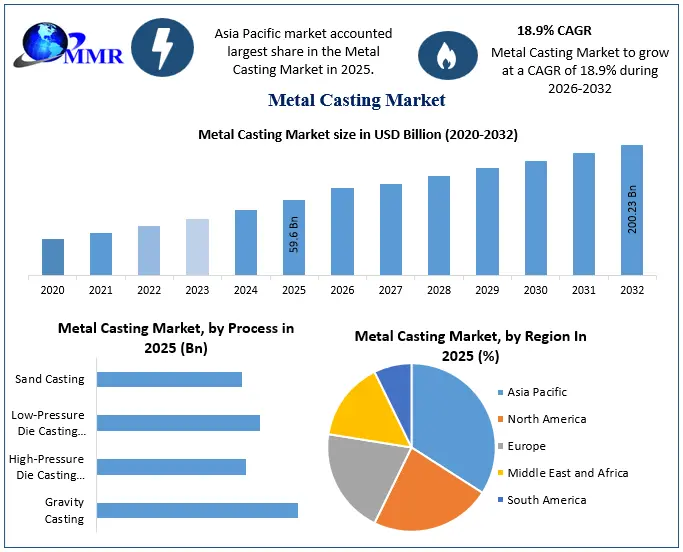
- Metal Casting Market was valued at US$ 59.6 billion in 2025 and is projected to reach US$ 200.23 billion by 2032, growing at a CAGR of 18.9%.
- Automotive manufacturers are increasing demand for lightweight cast components to improve efficiency and support EV production.
- Aluminum casting adoption is accelerating as OEMs seek weight reduction and improved vehicle performance.
- Asia-Pacific remains the primary manufacturing hub due to large-scale automotive production and expanding industrial capacity.
- Advanced die-casting technologies are transforming vehicle platform design and reducing assembly complexity.
- EV growth is creating new demand for battery housings, motor casings, structural components, and thermal management systems.
Why This Matters Now
Automakers are redesigning vehicle architectures faster than at any point in the past decade. Suppliers unable to support high-volume, lightweight, precision-cast components risk losing relevance as OEMs accelerate electric vehicle programs.
The shift from internal combustion engines to electric powertrains is changing the economics of manufacturing. Metal casting has moved from a traditional production process to a strategic capability that determines cost efficiency, vehicle weight, and production scalability.
Market Overview
The global Metal Casting Market is entering a period of accelerated expansion driven by automotive electrification, infrastructure investments, industrial modernization, and manufacturing innovation. According to Maximize Market Research, the market was valued at US$ 59.6 billion in 2025 and is expected to reach nearly US$ 200.23 billion by 2032, expanding at a CAGR of 18.9%.
For automotive manufacturers, this growth represents more than increased component demand. It signals a structural transformation in how vehicles are designed and produced. Modern EV platforms require large, lightweight, and highly integrated cast parts that reduce assembly complexity while improving vehicle performance.
Foundries are therefore investing in automation, digital manufacturing systems, simulation software, and advanced die-casting technologies to meet increasingly stringent OEM requirements. The result is a market where production efficiency, material innovation, and technological capability are becoming critical competitive differentiators.
Key Trends Driving Growth
The most significant trend shaping the market is the rapid expansion of electric vehicle production. EVs require lightweight structures to maximize battery efficiency and driving range. This has increased demand for aluminum and precision-cast components across vehicle platforms.
Another major trend is the emergence of large-scale die-casting technologies. Automotive manufacturers are increasingly adopting integrated casting approaches that consolidate multiple parts into single structural components. This reduces production costs, assembly time, and vehicle weight while improving manufacturing consistency.
Supply chains are also evolving. OEMs are seeking closer partnerships with casting suppliers capable of delivering precision-engineered components at scale. This trend is encouraging consolidation in specialized casting segments and increasing investment in high-capacity production facilities.
Digital manufacturing technologies are gaining momentum across foundries. Automated molding systems, predictive quality control, simulation-driven design, and additive manufacturing for tooling are helping manufacturers reduce waste, improve yields, and shorten product development cycles.
Sustainability requirements are further influencing market dynamics. Growing use of recycled metals and energy-efficient production technologies is becoming essential as governments and manufacturers pursue carbon reduction targets.
Get a free sample:https://www.maximizemarketresearch.com/request-sample/1613/
Segment Insights
- Dominant Segment: Automotive applications continue to represent the largest demand center for metal castings due to extensive use in engines, transmissions, chassis systems, and structural components. Automotive and transportation account for the largest share of casting demand in major manufacturing markets.
- Fastest-Growing Segment: High-pressure die casting is emerging as one of the fastest-growing casting processes as EV manufacturers increasingly utilize large structural castings and integrated vehicle architectures.
- Material Leadership: Cast iron remains widely used in industrial and heavy-duty applications, while aluminum is experiencing the strongest growth due to its lightweight characteristics and suitability for electric vehicles.
- EV Opportunity: Battery enclosures, motor housings, inverter components, and lightweight structural systems are creating entirely new demand categories for advanced casting suppliers.
Regional Growth Story
Asia-Pacific continues to dominate the global metal casting industry through its extensive manufacturing ecosystem, large automotive production base, and growing industrial investments. China remains the largest production center, supported by strong EV manufacturing activity and integrated supply chains.
India is emerging as one of the most attractive growth markets. Government manufacturing initiatives, infrastructure development programs, and increasing vehicle production are creating favorable conditions for casting investments. The country’s expanding automotive ecosystem is driving demand across both domestic and export-oriented production networks.
Germany continues to play a critical role in Europe through premium automotive manufacturing and advanced engineering capabilities. Meanwhile, Japan and South Korea remain leaders in precision manufacturing and automotive technology innovation.
North America is witnessing renewed momentum as vehicle manufacturers localize supply chains and invest in EV production facilities. These developments are increasing demand for regional casting capacity and advanced manufacturing capabilities.
Competitive Landscape
Competition is increasingly shifting from production volume toward technological capability. Leading casting companies are investing aggressively in automation, advanced materials, digital manufacturing platforms, and large-scale die-casting systems.
For OEMs, supplier selection is becoming a strategic decision rather than a procurement exercise. Companies capable of supporting next-generation EV architectures gain stronger negotiating power and deeper integration within vehicle development programs.
Industry fragmentation remains significant, but consolidation is accelerating in high-value segments such as precision casting, EV structural components, and advanced aluminum casting. This trend indicates growing barriers to entry and increasing emphasis on scale, technology, and engineering expertise.
Recent Developments
- Expansion of high-pressure die-casting capacity to support EV manufacturing programs.
- Increased investment in aluminum casting technologies for lightweight vehicle applications.
- Greater adoption of automation and digital foundry operations to improve efficiency and quality.
- Rising use of recycled materials to meet sustainability and regulatory requirements.
- Growing supplier partnerships focused on integrated vehicle platform development and structural casting solutions.
Strategic Implications
For OEMs, metal casting is becoming a core enabler of vehicle innovation. Lightweight structures, manufacturing efficiency, and cost optimization increasingly depend on advanced casting technologies.
Tier-1 suppliers face pressure to expand engineering capabilities and invest in next-generation production systems. Companies that fail to align with EV requirements risk losing share to more technologically advanced competitors.
Investors should view casting as a critical infrastructure layer within the broader automotive transition. Demand growth is no longer tied solely to vehicle volumes but also to changing vehicle architectures and manufacturing strategies.
Future Outlook
As electric vehicles, lightweight materials, and advanced manufacturing converge, the Metal Casting Market is set to become a strategic battleground where technology leaders, not simply volume producers, capture the greatest value.
Analyst Perspective
“The next phase of growth in the metal casting industry will be driven by automotive electrification, lightweight engineering, and advanced manufacturing technologies. Companies that invest in precision casting capabilities and scalable production platforms will be best positioned to capture emerging opportunities across global mobility markets.” — Dharati Raut, Analyst
About Maximize Market Research
Maximize Market Research Pvt. Ltd. (MMR) is a global market research and consulting company that provides reliable, data-focused, and practical business insights. The firm serves a wide range of industries, including healthcare, pharmaceuticals, technology, automotive, electronics, chemicals, personal care, and consumer goods. Through market forecasts, competitive analysis, strategic consulting, and industry impact assessments, MMR helps organizations understand changing market conditions, identify growth opportunities, and make informed business decisions for long-term success.
2nd Floor, Navale IT Park Phase 3
Pune Banglore Highway, Narhe
Pune, Maharashtra 411041, India
+91 9607365656
sales@maximizemarketresearch.com
