Key Highlights
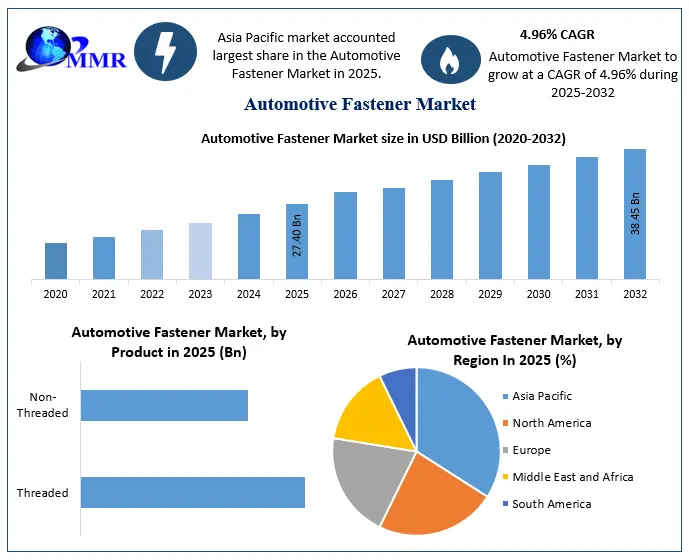
- The Automotive Fastener Market was valued at USD 27.40 Billion in 2025.
- The market is projected to reach USD 38.45 Billion by 2032.
- Revenue is expected to grow at a CAGR of 4.96% from 2026 to 2032.
- Vehicle electrification is reshaping component requirements across automotive platforms.
- Lightweight vehicle design is increasing demand for advanced fastening solutions.
- OEMs are redesigning vehicle architectures to support EVs, connectivity, and software-defined mobility.
- Supply-chain resilience and manufacturing efficiency are becoming critical competitive factors.
Why This Matters Now
The automotive industry’s transition toward electrification is changing far more than powertrains. It is forcing manufacturers to rethink how vehicles are assembled, how materials are integrated, and how every component contributes to safety, efficiency, and performance.
The Automotive Fastener Market, valued at USD 27.40 Billion in 2025 and expected to reach USD 38.45 Billion by 2032, sits at the center of that transformation. Every increase in market value signals rising demand for specialized fastening systems capable of supporting electric vehicle platforms, lightweight materials, connected vehicle technologies, and increasingly complex automotive architectures.
Market Overview
Fasteners rarely attract headlines, yet they remain among the most critical components in modern vehicle manufacturing. Thousands of fastening points hold together structural systems, battery enclosures, powertrain assemblies, interior components, safety systems, and electronic modules.
As automakers move from traditional internal combustion platforms toward electric and software-defined vehicles, fastening requirements are becoming more sophisticated. Engineers must balance weight reduction, durability, corrosion resistance, crash performance, and manufacturing efficiency simultaneously.
The industry’s projected growth reflects increasing vehicle complexity rather than simple production expansion. New vehicle platforms require fastening solutions designed specifically for battery systems, lightweight materials, and advanced electronics integration.
This shift creates opportunities for suppliers capable of delivering innovative, high-performance products that improve assembly efficiency while supporting next-generation vehicle designs.
Key Trends Driving Growth
Vehicle electrification remains the most significant catalyst influencing fastener demand. Electric vehicles introduce battery packs, power electronics, thermal management systems, and structural requirements that often require different fastening approaches than conventional vehicles.
Lightweight engineering is creating another powerful growth driver. Automakers are increasingly adopting aluminum, composites, and advanced materials to improve efficiency and extend vehicle range. These materials frequently require specialized fastening technologies capable of maintaining structural integrity under varying operating conditions.
Connected vehicle development is also changing component requirements. The expansion of sensors, communication modules, ADAS systems, and electronic control units increases the number of components requiring secure installation throughout the vehicle.
Manufacturing automation is reshaping production strategies. Automotive plants are investing heavily in robotics and precision assembly systems that depend on consistent fastening performance to maintain quality and throughput targets.
Sustainability objectives are influencing supplier decisions as well. Manufacturers are increasingly evaluating materials, production processes, and lifecycle performance as they pursue carbon-reduction goals across the automotive value chain.
Download Free PDF Brochure:https://www.maximizemarketresearch.com/request-sample/29346/
Segment Insights
- Dominant Segment: The report identifies leading product categories that continue to account for the largest share of automotive fastening demand due to their widespread use across vehicle production platforms.
- Fastest-Growing Segment: The report highlights emerging fastening categories benefiting from EV production growth, advanced material adoption, and evolving automotive engineering requirements.
- Structural fastening applications continue to remain critical because they directly influence vehicle safety, durability, and crash performance.
- Electrified vehicle platforms are increasing demand for specialized fastening solutions designed for battery enclosures, electronic systems, and lightweight assemblies.
- Precision-engineered fasteners are becoming increasingly important as automakers pursue higher manufacturing quality and tighter performance specifications.
Regional Growth Story
Asia-Pacific continues to play a central role in the automotive fastener ecosystem. Strong vehicle production volumes, expanding EV manufacturing, and extensive supplier networks support sustained demand across the region.
China remains particularly influential due to its position as a major automotive manufacturing hub and global leader in electric vehicle production. The country’s investments in EV capacity create downstream opportunities for component suppliers throughout the value chain.
India is emerging as a significant manufacturing destination. Rising vehicle production, increasing localization efforts, and government support for automotive development are encouraging supplier investment across multiple component categories.
Germany continues to shape technological innovation within the automotive sector. As European automakers expand electrification programs and software-defined vehicle initiatives, suppliers must develop fastening solutions compatible with increasingly advanced vehicle architectures.
Japan and South Korea remain important centers for automotive engineering, advanced manufacturing, and technology development. Their focus on quality, efficiency, and innovation continues to influence global component standards.
The United States is also strengthening its position through investments in EV manufacturing, supply-chain localization, and transportation modernization initiatives that support long-term component demand.
Competitive Landscape
Competition in the Automotive Fastener Market increasingly revolves around engineering capability rather than commodity production. Suppliers are being evaluated on their ability to solve complex manufacturing challenges associated with electrification and lightweighting.
OEMs are seeking partners capable of supporting multiple vehicle platforms while reducing assembly complexity and improving production efficiency. This shifts competitive advantage toward suppliers with strong research, development, and application engineering expertise.
The growing importance of battery-electric vehicles is changing supplier relationships. Fastener manufacturers that develop solutions specifically optimized for battery systems, thermal management assemblies, and lightweight structures gain strategic relevance within EV supply chains.
Manufacturing scale remains important, but innovation increasingly determines pricing power. Suppliers capable of reducing vehicle weight, improving durability, or streamlining assembly processes can command stronger positions in OEM sourcing decisions.
The market also reflects broader automotive supply-chain restructuring. Companies investing in automation, advanced materials, and global production flexibility are positioning themselves to capture future growth opportunities as vehicle architectures continue to evolve.
Recent Developments
- Increased supplier focus on EV-specific fastening solutions.
- Expansion of lightweight vehicle manufacturing programs.
- Greater adoption of automated assembly technologies in automotive production.
- Rising investments in advanced materials and precision-engineered components.
- Stronger emphasis on supply-chain resilience and localized manufacturing strategies.
- Continued integration of fastening technologies into next-generation vehicle architectures.
Strategic Implications
For OEMs, fastening systems are becoming strategic enablers of vehicle innovation. Decisions made at the component level increasingly influence weight reduction, production efficiency, safety performance, and sustainability outcomes.
Tier-1 suppliers face opportunities to move beyond traditional manufacturing roles by providing engineering expertise, design collaboration, and integrated assembly solutions. Value creation is shifting toward technical differentiation rather than volume alone.
Investors should view the market through the lens of automotive transformation. Companies aligned with EV growth, lightweight materials, automation, and advanced manufacturing are positioned to benefit from long-term industry shifts.
Fleet operators and mobility providers may not directly purchase fasteners, but they benefit from the resulting improvements in vehicle durability, efficiency, safety, and maintenance performance.
Future Outlook
The Automotive Fastener Market is projected to grow from USD 27.40 Billion in 2025 to USD 38.45 Billion by 2032, reflecting the automotive industry’s accelerating transition toward electrified, connected, and lightweight vehicles. As OEMs redesign vehicle architectures and suppliers compete to support next-generation mobility platforms, fastening technologies will become increasingly critical to manufacturing performance and vehicle reliability.
The next market leaders will be those that transform fasteners from standardized hardware into engineered solutions for electric, connected, and software-defined vehicles, while laggards remain trapped in a commodity-driven business model facing shrinking strategic relevance.
Analyst Perspective
“The Automotive Fastener Market is becoming a strategic component category as electrification, lightweight engineering, and advanced vehicle architectures reshape automotive manufacturing. Suppliers that align innovation with OEM transformation priorities will capture the strongest growth opportunities through 2032.” — Tejaswini Kakade
About Maximize Market Research
Maximize Market Research Pvt. Ltd. (MMR) is a global market research and consulting company that provides reliable, data-focused, and practical business insights. The firm serves a wide range of industries, including healthcare, pharmaceuticals, technology, automotive, electronics, chemicals, personal care, and consumer goods. Through market forecasts, competitive analysis, strategic consulting, and industry impact assessments, MMR helps organizations understand changing market conditions, identify growth opportunities, and make informed business decisions for long-term success.
Contact Us:
2nd Floor, Navale IT Park Phase 3
Pune Banglore Highway, Narhe
Pune, Maharashtra 411041, India
+91 9607365656
sales@maximizemarketresearch.com
