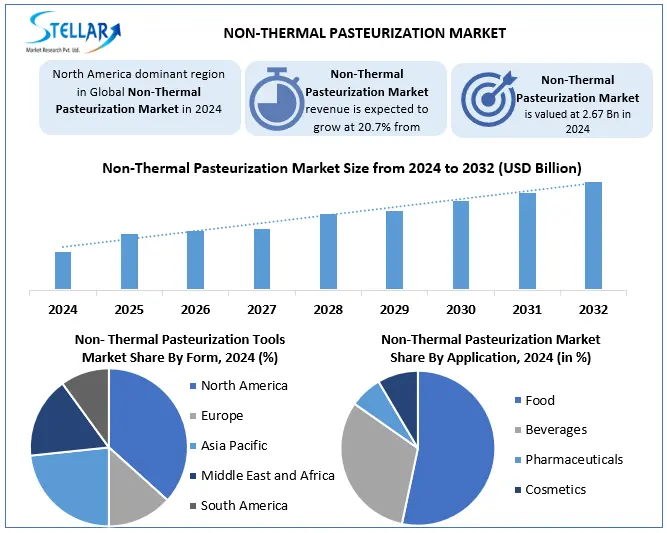
PUNE, June 22, 2026 – The Non-Thermal Pasteurization Market is witnessing significant expansion as food and beverage manufacturers increasingly adopt advanced processing technologies that enhance food safety while preserving nutritional quality and sensory characteristics. According to the latest analysis from Stellar Market Research, growing consumer demand for minimally processed foods, clean-label products, and extended shelf-life solutions is transforming non-thermal pasteurization from a niche technology into a strategic investment area across the global food industry.
Market Opportunity Overview
The food processing industry is undergoing a major transformation as consumers seek healthier, fresher, and less processed products without compromising food safety. Traditional thermal pasteurization methods, while effective in microbial reduction, can impact taste, texture, color, and nutrient content. As a result, manufacturers are increasingly turning toward non-thermal technologies that deliver pathogen control while maintaining product integrity.
Technologies such as High-Pressure Processing (HPP), Pulsed Electric Fields (PEF), Cold Plasma, Ultraviolet (UV) Treatment, and Irradiation are gaining commercial adoption across beverages, dairy products, fruits and vegetables, meat products, and ready-to-eat foods. This shift is creating new opportunities for food processors to meet evolving consumer preferences while complying with increasingly stringent food safety regulations.
As sustainability becomes a key industry priority, non-thermal processing technologies are also attracting investment due to their lower energy consumption and reduced environmental impact compared to conventional heat-based methods.
𝐃𝐨𝐰𝐧𝐥𝐨𝐚𝐝 𝐅𝐫𝐞𝐞 𝐏𝐃𝐅 𝐁𝐫𝐨𝐜𝐡𝐮𝐫𝐞: https://www.stellarmr.com/report/req_sample/non-thermal-pasteurization-market/2818
Key Findings from the Report
The Non-Thermal Pasteurization Market is projected to grow at a robust CAGR through the 2025–2032 forecast period.
High-Pressure Processing (HPP) remains the dominant technology segment due to widespread adoption in beverages, meat products, and ready-to-eat foods.
Pulsed Electric Field (PEF) technology is anticipated to be the fastest-growing segment owing to increasing applications in juice processing and liquid food preservation.
The Food & Beverage Industry accounts for the largest share of market demand globally.
North America leads the market due to strong adoption of premium packaged foods and advanced food processing infrastructure.
Asia-Pacific is emerging as the fastest-growing region supported by urbanization, changing dietary habits, and rising food safety awareness.
Growing investment in clean-label products is driving increased adoption of nutrient-preserving processing technologies.
Market Drivers and Restraints
Key Drivers
Rising Demand for Clean-Label Foods
Consumers increasingly prefer products free from artificial preservatives and excessive processing. Non-thermal pasteurization supports clean-label positioning while ensuring food safety.
Stringent Food Safety Regulations
Regulatory agencies worldwide are enforcing stricter microbial safety standards, encouraging food manufacturers to adopt advanced preservation technologies.
Growth of Premium and Functional Foods
Manufacturers of premium beverages, organic foods, dairy alternatives, and functional nutrition products are leveraging non-thermal technologies to preserve nutritional value and product quality.
Key Restraints
High Initial Capital Costs
The installation of advanced non-thermal processing systems requires substantial investment, limiting adoption among small and medium-sized food processors.
Technical Integration Challenges
Implementing new processing technologies within existing production lines can increase operational complexity and require specialized expertise.
Technology, Regulation, and Sustainability Trends
Technological innovation remains a defining factor shaping the market. High-pressure processing systems are becoming more efficient, scalable, and cost-effective, while advances in pulsed electric field technology are expanding commercial applications across liquid food processing.
Governments and food safety authorities continue to emphasize pathogen control, shelf-life extension, and food quality preservation. Regulatory approvals for innovative processing methods are encouraging broader industry adoption and facilitating market expansion.
Sustainability objectives are also influencing purchasing decisions across the food value chain. Non-thermal technologies generally consume less energy and generate lower emissions than conventional thermal processing methods. Food manufacturers increasingly view these solutions as critical tools for achieving environmental, social, and governance (ESG) goals.
Digital monitoring systems, AI-powered quality control platforms, and automated process optimization technologies are further improving operational efficiency and product consistency.
𝐃𝐨𝐰𝐧𝐥𝐨𝐚𝐝 𝐅𝐫𝐞𝐞 𝐏𝐃𝐅 𝐁𝐫𝐨𝐜𝐡𝐮𝐫𝐞: https://www.stellarmr.com/report/req_sample/non-thermal-pasteurization-market/2818
Regional Insights
North America Maintains Market Leadership
North America remains the largest regional market due to strong demand for premium packaged foods, widespread adoption of HPP technology, and rigorous food safety standards.
The United States continues to lead innovation and commercial deployment, supported by major investments from food processors and technology providers.
Asia-Pacific Emerges as a High-Growth Hub
Asia-Pacific is expected to witness the fastest growth during the forecast period. China, India, Japan, South Korea, and Southeast Asian countries are experiencing increased demand for packaged foods, ready-to-eat meals, and premium beverages.
Rapid urbanization, rising disposable incomes, and expanding food processing industries are creating substantial growth opportunities for non-thermal pasteurization technologies.
Europe Advances Sustainable Food Processing
European markets continue to prioritize food quality, sustainability, and regulatory compliance. Manufacturers across Germany, France, Italy, and the United Kingdom are increasingly investing in advanced preservation technologies to support clean-label product portfolios.
Recent Industry Developments
JBT Marel (2025): Expanded its food processing technology portfolio with enhanced HPP solutions designed to improve throughput efficiency and support growing demand for clean-label food production.
Hiperbaric (2025): Introduced next-generation high-pressure processing equipment focused on increasing operational productivity and reducing processing costs for food manufacturers.
Avure Technologies (2025): Expanded global customer partnerships across beverage and ready-to-eat food segments, strengthening commercial adoption of HPP technologies.
Pulsemaster (2024): Advanced pulsed electric field technology deployments in juice and beverage processing applications, improving energy efficiency and product quality retention.
European Food Safety Authorities & Industry Initiatives (2024): Continued support for innovative preservation technologies aimed at reducing food waste and enhancing sustainability across food supply chains.
Competitive Landscape
The Non-Thermal Pasteurization Market features a competitive landscape comprising technology providers, food processing equipment manufacturers, and specialized preservation solution developers. Leading participants include Hiperbaric, Avure Technologies, JBT Marel, Pulsemaster, Thyssenkrupp AG, Elea Technology, Nordion, and Universal Pure.
Market participants are prioritizing product innovation, technology commercialization, strategic partnerships, and geographic expansion. Investments in automation, digital monitoring systems, and scalable processing solutions are emerging as key competitive differentiators.
Analyst Commentary
“The future of food preservation lies in balancing safety, nutrition, and sustainability. Non-thermal pasteurization technologies enable manufacturers to meet evolving consumer expectations while maintaining regulatory compliance and operational efficiency. As clean-label demand continues to rise globally, these technologies will become increasingly integral to next-generation food production strategies,” said a Senior Research Analyst at Stellar Market Research.
Future Outlook
The Non-Thermal Pasteurization Market is expected to experience sustained growth through 2032 as food manufacturers prioritize quality preservation, food safety, and sustainability. High-pressure processing is likely to maintain market leadership, while emerging technologies such as pulsed electric fields and cold plasma systems gain commercial traction.
Growing investments in premium foods, functional beverages, plant-based products, and minimally processed foods will continue to support market expansion. Advances in automation, AI-enabled quality monitoring, and regulatory acceptance are expected to accelerate adoption across both developed and emerging economies.
About Stellar Market Research
Stellar Market Research is a global market research and business consulting firm delivering strategic intelligence across diverse industries and markets. The company specializes in market sizing, competitive benchmarking, growth forecasting, technology assessment, and business advisory services. Leveraging extensive primary and secondary research methodologies, Stellar Market Research helps organizations identify emerging opportunities, evaluate market risks, and develop informed growth strategies. Serving corporations, investors, policymakers, and industry stakeholders worldwide, the firm provides actionable insights that support sustainable business decisions in rapidly evolving market environments.
Media Contact
Stellar Market Research
Website: http://stellarmr.com/
Email: sales@stellarmr.com
