Key Highlights
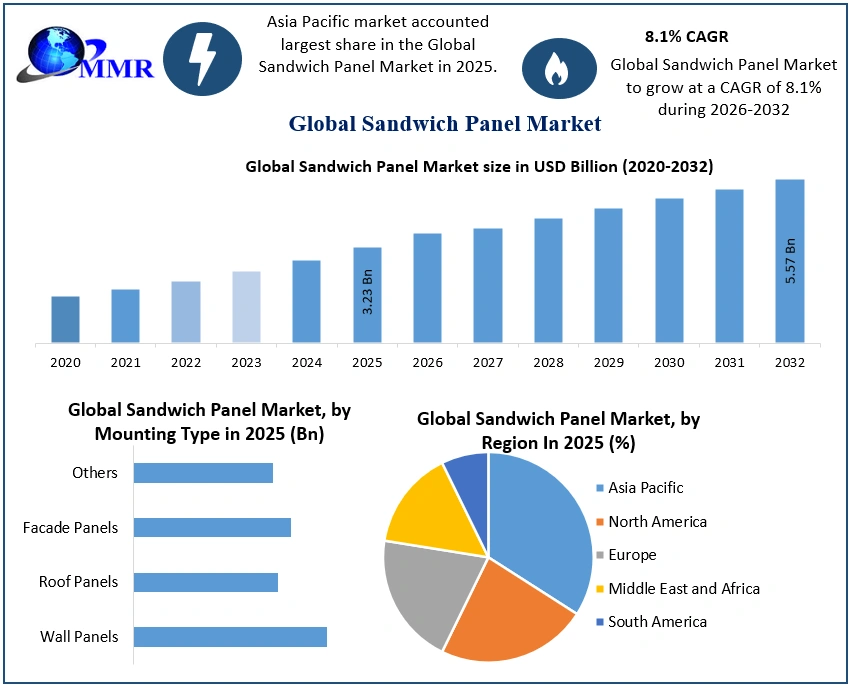
- Sandwich Panel Market valued at USD 3.23 Billion in 2025.
- Market expected to reach USD 5.57 Billion by 2032.
- CAGR projected at 8.1% from 2026 to 2032.
- Energy-efficient construction is strengthening demand across industrial and commercial sectors.
- Modular building adoption is increasing the use of insulated panel systems.
- Cold storage and logistics infrastructure expansion is creating new growth opportunities.
- Sustainability mandates are accelerating adoption of advanced building envelope solutions.
Why This Matters Now
Construction economics are changing rapidly. Rising energy costs, stricter environmental regulations, and faster project delivery requirements are forcing developers to rethink how buildings are designed and constructed.
The Sandwich Panel Market sits directly at the center of this shift. Valued at USD 3.23 Billion in 2025 and projected to reach USD 5.57 Billion by 2032 at a CAGR of 8.1%, the market’s expansion signals more than growing demand for construction materials. It reflects a structural move toward high-performance buildings that prioritize insulation, operational efficiency, and lifecycle cost reduction.
For developers, contractors, manufacturers, investors, and infrastructure planners, sandwich panels are becoming a strategic component rather than a commodity product.
Market Overview
Sandwich panels combine insulating core materials with durable outer layers to create lightweight, high-strength construction systems. Their ability to improve thermal efficiency while reducing installation time has made them increasingly important across industrial facilities, warehouses, logistics centers, commercial buildings, cold storage facilities, and infrastructure projects.
The market’s expected growth from USD 3.23 Billion in 2025 to USD 5.57 Billion by 2032 demonstrates a growing preference for integrated building solutions that can deliver both structural performance and energy savings. This growth trajectory indicates increasing investment in modern construction methods that reduce operating expenses while helping organizations meet sustainability objectives.
The business implication is significant. As energy efficiency becomes a measurable economic advantage, demand is shifting toward materials capable of reducing long-term building costs. Sandwich panels are increasingly positioned to benefit from this transition.
Key Trends Driving Growth
Energy efficiency has become one of the strongest demand drivers across global construction markets. Governments, developers, and facility operators are under pressure to reduce energy consumption and improve building performance. Sandwich panels provide insulation capabilities that directly support these objectives.
Industrial infrastructure expansion is creating another major growth avenue. Manufacturing facilities, warehouses, distribution hubs, and logistics centers require construction materials that can be installed quickly while maintaining durability and thermal performance. Sandwich panels align closely with these requirements.
Cold-chain development is also reshaping market opportunities. Growth in food processing, pharmaceuticals, and temperature-sensitive logistics is increasing investment in insulated storage facilities. These projects depend heavily on advanced panel systems capable of maintaining controlled environments.
Modular construction continues to gain momentum across both developed and emerging economies. Faster project timelines, labor shortages, and cost pressures are encouraging the adoption of prefabricated building systems. Sandwich panels support modular construction strategies by enabling rapid assembly and improved project efficiency.
Sustainability goals are becoming a competitive differentiator for developers and property owners. Building materials that contribute to energy conservation and environmental compliance are receiving greater attention from procurement teams and project planners.
Download PDF Sample:https://www.maximizemarketresearch.com/request-sample/10807/
Segment Insights
- Dominant Segment: Information not specified in the supplied source.
- Fastest-Growing Segment: Information not specified in the supplied source.
- Industrial applications remain important demand centers due to insulation and structural performance requirements.
- Commercial construction projects continue adopting sandwich panels to improve energy efficiency and reduce operating costs.
- Cold storage infrastructure represents a growing opportunity as temperature-controlled logistics networks expand.
- Modular and prefabricated construction projects are increasing utilization of insulated panel technologies.
The absence of publicly available segment-specific figures within the supplied source highlights an important market reality: growth is increasingly being driven by application diversity rather than dependence on a single end-use sector.
Regional Growth Story
The Sandwich Panel Market is benefiting from broad-based infrastructure development across multiple regions. Industrialization, urbanization, and sustainability-focused construction policies are creating favorable conditions for adoption.
Developed economies are emphasizing energy-efficient retrofits and green building standards. These initiatives are increasing demand for advanced insulation solutions capable of improving building performance without compromising structural integrity.
Emerging economies are investing heavily in industrial parks, logistics infrastructure, manufacturing facilities, and commercial developments. As these projects scale, demand for cost-effective and efficient construction materials is rising.
The expansion of e-commerce and global supply chains is adding another layer of demand. Distribution centers and fulfillment facilities increasingly require insulated structures that support operational efficiency while controlling energy costs.
Regional competitiveness is therefore becoming closely linked to construction modernization efforts. Markets investing in advanced building technologies are likely to create stronger opportunities for sandwich panel manufacturers and suppliers.
Competitive Landscape
Competition in the Sandwich Panel Market is increasingly centered on technology, manufacturing efficiency, sustainability performance, and project delivery capabilities.
Manufacturers are moving beyond basic panel production toward integrated building solutions that address evolving customer requirements. Product innovation is focusing on improved insulation performance, durability, fire resistance, environmental compliance, and ease of installation.
This competitive shift signals a broader transformation within the construction materials sector. Companies capable of combining manufacturing scale with engineering expertise are likely to strengthen pricing power and customer relationships.
Investment in production capabilities also reflects expectations of sustained demand growth. Capacity expansion initiatives indicate that manufacturers are preparing for a construction environment where energy-efficient building materials become standard rather than optional.
Strategic partnerships across construction ecosystems are becoming increasingly important. Collaboration between material suppliers, contractors, developers, and infrastructure operators is helping accelerate adoption and improve project outcomes.
The competitive landscape therefore points toward consolidation around innovation, operational excellence, and sustainability leadership rather than purely volume-based competition.
Recent Developments
- Growing investment in energy-efficient building materials across commercial and industrial construction.
- Increased adoption of modular construction methodologies supporting insulated panel demand.
- Expansion of cold-chain infrastructure creating new project opportunities.
- Rising focus on sustainability and regulatory compliance in building design.
- Continued modernization of industrial and logistics facilities requiring advanced insulation solutions.
Strategic Implications
The market’s projected increase from USD 3.23 Billion to USD 5.57 Billion represents a significant opportunity for stakeholders across the construction value chain.
For manufacturers, the opportunity lies in developing differentiated products that deliver measurable energy savings and enhanced building performance.
For developers, sandwich panels offer a pathway to reduce construction timelines while improving operational efficiency. Faster project completion and lower lifecycle costs can create meaningful competitive advantages.
For investors, the market reflects exposure to several long-term growth themes, including sustainable construction, infrastructure modernization, logistics expansion, and energy efficiency.
For policymakers, increasing adoption supports broader environmental objectives by improving building performance and reducing energy consumption.
The most successful participants will likely be those capable of aligning product innovation with evolving regulatory requirements and customer expectations.
Future Outlook
The next phase of market growth will be defined by how effectively construction ecosystems integrate energy efficiency, sustainability, and speed into project delivery models. As building performance standards become stricter and infrastructure investment accelerates, sandwich panels are expected to move from a specialized construction component to a core element of modern building design. The companies that lead in advanced insulation performance, sustainable manufacturing, and integrated construction solutions will define the next era of competitive advantage, while slower adopters risk losing relevance in an increasingly efficiency-driven construction market.
Analyst Perspective
“The Sandwich Panel Market is entering a period where energy efficiency, sustainability objectives, and construction productivity are becoming inseparable. Organizations that prioritize advanced building materials capable of reducing lifecycle costs and supporting modern construction methods will be best positioned to capture long-term value creation opportunities.” — Rucha Deshpande, Analyst
About Maximize Market Research
Maximize Market Research Pvt. Ltd. (MMR) is a global market research and consulting company that provides reliable, data-focused, and practical business insights. The firm serves a wide range of industries, including healthcare, pharmaceuticals, technology, automotive, electronics, chemicals, personal care, and consumer goods. Through market forecasts, competitive analysis, strategic consulting, and industry impact assessments, MMR helps organizations understand changing market conditions, identify growth opportunities, and make informed business decisions for long-term success.
Contact Us:
2nd Floor, Navale IT Park Phase 3
Pune Banglore Highway, Narhe
Pune, Maharashtra 411041, India
+91 9607365656
sales@maximizemarketresearch.com
