Market Overview
The Automotive Diagnosis Scan Tool Market is evolving alongside broader automotive digitization. Modern vehicles contain sophisticated electronic control units, advanced sensors, connectivity modules, and software-driven systems that require specialized diagnostic solutions.
Historically, diagnostic tools focused on identifying mechanical faults and basic engine performance issues. That role has expanded significantly. Today’s scan tools support complex vehicle architectures that integrate powertrain management, battery monitoring, ADAS calibration, connectivity systems, emissions controls, and safety functions.
The transition toward software-defined vehicles is fundamentally changing service requirements. Diagnostic platforms must now process larger volumes of vehicle data, support remote updates, and interact with increasingly centralized vehicle computing systems.
This transformation creates opportunities not only for equipment manufacturers but also for software providers, service networks, mobility operators, and fleet management companies.
Key Trends Driving Growth
Vehicle electrification is reshaping diagnostic requirements across the automotive ecosystem. Electric vehicles introduce new diagnostic priorities, including battery health monitoring, thermal management analysis, charging system verification, and power electronics assessment.
The rise of connected vehicles is creating another structural shift. Real-time vehicle data enables remote diagnostics, predictive maintenance strategies, and proactive service scheduling. This reduces unexpected failures and helps operators optimize maintenance cycles.
ADAS deployment is adding another layer of complexity. Advanced driver assistance technologies require precise calibration and verification procedures. Diagnostic platforms capable of supporting radar, camera, and sensor validation are becoming increasingly important for service providers.
Software-defined vehicle development is accelerating demand for diagnostic solutions capable of managing software faults, cybersecurity monitoring, and over-the-air update validation. Vehicles are becoming digital products, and diagnostics are becoming a core component of digital vehicle management.
Fleet operators are also driving market expansion. Commercial fleets increasingly rely on diagnostics to maximize utilization rates, improve operational efficiency, and reduce maintenance-related downtime. Every hour of vehicle availability directly impacts revenue generation.
Regulatory pressure continues to influence adoption. Stricter emissions standards, vehicle safety requirements, and compliance obligations require more sophisticated diagnostic capabilities across both OEM and aftermarket environments.
Request a Free Sample Copy or View Report Summary
Segment Insights
- Dominant Segment: Passenger vehicle diagnostic applications represent the leading demand contributor, supported by rising vehicle ownership, increasing electronics integration, and expanding maintenance requirements.
- Fastest-Growing Segment: Advanced diagnostics associated with connected vehicles, EV platforms, and electronically controlled vehicle systems are emerging as the fastest-expanding opportunity area.
- Diagnostic solutions supporting onboard diagnostics (OBD) remain foundational due to regulatory requirements and widespread vehicle compatibility.
- Fleet-focused diagnostic systems continue gaining traction as commercial operators prioritize predictive maintenance and operational efficiency.
- ADAS calibration and electronic systems diagnostics are becoming increasingly important as advanced safety technologies move into mainstream vehicle platforms.
Regional Growth Story
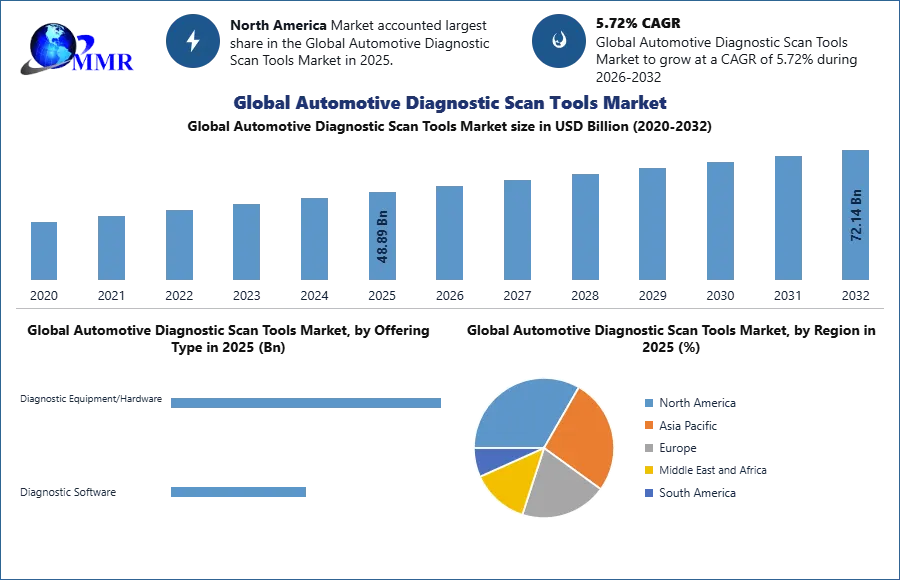
North America remains a major market for diagnostic technologies due to high vehicle ownership rates, mature aftermarket networks, and significant adoption of connected vehicle technologies.
The United States continues to benefit from strong investment in fleet management systems, digital vehicle servicing, and advanced automotive electronics. Diagnostic providers are increasingly integrating cloud connectivity and predictive analytics into their service offerings.
Europe’s growth story is closely tied to emissions compliance, electrification initiatives, and advanced vehicle safety regulations. Germany remains a critical automotive innovation hub where diagnostic requirements evolve alongside premium vehicle technologies and software-centric vehicle architectures.
Asia-Pacific represents a powerful growth engine driven by automotive production scale, expanding vehicle ownership, and accelerating technology adoption. China, Japan, South Korea, and India continue investing in connected mobility ecosystems that require increasingly sophisticated diagnostic capabilities.
China’s leadership in electric vehicle adoption is generating demand for specialized EV diagnostic platforms. Japan and South Korea continue contributing through automotive electronics innovation and advanced manufacturing capabilities.
India’s expanding vehicle population and modernization of service infrastructure are creating long-term opportunities for diagnostic equipment suppliers and digital service providers.
Competitive Landscape
Competition is shifting from hardware-centric products toward integrated diagnostic ecosystems. The industry’s leading participants are increasingly combining software, connectivity, analytics, and cloud-based capabilities into comprehensive vehicle health management platforms.
For OEMs, diagnostic technologies provide greater control over vehicle lifecycle management. Enhanced diagnostic capabilities support warranty optimization, customer retention initiatives, and service revenue generation.
For aftermarket service providers, advanced diagnostics represent a competitive necessity rather than an optional investment. As vehicles become more complex, access to sophisticated diagnostic capabilities increasingly determines service competitiveness.
The broader competitive signal is clear. Companies that combine diagnostics with connectivity, predictive analytics, and software management capabilities are positioning themselves for long-term leadership. Vendors focused solely on traditional scan-tool functionality face growing competitive pressure.
Diagnostic platforms are becoming data businesses. The ability to collect, analyze, and monetize vehicle performance information is emerging as a major differentiator across the market.
Recent Developments
- OEMs are expanding investments in connected vehicle ecosystems that support real-time diagnostics and predictive maintenance.
- Diagnostic platform providers are integrating cloud-based analytics and remote service capabilities.
- EV adoption is increasing demand for battery-specific and power electronics diagnostic solutions.
- ADAS deployment is creating new opportunities for calibration and sensor-validation technologies.
- Fleet operators are adopting predictive diagnostic systems to improve uptime and reduce maintenance expenses.
Strategic Implications
The diagnostic market is becoming increasingly important to transportation digitization strategies. Every advancement in electrification, connectivity, automation, and software integration increases demand for more capable diagnostic platforms.
OEMs benefit through stronger service retention and improved vehicle lifecycle visibility. Suppliers gain opportunities to expand software revenues and recurring service models. Fleet operators improve asset productivity through predictive maintenance and reduced downtime.
The greatest value creation opportunity lies at the intersection of diagnostics, connectivity, and data analytics. Organizations capable of transforming diagnostic information into operational intelligence will capture disproportionate competitive advantages.
For investors, diagnostic technology represents an increasingly attractive segment because it sits at the convergence of automotive electronics, software development, connected mobility, and recurring service revenue models.
Future Outlook
The next phase of automotive diagnostics will move beyond fault detection toward continuous vehicle health management. Connected platforms, predictive analytics, remote servicing, and software-centric maintenance models will redefine how vehicles are monitored and maintained throughout their lifecycle.
As software-defined vehicles, EVs, and autonomous systems become mainstream, diagnostic capabilities will increasingly determine operational efficiency, customer satisfaction, and service profitability.
The future winners will be companies that transform diagnostics into intelligent mobility platforms, while laggards will remain trapped in a repair-centric business model that cannot keep pace with the software-driven automotive era.
Analyst Perspective
“The automotive industry’s transition toward connected, electrified, and software-defined vehicles is fundamentally changing diagnostic requirements. Organizations that invest early in advanced diagnostic capabilities will be best positioned to capture value across the evolving automotive service ecosystem.” — Tejaswini Kakade, Analyst
About Maximize Market Research
Maximize Market Research Pvt. Ltd. (MMR) is a global market research and consulting company that provides reliable, data-focused, and practical business insights. The firm serves a wide range of industries, including healthcare, pharmaceuticals, technology, automotive, electronics, chemicals, personal care, and consumer goods. Through market forecasts, competitive analysis, strategic consulting, and industry impact assessments, MMR helps organizations understand changing market conditions, identify growth opportunities, and make informed business decisions for long-term success.
2nd Floor, Navale IT Park Phase 3
Pune Banglore Highway, Narhe
Pune, Maharashtra 411041, India
+91 9607365656
sales@maximizemarketresearch.com
