Market Overview
The Global Rolling Stock Market is evolving from a traditional equipment industry into a technology-enabled transportation ecosystem. Passenger coaches, locomotives, rapid transit vehicles, freight wagons, metro trains, and high-speed rail platforms are becoming increasingly sophisticated assets that integrate digital intelligence, electrification technologies, and predictive maintenance capabilities.
Growing urban populations continue to place pressure on transportation networks. Governments are responding by expanding rail capacity to move people and goods more efficiently. This trend is creating demand for both new rolling stock and upgrades to existing fleets.
The industry’s strategic importance has increased because rail transportation aligns with multiple policy priorities simultaneously. It improves mobility, reduces emissions, enhances energy efficiency, and supports economic development through infrastructure investment.
The market is therefore benefiting from long-term structural drivers rather than short-term transportation cycles.
Key Trends Driving Growth
Rail electrification remains the most significant transformation occurring across the industry. Governments and transportation authorities are increasingly replacing diesel-powered systems with electric alternatives to support carbon reduction goals and improve operational efficiency.
The electrification trend mirrors developments occurring across the broader transportation sector. Similar to electric vehicle adoption in automotive markets, rail operators are seeking technologies that reduce fuel dependency while improving long-term economics.
Digitalization is creating another powerful growth engine. Rolling stock manufacturers are embedding advanced monitoring systems, predictive maintenance capabilities, real-time diagnostics, and connectivity solutions into next-generation rail platforms.
These technologies enable operators to reduce maintenance costs, improve asset availability, and optimize fleet performance. The value proposition extends beyond equipment ownership to lifecycle management and operational efficiency.
Passenger expectations are also changing. Modern travelers increasingly expect seamless mobility experiences, real-time information, digital ticketing integration, and higher service reliability. Rolling stock procurement decisions increasingly consider passenger experience metrics alongside technical performance specifications.
Freight transportation continues to evolve as global supply chains become more complex. Rail operators are investing in advanced freight rolling stock capable of improving efficiency, supporting intermodal logistics strategies, and enhancing network utilization.
Automation is emerging as another important trend. While fully autonomous rail operations remain limited in many regions, advanced signaling systems, automated train control technologies, and intelligent traffic management solutions are increasingly influencing investment priorities.
Request a Free Sample Copy or View Report Summary
Segment Insights
Dominant Segment: Passenger rolling stock remains the largest segment due to growing urbanization, metro network expansion, commuter rail development, and rising public transportation demand.
Fastest-Growing Segment: Electrified rolling stock solutions are emerging as the fastest-growing opportunity area as governments prioritize transportation decarbonization and energy efficiency initiatives.
Metro and rapid transit systems continue attracting significant investment due to urban mobility requirements and congestion management objectives.
High-speed rail programs are creating opportunities for advanced train technologies, digital systems integration, and premium passenger transportation services.
Freight rolling stock modernization remains a critical focus area as logistics providers seek greater efficiency and supply-chain resilience.
Regional Growth Story
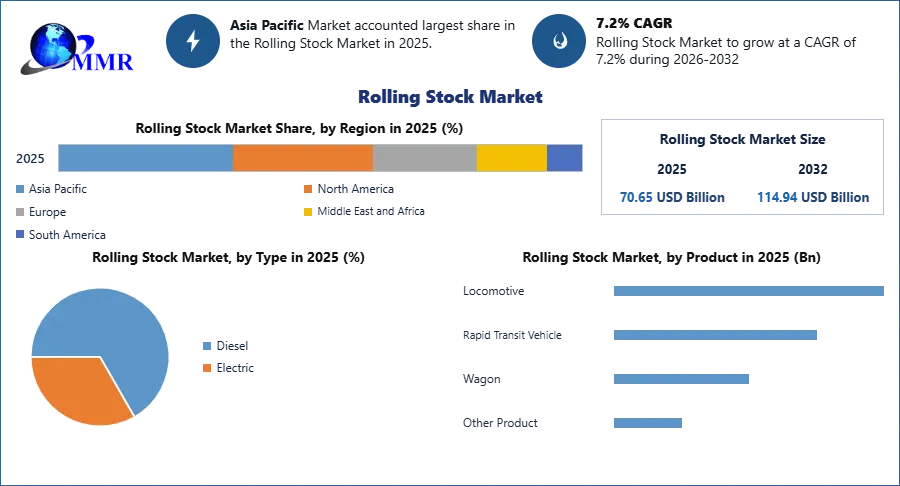
Asia-Pacific continues to lead global market activity due to large-scale transportation infrastructure investments and rapid urbanization. China remains a dominant force in rolling stock production, rail network expansion, and transportation modernization initiatives.
China’s continued investment in high-speed rail and urban transit systems is influencing procurement strategies across global markets. The country’s scale demonstrates how rail infrastructure can support economic development while addressing environmental challenges.
India is becoming a major growth engine through railway modernization programs, metro network expansion, and transportation infrastructure investment. The country’s efforts to improve connectivity are creating substantial opportunities across the rolling stock value chain.
Japan and South Korea continue contributing through advanced engineering capabilities, rail technology innovation, and operational excellence. These markets often serve as benchmarks for safety, efficiency, and passenger experience.
Europe remains a strategically important region due to aggressive sustainability policies and established rail networks. Germany continues to play a central role in rail technology development and transportation innovation.
North America is witnessing renewed interest in passenger rail expansion, freight efficiency improvements, and sustainable transportation investments. This shift is creating opportunities for both domestic and international rolling stock suppliers.
Competitive Landscape
Competition is increasingly centered on technology ecosystems rather than vehicle manufacturing alone.
Leading manufacturers are integrating electrification technologies, predictive maintenance platforms, digital diagnostics, passenger connectivity solutions, and automation capabilities into their offerings. The objective is to provide complete transportation solutions rather than standalone rail vehicles.
This shift is changing competitive dynamics. Manufacturers capable of combining rolling stock production with software expertise, lifecycle services, and digital capabilities are gaining strategic advantages.
Long-term maintenance contracts are becoming increasingly valuable. These agreements provide recurring revenue streams while strengthening customer relationships and expanding service opportunities.
The competitive landscape also reflects broader transportation digitization trends. Companies investing in smart mobility platforms, connected transportation systems, and operational intelligence solutions are positioning themselves for future market leadership.
For rail operators, supplier selection increasingly depends on lifecycle performance, digital capabilities, and sustainability outcomes rather than acquisition cost alone.
Recent Developments
Rail electrification projects continue expanding across passenger and freight transportation networks.
Governments are increasing investment in railway modernization and urban transit infrastructure.
Predictive maintenance technologies are becoming standard features in new rolling stock deployments.
Smart mobility initiatives are integrating rail systems with broader transportation ecosystems.
Digital rail platforms are improving operational efficiency, asset management, and passenger experience.
Strategic Implications
The rolling stock industry is becoming a critical component of transportation decarbonization strategies. Governments require efficient transportation systems capable of supporting economic growth while reducing environmental impact.
Manufacturers are benefiting from sustained infrastructure investment cycles, while operators gain opportunities to improve service quality and reduce operational costs through advanced technologies.
Investors are increasingly viewing rolling stock as part of a broader infrastructure modernization opportunity. The combination of public-sector support, sustainability objectives, and urbanization trends creates long-term market visibility.
The sector also illustrates a broader transportation reality: future competitiveness will depend on the integration of physical assets and digital intelligence.
Future Outlook
The next generation of rolling stock will function as intelligent transportation platforms rather than conventional rail vehicles. Electrification, automation, predictive maintenance, digital connectivity, and mobility platform integration will increasingly define procurement decisions across global rail networks.
As governments pursue aggressive carbon reduction targets and cities seek scalable mobility solutions, rail transportation will assume a larger role within national infrastructure strategies and multimodal transportation ecosystems.
The future leaders will be manufacturers and operators that combine electrified fleets, digital intelligence, and integrated mobility capabilities at scale, while laggards will struggle with aging assets and fragmented technologies in a transportation market increasingly defined by connected, sustainable, and data-driven rail ecosystems.
Analyst Perspective
“The rolling stock industry is moving beyond fleet expansion toward intelligent transportation transformation. Electrification, digitalization, and mobility integration are becoming the defining forces shaping future competitiveness across global rail markets.” — Tejaswini Kakade, Analyst
About Maximize Market Research
Maximize Market Research Pvt. Ltd. (MMR) is a global market research and consulting company that provides reliable, data-focused, and practical business insights. The firm serves a wide range of industries, including healthcare, pharmaceuticals, technology, automotive, electronics, chemicals, personal care, and consumer goods. Through market forecasts, competitive analysis, strategic consulting, and industry impact assessments, MMR helps organizations understand changing market conditions, identify growth opportunities, and make informed business decisions for long-term success.
2nd Floor, Navale IT Park Phase 3
Pune Banglore Highway, Narhe
Pune, Maharashtra 411041, India
+91 9607365656
sales@maximizemarketresearch.com
