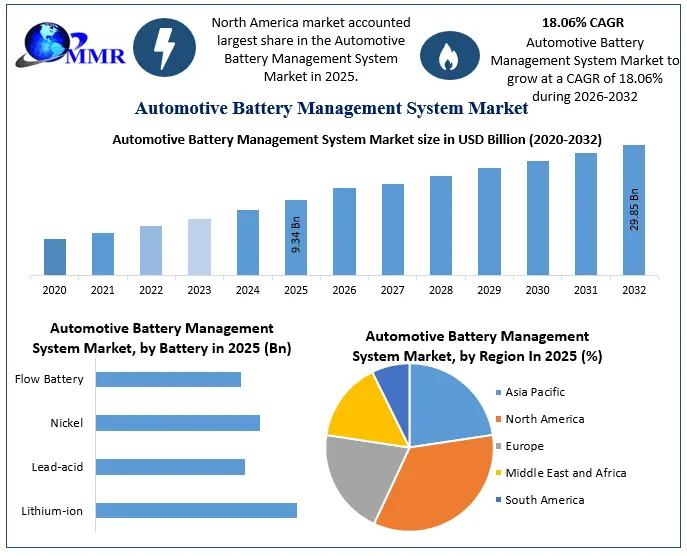
Market Overview
The Automotive Battery Management System Market occupies a pivotal position within the global electric mobility ecosystem. Battery management systems serve as the electronic intelligence layer that monitors, protects, and optimizes battery performance throughout a vehicle’s operating life.
The transition from internal combustion engines to electric propulsion has elevated battery systems from a supporting component to the most valuable asset inside modern vehicles. As battery investments increase, manufacturers require sophisticated systems capable of managing energy flow, thermal conditions, charging behavior, and battery health.
Battery management systems perform these critical functions while helping maximize battery lifespan and operational efficiency.
The market is benefiting from accelerating electric vehicle production, expanding battery manufacturing capacity, and growing investments in next-generation mobility technologies.
Beyond performance optimization, BMS platforms are becoming essential tools for improving safety, supporting regulatory compliance, and enabling advanced vehicle intelligence.
Key Trends Driving Growth
Electric vehicle adoption remains the strongest force shaping market development. Every new EV introduced into the market requires increasingly sophisticated battery management capabilities.
Automakers are seeking solutions that extend driving range, improve charging efficiency, and reduce battery degradation. These objectives directly influence vehicle competitiveness and customer satisfaction.
Battery technology innovation is creating additional opportunities. As manufacturers deploy higher-capacity battery packs and more complex cell architectures, battery management systems must process increasing volumes of operational data while maintaining system reliability.
Thermal management has emerged as a particularly important area of focus. Effective temperature control improves battery performance, supports fast charging, and reduces safety risks.
Software-defined vehicle development is reshaping BMS requirements. Modern vehicles increasingly rely on software platforms to manage critical functions, and battery systems are becoming deeply integrated into these architectures.
This shift enables advanced capabilities such as over-the-air software updates, predictive diagnostics, and adaptive energy management.
Connected vehicle ecosystems are also influencing market evolution. Real-time communication between vehicles, charging infrastructure, and cloud platforms enables continuous monitoring of battery health and performance.
These capabilities support predictive maintenance strategies that reduce unexpected failures and improve lifecycle economics.
The expansion of charging infrastructure further strengthens demand. Faster charging technologies require increasingly advanced battery management systems capable of balancing performance, safety, and battery longevity.
Request a Free Sample Copy or View Report Summary
Segment Insights
- Dominant Segment: Lithium-ion battery applications represent the dominant segment due to widespread adoption across passenger and commercial electric vehicles.
- Fastest-Growing Segment: Advanced intelligent battery management systems integrated with connected vehicle platforms are emerging as the fastest-growing segment.
- Passenger vehicle applications continue driving substantial demand as global EV adoption expands.
- Commercial fleet electrification is creating new opportunities for battery monitoring, predictive maintenance, and energy optimization solutions.
- Centralized and integrated BMS architectures are gaining momentum as automakers pursue software-defined vehicle strategies.
Regional Growth Story
Asia-Pacific remains the most influential region in the Automotive Battery Management System Market. The region benefits from extensive battery manufacturing capacity, strong electric vehicle production, and substantial investments in mobility electrification.
China plays a particularly significant role due to its leadership in EV deployment, battery manufacturing, and automotive electrification initiatives. The country’s extensive battery supply chain creates significant demand for advanced management systems.
Japan and South Korea continue contributing through battery innovation, semiconductor expertise, and automotive technology leadership. Their established positions in battery manufacturing support ongoing market development.
Europe is advancing through ambitious emissions reduction targets and transportation decarbonization policies. Germany remains a key center for automotive innovation, EV production, and advanced battery technology development.
North America is experiencing strong momentum through EV investments, battery manufacturing expansion, and growing consumer adoption of electric vehicles.
The United States continues attracting investments across battery production, vehicle manufacturing, and charging infrastructure development.
India is emerging as an increasingly important growth market as transportation electrification initiatives gain momentum and domestic EV production expands.
Across regions, electrification policies are accelerating demand for battery intelligence technologies.
Competitive Landscape
Competition within the Automotive Battery Management System Market is increasingly defined by software capabilities, semiconductor expertise, and system integration rather than hardware alone.
Leading companies are investing heavily in intelligent battery management platforms capable of supporting advanced diagnostics, energy optimization, and connected vehicle ecosystems.
The competitive landscape reflects a broader shift occurring throughout the automotive industry. Battery performance is becoming a primary determinant of vehicle competitiveness, and battery management systems directly influence that performance.
Suppliers capable of combining electronics, software, sensors, and battery expertise are strengthening their strategic positions.
Partnerships between automakers, battery manufacturers, semiconductor providers, and software developers are becoming increasingly important. These collaborations accelerate innovation while supporting large-scale electrification strategies.
The market also highlights growing convergence between automotive engineering and digital technology. Future competitive advantages will increasingly depend on data analytics, software intelligence, and energy optimization capabilities.
Recent Developments
- Automotive manufacturers continue increasing investments in EV platforms and battery technologies.
- Battery management systems are becoming more integrated with software-defined vehicle architectures.
- Connected vehicle technologies are expanding battery monitoring and predictive maintenance capabilities.
- Fast-charging infrastructure development is increasing demand for advanced battery protection systems.
- Semiconductor innovation is improving battery monitoring accuracy and processing performance.
Strategic Implications
The Automotive Battery Management System Market represents one of the most strategically important segments within the electric mobility value chain.
For automakers, battery management capabilities directly influence vehicle range, safety, charging performance, and customer satisfaction. For battery manufacturers, advanced BMS solutions help maximize battery value and lifecycle performance.
Investors should recognize that battery intelligence is becoming a critical source of competitive differentiation. As battery technologies become increasingly standardized, software and energy management capabilities will drive value creation.
The market also illustrates a broader industry reality: the future of mobility depends not only on better batteries but on smarter batteries.
Future Outlook
Battery management systems will continue evolving from monitoring tools into intelligent energy orchestration platforms. Future systems will leverage artificial intelligence, predictive analytics, cloud connectivity, and real-time optimization to maximize battery performance throughout the vehicle lifecycle.
As autonomous vehicles, connected mobility ecosystems, and software-defined transportation platforms expand, battery management systems will become increasingly integrated into broader vehicle intelligence architectures.
The future leaders will be companies that transform battery data into competitive advantage through software, connectivity, and predictive intelligence, while laggards will remain trapped in a hardware-centric market increasingly defined by energy intelligence and digital mobility capabilities.
Analyst Perspective
“Battery management systems are becoming the operating system of electric mobility. As automakers compete on range, charging performance, safety, and lifecycle value, intelligent battery management will increasingly determine which companies lead the next phase of transportation electrification.” — Tejaswini Kakade, Analyst
About Maximize Market Research
Maximize Market Research Pvt. Ltd. (MMR) is a global market research and consulting company that provides reliable, data-focused, and practical business insights. The firm serves a wide range of industries, including healthcare, pharmaceuticals, technology, automotive, electronics, chemicals, personal care, and consumer goods. Through market forecasts, competitive analysis, strategic consulting, and industry impact assessments, MMR helps organizations understand changing market conditions, identify growth opportunities, and make informed business decisions for long-term success.
2nd Floor, Navale IT Park Phase 3
Pune Banglore Highway, Narhe
Pune, Maharashtra 411041, India
+91 9607365656
sales@maximizemarketresearch.com
