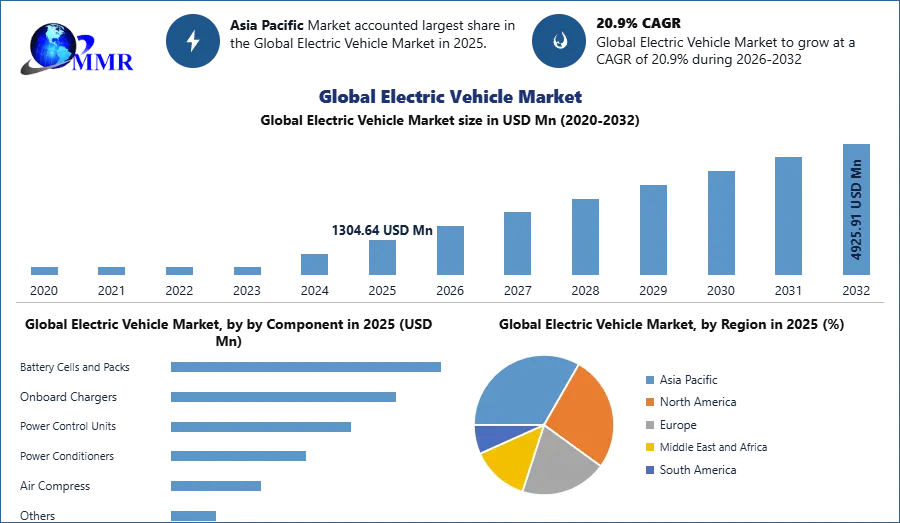
Market Overview
The Electric Vehicle Market has evolved from an emerging segment into a foundational pillar of the global automotive industry. Electrification is influencing nearly every aspect of transportation, from vehicle design and manufacturing to infrastructure planning and energy distribution.
Electric vehicles increasingly serve as platforms for innovation in battery technology, vehicle connectivity, autonomous driving, and software-defined mobility. This evolution has expanded the market’s significance beyond automotive manufacturing and into broader technology, energy, and transportation ecosystems.
Automakers are allocating significant resources toward EV platform development while restructuring product portfolios around electrified mobility. Suppliers are adapting by investing in batteries, power electronics, charging technologies, and digital vehicle architectures.
As transportation systems pursue decarbonization goals, electric vehicles are becoming central to national mobility strategies and long-term industrial policies.
Key Trends Driving Growth
Electrification remains the dominant force shaping industry development. Governments, consumers, and corporations are increasingly prioritizing low-emission transportation solutions.
The transition from internal combustion engines to electric powertrains is accelerating demand for batteries, electric motors, power electronics, thermal management systems, and advanced energy management technologies.
Battery innovation represents another major growth driver. Improvements in energy density, charging performance, battery safety, and lifecycle durability continue enhancing vehicle competitiveness.
As battery technologies improve, automakers gain greater flexibility in vehicle design while consumers benefit from improved driving experiences and operational efficiency.
Charging infrastructure expansion is addressing one of the industry’s most significant adoption challenges. Investments in public charging networks, workplace charging solutions, and residential charging systems are improving accessibility and convenience.
The emergence of software-defined vehicles is creating a new competitive dimension. Modern EVs increasingly function as digital platforms capable of receiving over-the-air updates, supporting connected services, and integrating advanced driver assistance technologies.
Connectivity ecosystems are becoming increasingly important. Real-time vehicle diagnostics, predictive maintenance, energy optimization, and remote vehicle management are creating new value propositions for consumers and fleet operators.
Fleet electrification is also gaining momentum. Commercial transportation companies are deploying electric vehicles to reduce fuel costs, support sustainability objectives, and comply with environmental regulations.
This trend is creating opportunities across logistics, public transportation, and mobility-as-a-service sectors.
Request a Free Sample Copy or View Report Summary
Segment Insights
- Dominant Segment: Battery Electric Vehicles (BEVs) remain the dominant segment due to increasing consumer adoption and ongoing investments in dedicated EV platforms.
- Fastest-Growing Segment: Connected and software-enabled electric vehicle platforms are emerging as the fastest-growing segment as digital mobility capabilities expand.
- Passenger vehicle applications continue generating significant demand through rising consumer interest and expanding model availability.
- Commercial fleet electrification is creating new growth opportunities across logistics, delivery, and public transportation sectors.
- Advanced battery systems and energy management technologies are becoming critical differentiators across vehicle categories.
Regional Growth Story
Asia-Pacific remains a leading force in the Electric Vehicle Market. The region benefits from extensive manufacturing capabilities, strong battery production capacity, and significant investments in transportation electrification.
China continues playing a central role through large-scale EV deployment, battery manufacturing leadership, and extensive charging infrastructure development. The country’s integrated ecosystem supports innovation across the entire EV value chain.
Japan and South Korea contribute through advanced battery technologies, automotive engineering expertise, and investments in next-generation mobility solutions.
Europe remains a major growth engine driven by emissions reduction initiatives, regulatory support, and automotive electrification strategies. Germany continues serving as a key center for EV innovation, battery development, and premium electric vehicle production.
North America is experiencing significant momentum through manufacturing investments, battery production expansion, and increasing consumer adoption. The United States remains a focal point for EV innovation, charging infrastructure deployment, and software-driven mobility development.
India is emerging as an important electrification market supported by government initiatives, urban mobility requirements, and expanding domestic manufacturing capabilities.
Across regions, transportation modernization and sustainability objectives continue accelerating EV adoption.
Competitive Landscape
Competition within the Electric Vehicle Market is increasingly determined by ecosystem strength rather than vehicle production alone.
Leading manufacturers are investing simultaneously in battery technologies, software platforms, charging infrastructure, vehicle connectivity, and autonomous driving capabilities. This reflects a broader shift toward integrated mobility ecosystems.
Battery supply chains have become a critical strategic priority. Companies securing access to battery technologies and manufacturing capacity are strengthening their long-term competitive positions.
The competitive landscape also highlights growing collaboration between automakers, battery manufacturers, technology companies, and energy providers. These partnerships enable faster innovation while supporting large-scale market expansion.
Software capabilities are emerging as a major differentiator. Automakers capable of delivering continuous vehicle improvements through digital platforms are creating new opportunities for customer engagement and recurring revenue generation.
As vehicles become increasingly connected and autonomous, competition will extend far beyond traditional automotive boundaries.
Recent Developments
- Automakers continue expanding dedicated electric vehicle platforms and product portfolios.
- Battery manufacturing investments are increasing across major automotive regions.
- Charging infrastructure deployment is accelerating to support broader EV adoption.
- Software-defined vehicle architectures are becoming central to new EV development programs.
- Fleet operators are increasing investments in commercial vehicle electrification strategies.
Strategic Implications
The Electric Vehicle Market represents a structural transformation rather than a cyclical growth opportunity.
For OEMs, success increasingly depends on battery strategy, software capabilities, charging ecosystems, and supply chain resilience. For suppliers, electrification is creating opportunities across batteries, semiconductors, connectivity technologies, and advanced materials.
Investors should recognize that value creation is shifting toward energy technologies, software platforms, and digital mobility services. Traditional automotive advantages alone may no longer guarantee market leadership.
The market is also redefining transportation economics. Energy efficiency, digital services, and lifecycle performance are becoming increasingly important drivers of competitive differentiation.
Future Outlook
Electric vehicles will continue evolving into intelligent mobility platforms that combine electrified propulsion, software-defined functionality, connected services, and autonomous capabilities. The convergence of batteries, artificial intelligence, connectivity, and transportation infrastructure will create new business models across the mobility ecosystem.
Future industry leaders will not simply manufacture electric vehicles—they will control integrated mobility platforms spanning energy management, software services, connectivity ecosystems, and transportation intelligence.
The winners of the next decade will be the companies that master the convergence of electrification, software, and mobility ecosystems, while laggards will remain trapped in legacy automotive models built for a transportation industry that no longer exists.
Analyst Perspective
“Electric vehicles have moved beyond product innovation and become a strategic transformation of the entire transportation ecosystem. The companies that successfully integrate batteries, software, connectivity, and mobility services will define the future of automotive leadership.” — Tejaswini Kakade, Analyst
About Maximize Market Research
Maximize Market Research Pvt. Ltd. (MMR) is a global market research and consulting company that provides reliable, data-focused, and practical business insights. The firm serves a wide range of industries, including healthcare, pharmaceuticals, technology, automotive, electronics, chemicals, personal care, and consumer goods. Through market forecasts, competitive analysis, strategic consulting, and industry impact assessments, MMR helps organizations understand changing market conditions, identify growth opportunities, and make informed business decisions for long-term success.
2nd Floor, Navale IT Park Phase 3
Pune Banglore Highway, Narhe
Pune, Maharashtra 411041, India
+91 9607365656
sales@maximizemarketresearch.com
