Market Overview
The global Three-Wheeler Market is undergoing structural transformation driven by urbanization, affordability requirements, and the need for efficient transportation in densely populated cities. Three-wheelers continue to serve as critical mobility assets for passenger transportation, cargo movement, and last-mile connectivity.
The market’s growth trajectory is increasingly linked to electrification. Governments are encouraging electric vehicle adoption through subsidies and policy support, while fleet operators are evaluating total cost of ownership advantages offered by electric platforms. What was once primarily an informal transportation segment is evolving into a strategic component of modern mobility ecosystems.
For investors, the significance extends beyond vehicle sales. The sector creates demand for batteries, charging networks, software platforms, telematics services, fleet financing, and aftermarket support.
Key Trends Driving Growth
The strongest growth catalyst remains the expansion of affordable urban mobility. Rising population density and increasing congestion make compact vehicles more practical than larger transportation alternatives in many emerging markets.
Electrification is accelerating across passenger and cargo applications. Governments seeking lower urban emissions are supporting electric three-wheeler deployment through incentives and regulatory frameworks. This transition is creating new competitive dynamics among OEMs and component suppliers.
Fleet digitization is becoming a major differentiator. GPS-enabled tracking, telematics systems, predictive maintenance tools, and connected fleet platforms are helping operators improve utilization rates and reduce operating costs. As transportation becomes increasingly data-driven, software capabilities are emerging as an important competitive asset.
Battery-swapping technology is gaining attention because it addresses vehicle downtime concerns. Instead of waiting for charging cycles, operators can replace depleted batteries quickly, improving asset productivity and strengthening the business case for commercial electrification.
The growth of e-commerce and urban logistics is also expanding demand for cargo-oriented three-wheelers. Last-mile delivery economics increasingly favor compact, maneuverable vehicles capable of operating efficiently in congested city environments.
Request a Free Sample Copy or View Report Summary
Segment Insights
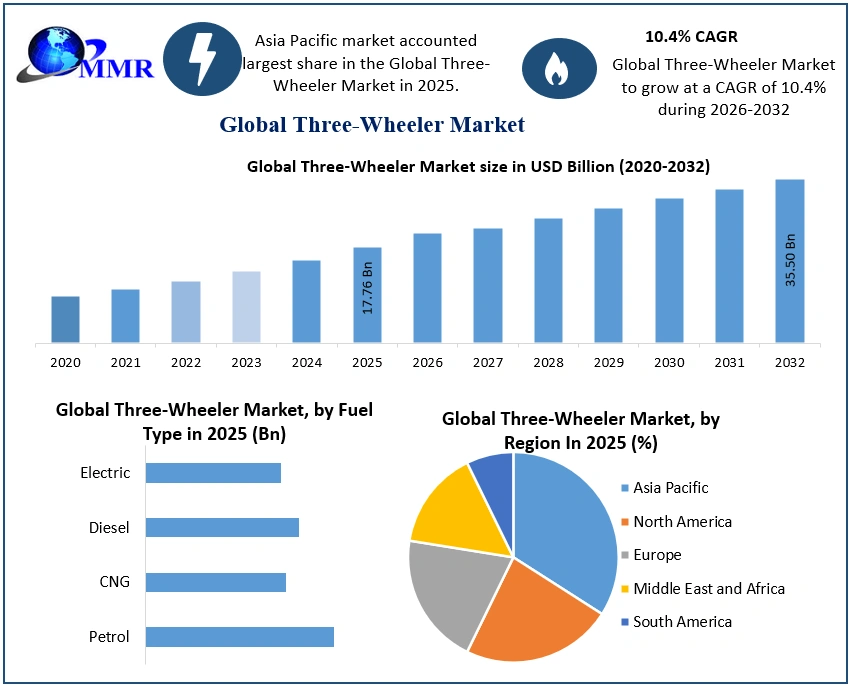
- Dominant Segment: Asia-Pacific Region – The region holds the largest share of the global market due to urbanization, population density, and strong manufacturing capabilities. This leadership gives regional OEMs significant scale advantages.
- Dominant Vehicle Category: Passenger Carrier Three-Wheelers – Passenger transportation remains the largest use case, supported by demand for affordable urban mobility solutions. This keeps fleet renewal and replacement cycles active.
- Fastest-Growing Segment: Electric Three-Wheelers – Increasing policy support, sustainability goals, and fleet economics are driving rapid adoption. Growth in this segment is reshaping supplier relationships and investment priorities.
- Technology Trend: Connected vehicle technologies, telematics, and GPS integration are becoming mainstream features in commercial operations. This creates opportunities for mobility software providers and fleet analytics companies.
Regional Growth Story
Asia-Pacific continues to dominate the market and remains the industry’s center of gravity. The combination of urbanization, rising transportation demand, and established manufacturing ecosystems supports both domestic consumption and export opportunities.
India has emerged as a particularly influential market due to rapid electric three-wheeler adoption and strong policy support. The country has become one of the most important global growth engines for electric three-wheelers, reinforcing its position in the broader EV transition.
China remains a major manufacturing and electrification hub, while other emerging economies continue to expand demand for affordable mobility and commercial transportation. Together, these markets are creating a large-scale platform for future mobility innovation.
Competitive Landscape
Competition is shifting from traditional vehicle manufacturing toward ecosystem development.
OEMs are investing in electric platforms, connected technologies, and alternative energy solutions to secure long-term relevance. Success increasingly depends on battery partnerships, software integration, fleet relationships, and aftersales support rather than vehicle assembly alone.
The emergence of battery-swapping solutions signals a broader industry effort to solve operational barriers that limit EV adoption. Suppliers positioned in batteries, energy management systems, telematics, and fleet software stand to gain influence as vehicle platforms become more technologically sophisticated.
For established manufacturers, electrification represents both opportunity and risk. Companies that scale EV production efficiently can strengthen pricing power and fleet relationships. Those that delay investment may face erosion of market share as mobility providers prioritize lower-emission transportation assets.
Recent Developments
- Manufacturers are increasing investments in electric three-wheeler platforms and sustainability-focused vehicle development.
- Battery-swapping solutions are being introduced to reduce charging-related downtime and improve commercial fleet productivity.
- Connected technologies including GPS tracking and telematics are being integrated into fleet operations.
- Government incentives continue to support electric vehicle adoption and emissions reduction initiatives.
- Fleet operators are increasingly evaluating electric three-wheelers as part of broader decarbonization and operating-cost reduction strategies.
Strategic Implications
For OEMs, the priority is clear: scale electrification while building software-enabled mobility ecosystems.
For Tier-1 suppliers, growth opportunities are shifting toward batteries, power electronics, telematics, connectivity solutions, and safety technologies. Traditional component portfolios will increasingly compete with digital and energy-management offerings.
Fleet operators must evaluate vehicle acquisition decisions through a total-cost-of-ownership lens. Connectivity, uptime, battery management, and operational analytics are becoming as important as vehicle purchase price.
Investors should recognize that value creation is moving beyond manufacturing toward integrated mobility platforms and transportation services.
Future Outlook
The next phase of growth will be defined by how quickly the industry converts affordability advantages into fully connected, electrified mobility networks. Battery innovation, charging infrastructure deployment, telematics integration, and fleet digitization will increasingly determine competitive outcomes rather than vehicle hardware alone.
The companies that build scalable electric mobility ecosystems will define the future of urban transportation, while those that remain dependent on conventional vehicle economics risk losing relevance as the three-wheeler market becomes a digital, connected, and electrified mobility platform.
Analyst Perspective
“The Three-Wheeler Market is entering a pivotal transformation phase where electrification, connectivity, and urban mobility requirements are converging. Companies that align vehicle innovation with fleet productivity and sustainable transportation goals will be best positioned to capture the next wave of industry growth.” — Tejaswini Kakade
About Maximize Market Research
Maximize Market Research Pvt. Ltd. (MMR) is a global market research and consulting company that provides reliable, data-focused, and practical business insights. The firm serves a wide range of industries, including healthcare, pharmaceuticals, technology, automotive, electronics, chemicals, personal care, and consumer goods. Through market forecasts, competitive analysis, strategic consulting, and industry impact assessments, MMR helps organizations understand changing market conditions, identify growth opportunities, and make informed business decisions for long-term success.
2nd Floor, Navale IT Park Phase 3
Pune Banglore Highway, Narhe
Pune, Maharashtra 411041, India
+91 9607365656
sales@maximizemarketresearch.com
